
Lowest Price Guaranteed
Pages
198
Last Updated
August 2025
View Count
10207
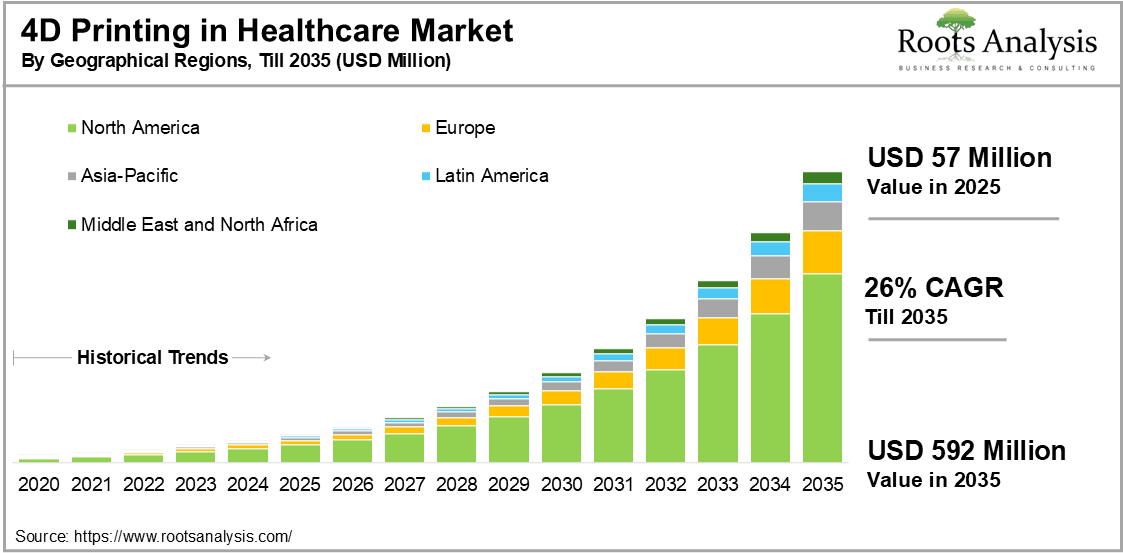
The global 4D printing in healthcare market is projected to grow from US 57 million in 2025 to USD 592 million by 2035, representing a CAGR of 26%, during the forecast period.
 |
To learn more about this report, request a free sample copy
4D printing is a revolutionary technology that is used to create medical devices, medical implants and drug delivery systems. This advanced technology holds significant potential in healthcare industry, enabling the designing of organ-on-chips model, drug delivery systems and diagnostic tools. Beyond organ printing, 4D printing technology combines living cells and bio-inks to develop a structure that works as a functional tissue. The ability to print functional tissues and organ chips has enabled researchers to progress regenerative medicine to address the concerns with organ failure and damage. In addition to regenerative medicine, 4D printing technology can also be used to develop responsive surgical tools, biomaterials rehabilitation devices and diagnostic tools.
Furthermore, the ability of 4D bioprinting to create dynamic shape-shifting clinical models (as compared to 3D bioprinting) for drug delivery and organ health monitoring has offered enormous opportunities to industrial players to explore more applications. It is worth noting that 4D printing is currently used in chemotherapies, which further create massive scope in designing smart therapy delivery models to treat cancer patients. For instance, in July 2023, the researchers of Queen’s University Belfast developed customized 4D printed smart implant to manage breast cancer. This is first-of-its-kind where 4D printing is used to create breast implants, wherein the implants will also release the chemotherapeutic drugs.
Considering a broad scope of 4D printing in healthcare industry, several industrial players are shifting to technological innovation for manufacturing surgical robots that can perform variety of surgical tasks with higher precision, biomedical splints, implants and smart biomaterials. For instance, in September 2024, the Indian Institute of Science (IISc) researchers team developed artificial blood vessel that mimics the real blood vessels using 4D printing technology and nanoengineered hydrogel ink. This artificial blood vessel serves as a boon to graft blocked or damaged blood vessels due to injuries and other reasons. Overall, the 4D printing in healthcare market is likely to grow at a substantial rate driven by the increasing usage across a wide range of applications.
The 4D printing in healthcare market research report presents an in-depth analysis of various leading players involved in providing innovative 4D printers, printing materials and technologies, across different segments, as defined in the table below.
| Key Report Attributes | Details | |
| Historical Trend | Since 2019 | |
| Forecast Period | Till 2035 | |
| Market Size 2025 | $57 Million | |
| Market Size 2035 | $592 Million | |
| CAGR (Till 2035) | 26% | |
| Type of Component |
|
|
| Type of Technology |
|
|
| Type of Application |
|
|
| End User |
|
|
| Geographical Regions |
|
|
| Leading Market Players |
|
|
| PowerPoint Presentation (Complimentary) |
Available | |
| Customization Scope | 15% Free Customization | |
| Excel Data Packs (Complimentary) |
Available | |
One of the key objectives of the 4D printing in healthcare market report was to estimate the current size, opportunity and the market growth potential, over the forecast period, till 2035. We have provided informed estimates on the likely evolution of the market for the forecast period.
The market analysis also features the likely distribution of the current and forecasted opportunity within the market distributed across various segments, such as type of component (equipment (3D Printer and 3D bioprinter), software & services, and programmable materials (shape memory materials, hydrogels, and living cells)), type of technology (stereolithography, fused deposition modelling, selective laser sintering and direct metal laser sintering), type of application (medical models, surgical guides, patient-specific implants, dental implants and prosthetics), end user (hospitals & surgical centers, dental clinics & laboratories and pharmaceutical and biotechnology companies), geographical regions (North America, Europe, Asia-Pacific, Middle East and North Africa, and Latin America) and leading players.
In order to account for future uncertainties associated with some of the key parameters and to add robustness to our model, we have provided three market forecast scenarios, namely conservative, base, and optimistic scenarios, representing different tracks of industry’s evolution. All actual figures have been sourced and analyzed from publicly available information forums and primary research discussions. The financial figures mentioned in this market report are in USD, unless otherwise specified.
Based on the type of component, the global 4D printing in healthcare market is segmented into equipment (3D Printer and 3D Bioprinter), software & services, and programmable materials (shape memory materials, hydrogels, and living cells). According to our projection, equipment segment accounts for the highest share of the market and the trend is likely to remain unchanged during the projected period. This is primarily due to the fact that 3D printers (that are already installed in healthcare facilities for printing bio-based materials) require software updating to support the manufacturing of numerous 4D products. Furthermore, the increasing advancements in 4D printing software and increasing preferences for third party services to print 4D products have further contributed to the growth of this segment.
However, it is worth noting here that the programmable materials segment is likely to grow at a substantial CAGR during the forecast period. This can be attributed to the fact that smart materials are widely used in biomedical engineering owing to its unique characteristics, such as response towards external stimuli, such as pH, temperature, light and other attributes. These smart materials are widely adopted to develop drug delivery devices, organ-on-a-chip and biocompatible materials, contributing to the significant growth of this segment during the forecast period.
The global market is based on different types of technology, such as stereolithography, fused deposition modelling, direct inkjet cure and other technologies. Among these, fused deposition modelling technology segment holds the highest 4D printing in healthcare market share (over 40%). Fused deposition modelling offers high flexibility in printing different materials and print in minimal time and cost. However, direct inkjet cure technology is expected to grow at a higher CAGR during the forecast period owing to the high accuracy, capability of full-color printing and support printing of multi-materials.
The global 4D printing in healthcare market is categorized across different type of applications, such as medical models, surgical guides, patient-specific implants, dental implants and prosthetics. According to our projection, patient-specific implants accounts for the highest share (40%) of the market driven by the growing adoption of 4D printers for prototyping of tailored implants. Moreover, similar to applications of dental 3D printing, 4D printers are widely used for the manufacturing of patient specific dental implants, clear aligners and dentures, which contributed to the highest share of the market.
However, it is worth noting here that prosthetics segment is expected to register higher CAGR during the forecast period. This can be attributed to the increasing use of 4D printing in manufacturing of implants that mimics natural tissues to perform prosthetic procedures. Many MedTech companies have begun the realization of applications of 4D printing for development of prosthetics. This is evident from upsurgence of start-ups in this domain.
In 2022, Castomize was established in order to develop mouldable and reusable casts, based on 4D printing technology. As stated by Mr Teo (Chief Executive Officer, Castomize), “When you fracture a limb, your muscles around that bone will deteriorate and become smaller because you’re not using them, which is why patients need to have a recast once every few weeks. Our casts are reusable, so patients can save money by just having one cast. One thing about the healthcare industry is that people like to stick to established processes, so when something like our casts come along, it’s a process that is new to healthcare workers, so we actually faced some resistance. But once we explained to them that our casts can help to save costs in the long run, they became more amenable to the idea.”
Based on the end user, the global 4D printing in healthcare market is segmented into hospitals & surgical centers, dental clinics & laboratories, pharmaceutical and biotechnology companies. Currently, dental clinics & laboratories accounts for the highest share (over 80%) of the market. This can be attributed to the growing shift towards customized dental implants to correct teeth misalignment. Notably, 4D printing technology to print dental implants, prosthetics, patient specific implants and medical models. It is worth mentioning that dental clinics & laboratories segment is expected to grow at a higher CAGR during the forecast period. This is due to the fact that 4D printing technology is widely accepted for the printing of dental implants with accurate dimensions and are highly cost-effective.
This segment highlights the distribution of global 4D printing in healthcare market across different geographical regions, such as North America, Europe, Asia-Pacific, Middle East and North Africa, and Latin America. According to our projections, presently, North America holds the highest share (more than 65%) of the market, and the trend of dominance is likely to remain unchanged during the forecast period. This dominance is due to the increasing demand for customized dental implants to correct misalignment of teeth in patients. Furthermore, key players established in this region are continually increasing advancements in 4D printing technology to explore more applications in healthcare industry.
However, in Asia-Pacific, the market for 4D printing in healthcare is likely to grow at a higher CAGR during the forecast period driven by the growing adoption of 4D printing technology across healthcare sector for printing custom-implants and prosthetics. Singapore based Castomize Technologies, established in 2022, is a startup working on development of 4D bioprinted orthopedic implants.
The “4D Printing in Healthcare Market: Industry Trends and Global Forecasts, till 2035” market report features an extensive study of the current market size and future opportunities associated with companies within the 4D printing industry, during the given forecast period. The market report highlights the 4D Printing in Healthcare Market analysis. Key takeaways of the 4D printing in healthcare market report are briefly discussed below.
Currently, the global market landscape for 4D printing in healthcare seems competitive featuring the presence of several well-established and new entrants. In order to leverage the competitive edge, several industrial players are focusing on collaborations and partnerships for the development of advanced 4D printing technologies and material innovations that aid in printing wide range of medical devices, drug delivery systems, dental implants and prosthetics. For instance, in June 2024, Bio INX (a company engaged in bioink technologies) launched DEGRES INX, a biodegradable resin with excellent shape memory properties. This innovative resin material can return into its original shape after 3D printing.
As per Aysu Arslan (Chief Scientific Officer, Bio INX), “The material is specifically developed for biocompatibility, design flexibility, and shape memory properties. In this way, it is ideal for 4D-(bio)-printing solutions. It can be, for example, an ideal material for biodegradable stents, where a collapsed version can be used to introduce the structure to the desired location, where it will expand after exposure to body temperature. Overall, the market is highly consolidated with small, mid-sized and large companies who are continually increasing their efforts for the development of advanced 4D printers.
Some of the major growth drivers of the 4D printing in healthcare industry are increasing adoption of 4D printers for creating clear aligners, dental implants and prototypes of medical devices. It is worth noting here that 4D printing has been widely adopted in the dental industry for printing of clear aligners and also to perform prosthetic procedures, which is expected to be a key growth driver of the market. Furthermore, the growing shift towards smart materials to apply stimuli, shape-morphing and generating stimulus response in the bio-printed products. Smart materials combined with 4D printing technology helps in manufacturing biomedical equipment’s, which is likely to bolster the demand for advanced 4D printers during the upcoming years.
Despite increasing usage, 4D printing in healthcare industry witnesses challenges such as lack of standardization and scalability issues. It is important to highlight here that 4D printing is an emerging technology, hence the printed materials, such as medical implants and devices require to meet stringent guidelines provided by the USFDA. These stringent guidelines may delay the commercialization of 4D printed in the market, creating a significant barrier in widespread adoption.
Additionally, the 4D printing products such as prosthetics and implants require tech-oriented computational modeling and stimulators to understand how these printed products work under different conditions. The requirement of specialized equipment may increase the overall expenditure and cause scalability challenges, creating a significant barrier for industrial players. Although the 4D printing technology is skyrocketing consistently, some restrictions pertaining to intellectual property rights and cost need to be addressed.
Some of the noticeable trends that are driving the 4D printing in healthcare industry includes increasing advances in 4D printing and rising adoption of 4D bioprinting. It is important to highlight here that several technologies developers and healthcare experts in combining 4D magnetic resonance images (MRI images) of blood flow with 3D printers to develop a functional heart model (multicolored). This 4D scanning allows healthcare experts to visualize blood flow through each section of the heart by using color-coding, making it an optimal tool for identifying problems in the heart and designing surgical procedures.
Furthermore, 4D bioprinting in healthcare industry is currently being used for grafting artificial tissues that are highly useful in bone grafting and organ transplant. The ability of 4D bioprinting in grafting artificial tissues has catered the attention of industrial players to explore applications of 4D printing in healthcare industry.
The global market for 4D printing in healthcare is currently valued at 57 million in 2025 and is poised to reach USD 592 million by 2035. This lucrative growth is likely to be the result of growing shift towards personalized treatment, tissue regeneration, and customized implants. 4D printers enable the printing of smart materials offering new opportunities to print tissues and organ structure. It is worth noting here that software and services are expected to remain dominant during the forecast period driven by the growing adoption across different healthcare verticals.
Examples of key 4D printing companies serving healthcare applications (which have also been captured in this market report, arranged in alphabetical order) include 3D Systems, Dassault Systèmes, EnvisionTEC, Materialise, Organovo Holdings, Poietis and Stratasys. This market report includes an easily searchable excel database for the leading companies offering platforms and services along with information on their product portfolios.
Several recent developments have taken place in the market, some of which have been outlined below.