


 Download Free Sample
 Buy Now
AI in Cultured Meat Market Overview
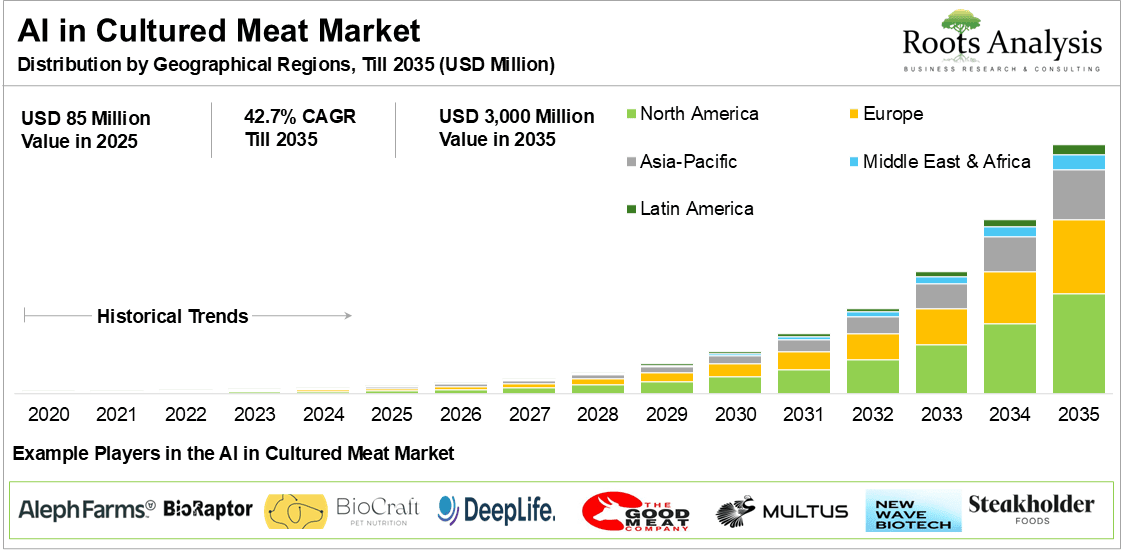
The global AI in cultured meat market size, valued at USD 60 million in 2024, is projected to reach USD 85 million in 2025 and USD 3,000 million by 2035, representing a CAGR of 42.7% during the forecast period.
 |
See What’s in the Full Report – Request Your Complimentary Insights!
AI in Cultured Meat Market: In Summary
- The global AI in cultured meat market is growing at an unprecedented rate, driven by the rising demand for protein alternatives and high demand for meat across the globe.
- According to the World Population report, nearly 41,569 thousand tonnes (41.57 tonnes) of meat is consumed in the US every year. This high consumption has necessitated the demand for advanced technologies to help accelerate the development of cultured meat to reduce dependency on animal farming.
- The market for AI in cultured meat has shown robust growth, anticipating growth at a CAGR of 42.7% during the forecast period.
- In terms of technology, the machine learning segment is securing highest share, driven by the growing usage of machine learning for data collection and analysis for optimizing nutrient media to cultivate meat.
- In future, the deep learning segment is likely to witness higher CAGR, driven by its acceptance to understand gene edits effect on cultured meat and cell line optimization.
- North America region is currently securing 40% of the overall revenue share. This high share stems from the presence of well-established regulatory guidelines and rising research on cultured meat. However, the market for AI in cultured meat is likely to grow at a higher CAGR during the forecast period in Asia-Pacific.
- The market for AI in cultured meat seems highly competitive, featuring the presence of well-established players. Some of the notable players are Aleph Farms (Israel), BioRaptor (Israel), DeepLife (France), and GOOD Meat (US).
- Notably, the Aleph Farms (Israeli cultivate meat startup company) has raised USD 29 million to expand its AI based pilot facility for cultured meat production.
- The future focus of industrial players will be on AI integrated 3D bioprinting for cell printing and innovation in AI technology. Moreover, partnerships and collaborations will remain cornerstone for market expansion in the future.
AI in Cultured Meat Market Introduction
Cultured meat is a unique form of lab-grown meat which is cultivated inside the laboratories by using animal cells and culture media under controlled conditions. It is important to note here that meat is an excellent source of macronutrients and micronutrients. Being high in nutrition, meat has been extensively consumed worldwide on a large scale. As per the report of World Population, nearly 41,569 thousand tonnes (41.57 tonnes) of meat is consumed in the US every year, indicating a significant high consumption.
Notably, the high demand cannot be fulfilled by the conventional animal farming approach, necessitating the demand for cultured meat. It is worth noting that cultured meat has emerged as a potential solution to fulfil the growing demand. However, the slow cultivation process, cell line development to scaffold design and optimizing bioprocesses to maintain quality control is a time consuming and resource intensive process. Owing to the rapid demand, market players are adopting AI technologies in scaling production of cultured meats.
AI technology plays a crucial role in analyzing vast amounts of data to identify nutrient production, cell growth and optimize bioprocess, such as culture media formulation and cell line development. Moreover, the integration of AI also helps to optimize bioreactor parameters, such as nutrient level, oxygen supply, temperature, and pH, making cultured meat product more cost-effective, efficient, and scalable.
Driven by its significance, market players are increasingly undertaking active initiatives to develop advanced AI-algorithms that can help to streamline cultured meat processes on a large scale. For instance, in June 2025, Mulus Biotechnology (UK), reveals the production animal-free media formulation for cultivated meat using AI technology and automation. This company has explored machine learning with high throughput lab automation systems to accelerate media preparation using data collected through AI tools. With consistent innovation and striking demand of advanced technology for cultivated meat, we believe that AI in cultured meat market will grow at a steady rate in the future.
AI in Cultured Meat Market: Report Attributes
| Key Report Attribute | Details |
| Historical Trend | Since 2020 |
| Forecast Period | Till 2035 |
| Market Size 2025 | USD 85 Million |
| Market Size 2035 | USD 3,000 Million |
| CAGR (Till 2035) | 42.7% |
One of the key objectives of the AI in cultured market report was to estimate the current size, opportunity, and the market growth potential, over the forecast period, till 2035. We have provided informed estimates on the likely evolution of the market for the forecast period.
The global AI in cultured meat market analysis also features the likely distribution of the current and forecasted opportunity within the market across various segments, such as type of AI technology, type of meat, application area, end user, geographical regions, and leading players.
In order to account for future uncertainties associated with some of the key parameters and to add robustness to our model, we have provided three market forecast scenarios, namely conservative, base, and optimistic scenarios, representing different tracks of industry's evolution.
Recent Developments in AI in Cultured Meat Market
Several recent developments in AI in alternative protein production industry have occurred and we have outlined some of these below:
- In June 2025, DeepLife (France) and Gourmey (Turkey) entered into a partnership to develop world’s first avian digital twin (a virtual replica of poultry cell) engineered to optimize nutrient density, growth condition and flavor expression in cultured meat. This partnership combines DeepLife’s AI driven biology simulation engine with Gorumey’s proprietary cell cultivation platform to accelerate production of high-quality alternative proteins or cultivate meat on a large scale.
- In March 2025, Aleph Farms (Israeli cultivate meat startup company) successful raised USD 29 million and expecting to raise USD 10-15 million in upcoming months to modify its core technologies and AI based pilot facility to expand the production of cultivated meat and commercialize lower-cost whole-cut cultivated steak.
- In January 2025, China opens its first-of-its-kind cultivated meat center, 'New Protein Food Science and Technology Innovation Base' in Beijing with support from local Govt & Businesses with an investment of USD 11 million. This new center will incorporate artificial intelligence and blockchain technologies for real-time monitoring and traceability of cultivated meat production chain, processing, research, circulation, sales and improve food safety.
Unlock Deeper Insights – Schedule Your Personalized Workshop Today!
AI in Cultured Meat Market Segmentation Insights
The market report presents an in-depth analysis of AI in Cultured Meat providers who are currently active across various segments of the industry as mentioned below:
AI in Cultured Meat Market: Market Segmentation
| Market Segmentation | Details |
| Type of AI Technology |
|
| Type of Meat |
|
| Application Area |
|
| End User |
|
| Geographical Regions |
|
| Market In North America |
|
| Market In Europe |
|
| Market in Asia-Pacific |
|
| Market in Middle East & Africa |
|
| Market in Latin America |
|
Industry Experts on AI in Cultured Meat Market
Several industrial experts suggested that AI could be the best solution for cost-effective cultivated meat.
During an interview, Nicolas Morin (the co-founder of French startup company, Gourmey) states that, 'The integration of AI tools, such as digital twin with first principal model of cell metabolism help to identify the optimal feed formulation which further help to develop high quality cultivated meat. He further stated the this isn’t a biotech revolution, instead AI driven tools are the new era of cultivated food revolution market.'
AI in Cultured Meat Market Share Insights
Market Share by Type of AI Technology: Will Machine Learning Cultured Meat Bioprocessing Dominate the Market?
- The global market is distributed across different types of technology, such as machine learning, deep learning, natural language processing (NLP), computer vision, and predictive analytics. According to the AI cultured meat market report, the machine learning segment is dominating the market. This can be ascribed to the widespread usage of machine learning in optimizing bioprocesses for cultivated meat. The integration of machine learning helps to adjust system processes, such as temperature, pH and nutrient levels in real-time, which improved cultivation efficiency.
- In the long run, the deep learning segment is likely to grow at the fastest CAGR in the future. This lucrative growth stems from the growing usage of deep learning tools for cell lines optimization. These tools play a crucial role in predicting effects of gene edits on cellular growth and behavior, which is important to develop cell lines for cultivating meat.
Market Share by Type of Meat: Does Poultry Meat Continue to Dominate in the Future?
- Based on the type of meat, the global market is segmented into beef, poultry, seafood, pork and others. According to the AI cultured meat market forecast, the poultry segment is dominating the market due to the increasing consumption across the globe. Notably, the poultry grows more quickly than other meats, so it is well-suited for AI optimization for large-scale production. It is simpler to produce consistent, high-quality outputs with this more accelerated timeline in cultured poultry production, leading to its market dominance.
- In future, it is estimated that seafood segment will grow at a higher CAGR during the forecast period. This can be attributed to the fact that seafood species require optimal growing conditions, such as controlled temperature, nutrient balance and salinity. Computer vision for tissue maturation and quality control for higher yields of seafood species.
Market Share by Application Area: Does AI in Cell Line Development for Cultivated Meat Holds Majority of the Market Share?
- Based on the application area, the global market is segmented into cell line development, media optimization, scaffold design, bioprocess monitoring & optimization, quality control, and others. According to the AI cultured meat industry analysis, the cell line development segment is holding maximum share of the market. This dominance is driven by the increasing usage of cell line development for cultured meat. Notably, the predictive modeling for cell proliferation and differentiation is highly useful for designing customized cell lines for specific meat types, such as poultry, beef, and seafood.
- It is important to highlight here that the bioprocess monitoring & optimization segment is likely to grow at a higher CAGR in the future. This can be attributed to the fact that AI algorithms play a crucial role in analyzing data in real-time for optimizing the cell growing conditions, such as nutrient levels, oxygen supply, and media composition. This real-time approach ensures faster meat production with higher efficiency.
Market Share by End User: How Cultured Meat Producers are Leveraging AI Technology?
- On the basis of end user, the global market is bifurcated into cultured meat producers, research institutions, biotech companies, food regulatory authorities. Among these, the cultured meat producers’ segment dominates the market, accounting for the largest share. This can be attributed to the rising demand for advanced AI-enabled media optimization tools to accelerate the development of custom cell lines and optimization of cell strains for large scale production of cultured meat.
- It is interesting to note here that the research institutions segment is expected to show robust growth, registering higher CAGR in the future. The expanding research on cultured meat across various research organizations is increasing the adoption of AI algorithms to understand the tissue formation, cell differentiation, nutrient requirement and cell metabolism process in animal cells for cultivating meat.
Pay Only for What You Need – The Best Way to Optimize
Market Share by Geographical Regions: Which Region Grow at the Fastest CAGR During the Forecast Period?
- The global market is distributed across North America, Europe, Asia-Pacific, Middle East & Africa, and Latin America. Among these, the North America region is dominating the market by holding 40% share and is likely to remain dominant in the future. This highest growth is due to the rising research and development initiatives on cultured meat, favorable regulatory policies for lab-grown meat, and pressing need for meat to feed large scale population.
- In Asia-Pacific, the market is likely to grow at a higher CAGR during the forecast period. Asian countries, like China and India, Japan and South Korea are the large consumers of poultry meat. Cultured meat producers are leveraging AI technologies to improve productivity, enhance scalability, and reduce the cost of meat, which is likely to create a favorable environment for market growth.
AI in Culture Market: Report Deliverables
| Report Deliverables | Details |
| Excel Data Packs (Complimentary) |
|
| Key AI in Cultured Meat Companies Companies Profiled |
(A complete list of companies captured is available in the report) |
| PowerPoint Presentation (Complimentary) | Available |
| Customization Scope | 15% Free Customization |
AI in Cultured Meat Market Key Takeaways
The "AI in Cultured Meat Market Report: Industry Trends and Global Forecasts, till 2035" market report features an extensive study of the current market landscape, market size, market share, market growth, market trends, market value, market forecast, market outlook, statistics, and future opportunities for market players. The market research report lays emphasis on the AI in cultured meat technologies that are being developed. Key takeaways of the market report are briefly discussed below.
AI in Cultured Meat Market Competitive Landscape
The global AI in cultured meat industry is highly competitive, featuring the presence of several small, mid-sized and large companies. With increasing research and acceptance of cultured meat across the globe, several industrial players have shown active interest in this industry to drive innovations. In order to leverage the competitive edge, the market players are fostering partnerships and collaborations for integrating sustainability LCA modeling with AI for cultivated proteins. However, the primary focus of industrial players will be on quality control and cost-effectiveness of culture meat.
Market Size Analysis: How Does AI-Guided Scaffold Design and Texture Engineering Reinforcing the Cultured Meat Industry?
In 2025, the global artificial intelligence cultured meat market size is valued at USD 85 million and is expected to grow at a CAGR of 42.7% in the future. This unprecedented growth stems from the robust technological innovations and high demand for culture meat. Notably, the AI-guided scaffold design and texture engineering tools can interpret vast amount of data associated to physical and chemical properties of the scaffolding materials and their interaction with different cell types. This broad analysis helps to design the scaffold that can mimic the structural properties of the natural extracellular matrix of the meat, including fat cells and fibers.
In addition, the technologies, such as 3D bioprinting powered by the AI offer precise control on scaffold morphology, which further support the organized cell differentiation and cell growth, leading to culture artificial meat.
Market Drivers: What are the Major Growth Drivers of AI-Driven Bioreactor Optimization Market?
The global market for culture meat is increasingly focusing on sustainable and ethical meat alternatives, which is expected to be a key growth catalyst for this industry. It is worth noting that consumers are more aware of environmental impact, such as greenhouse gas emission, land requirements and water usage. Moreover, the ethical concerns associated with animal welfare and livestock family are driving the demand for alternative sources of proteins, which further drives the demand for culture meat.
Increasing Need for Bioreactor Control with AI for Scalable Tissue Growth
It is important to note here that cell and tissue cultivation is a complex process. Therefore, the cultivation of cultured meat through cells requires high precision and efficiency in bioprocessing and tissue engineering. In order to address these challenges, industrial players are leveraging digital twins for cultured meat bioprocess. This AI powered digital twin advanced tool enables researchers to predict cell characteristics and response to nutrient growth media in real-time. The information helps to fine-tune predictive maintenance with AI in fermentation / bioprocessing for large scale production of cells and tissues with higher speed and accuracy.
Get an Instant Quote in 10 Minutes. Lowest Price Guaranteed
Market Challenges: What are the Top Barriers AI in Cultured Meat Industry?
Despite growing demand, the high production cost and requirement of advanced infrastructure may hinder the market growth. It is important to note here that culture media components, such as fetal bovine serum, may cost around USD 84.50 for 50 ml. Additionally, the microcarriers can cost around USD 16,000 per 2000 liter bioreactor tank. These high upfront expenses may limit industry growth.
Regulatory Guidelines: Which Regulatory Markets Accept AI-Assisted Validation (US, EU, Singapore, Israel)?
The complex regulatory guidelines for the approval of cultured meat may impact the market growth. It is worth noting that several regions have accepted AI-assisted validation for cultured meat approval and commercialization.
- US: The regulatory agencies, such as the USFDA and the USDA have completed pre-market safety reviews of cultured meat products. These regulatory authorities have shared detailed evaluation processes publicly, indicating openness and transparency to AI-assisted validation for cultured meat.
- Israel: Israel has also accepted cultivated meat under its novel food framework. However, the pilot programs are currently understood to provide well-established regulatory approval processes and acceptance of advanced validation methodologies, including AI-assisted validation.
- European Union: It is worth noting that the European Union did not accept the final authorization of cultured meat products. However, there are several safety and discussions currently undergoing, and AI-assisted validation is still not documented as accepted.
AI in Cultured Meat Market Trends: What are the Future Growth Opportunities in the Market?
Despite challenges and stringent regulatory framework, the market is experiencing a transformative shift driven by the ongoing trends. Some of the potential trends are listed below:
Technological Advancements for Quality Control
The cultured meat industry is undergoing a transformation to bring new culinary trends for the development of cost-effective culture media and animal cell lines. Technological innovations, such as AI, specifically deep learning and machine learning are the center of technological innovations. In addition to AI improvement, the industrial players are focusing on digital twins for cultured meat bioprocess and bioreactor control with AI for scalable tissue growth to accelerate R&D activities on cultured meat.
Development of AI for 3D Bioprinting and Scalability
It is important to highlight here that AI is increasingly being applied to 3D bioprinting for cultured meat. The integration of AI helps to optimize material formulation and printing parameters. Moreover, the use of modeling sensors help to create more complex scaffold structures, and also helps in cell line characterization and cell line development. Moreover, the launch of open-source AI hubs, such as AI4CM Hub is fostering a collaborative research environment for cultivated meat.
AI in Cultured Meat Market Report Coverage
The market report presents an in-depth analysis, highlighting the capabilities of various stakeholders in the AI in cultured meat industry, across different geographies. Amongst other elements, the market report includes:
- An Infographic Executive Summary
- Regulatory Scenario
- Comprehensive Database of Leading Players
- Competitive Landscape
- Company Competitiveness Analysis
- Startup Ecosystem in the AI in Cultured Meat Market
- Company Profiles
- Porter’s Five Forces Analysis
- Patent Analysis
- Partnerships and Collaborations
- Funding and Investment Analysis
- Market Forecast and Opportunity Analysis
- Adjacent Market Analysis
- Key Winning Strategies
- SWOT Analysis
Glossary
- Cultured Meat: This is a form of lab-grown meat, cell cultivated meat and cultured meat produced by cultivating animal cells in a controlled laboratory or bioreactor environment, rather than from slaughtered animals.
- Cell Line Development: This refers to the process of establishing and optimizing stable populations of animal cells for growth and proliferation in vitro, a foundational step in cultured meat production.
- Cell Culture Media: It is a form of liquid or gel designed to support the growth of cells in an artificial environment, providing essential nutrients, growth factors, and other biochemicals.
- Bioreactor: It refers to the vessel or apparatus designed to carry out biological processes, such as the cultivation of cells or tissues, under controlled conditions.
- Bioprocess Monitoring & Optimization: The use of technology, often AI, to observe, analyze, and refine the biological processes within bioreactors to maximize efficiency, yield, and product quality.
- Scaffold Design: The engineering of three-dimensional structures, often plant-based, that provide physical support and guidance for cells to grow and differentiate into muscle and fat tissue, mimicking the structure of conventional meat.
From the Author’s Desk
Author’s View on AI in Cultured Meat Market
The AI in cultured meat market is growing unprecedently due to the ongoing demand for protein alternatives. The traditional approach for meat cultivation is not sufficient to fulfil the rising demand. Therefore, cultured meat companies are focusing on AI, such as machine learning and deep learning. Fundamental technology becomes a backbone for cultured mass production by optimizing the bioprocess conditions using analytical data collected through AI devices. The consistent emphasis on AI's role in cost reduction underscores this critical dependency. This implies that AI is the essential catalyst that will determine the industry's ability to achieve economic feasibility and widespread market penetration.
Customization Opportunities
At Roots Analysis, we genuinely care about your success and understand that your business requirements are unique. While our market research reports provide valuable insights, we recognize that they might not cover every aspect you need to make well-informed strategic decisions. To account for that, we offer 15% free report customization tailored to your specific needs. Whether you require additional quantitative analysis, qualitative insights, or any other information related to the electric vehicles market, reach out to us today at support@rootsanalysis.com


