
Lowest Price Guaranteed
Pages
403
Last Updated
August 2026
View Count
5755
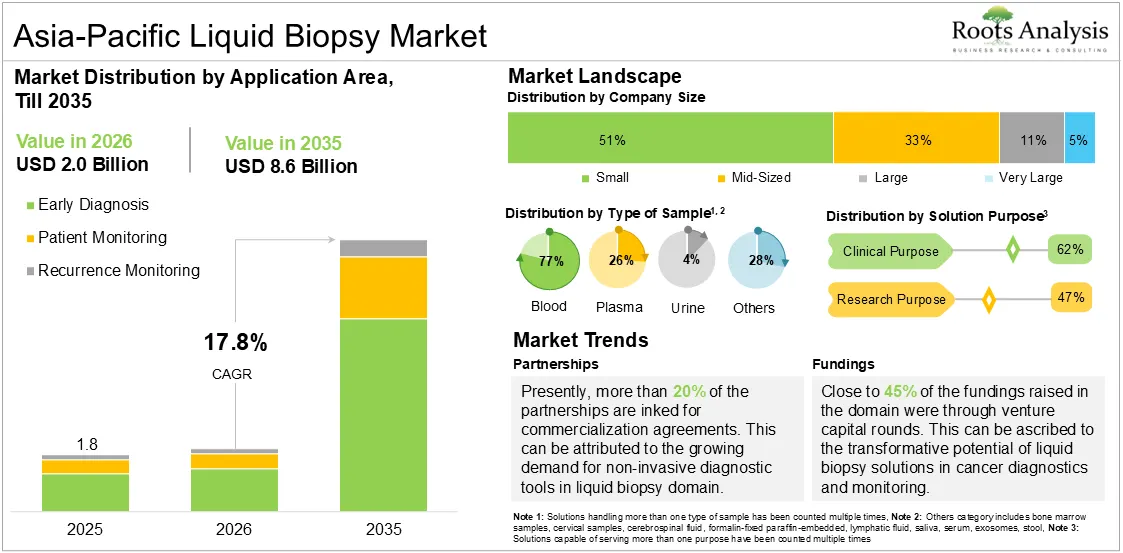
The Asia-Pacific liquid biopsy market, valued at USD 1.8 billion in 2025, is projected to reach USD 2.0 billion in 2026 and USD 8.6 billion by 2035, representing a CAGR of 17.6% during the forecast period 2026 to 2035.
To learn more about this report, request a free sample copy
Cancer diagnosis has traditionally relied on tissue-based testing because it allows clinicians to study tumor samples directly and understand the disease's molecular profile. However, this approach is not suitable for every patient or every stage of cancer care. Tissue biopsy can involve procedural discomfort, a risk of complications, longer turnaround times, and difficulty obtaining repeat samples, especially when tumors are located in hard-to-access sites. As oncology care becomes more personalized and monitoring-driven, the need for diagnostic tools that provide repeated insights with a lower patient burden has become increasingly important.
This shift has generated strong clinical interest in liquid biopsy as a more accessible, patient-friendly diagnostic approach. Rather than requiring tumor tissue, liquid biopsy analyzes blood, plasma, urine, or other body fluids to detect cancer-related biomarkers, including circulating tumor DNA (ctDNA), cell-free DNA (cfDNA), circulating tumor cells (CTCs), extracellular vesicles, and other molecular signals. Because these tests are minimally invasive and repeatable, they can support molecular profiling, therapy selection, treatment-response monitoring, minimal residual disease (MRD) assessment, recurrence detection, and early cancer detection.
In the Asia-Pacific region, liquid biopsy adoption is gaining momentum as healthcare systems, diagnostic companies, hospitals, and insurers increasingly focus on scalable, noninvasive cancer-testing solutions. A recent example occurred in March 2026, when Guardant Health launched its Shield Multi-Cancer Detection test in Hong Kong, Singapore, and the Philippines through a partnership with Manulife. Eligible customers gained access to the blood-based test beginning in April 2026. This development highlights the growing commercialization of liquid-biopsy-based cancer-screening solutions across key Asian markets.
India is also emerging as an important market for liquid biopsy. In July 2026, Zydus Lifesciences entered into an exclusive agreement with Guardant Health to make the Shield Multi-Cancer Detection test available in India and signed a memorandum of understanding (MoU) with Apollo Hospitals to offer the blood-based test in the country. Apollo Cancer Centres also became the first healthcare network in India to offer Guardant Health's Shield Multi-Cancer Detection blood test, reflecting the growing role of hospital-led partnerships in expanding access to advanced cancer screening across the Asia-Pacific region.
The region has also seen recent regulatory progress in precision oncology. In December 2025, Guardant Health Japan announced that Japan's Ministry of Health, Labour and Welfare had approved Guardant360 CDx as a companion diagnostic to identify ESR1 mutations in patients with hormone receptor-positive, HER2-negative breast cancer who were being considered for imlunestrant treatment. In April 2026, Guardant Health Japan also received approval for Guardant360 CDx as the first companion diagnostic in Japan for camizestrant in ESR1-mutated advanced breast cancer. These approvals reflect the growing role of liquid biopsy in therapy selection and biomarker-driven cancer treatment across the Asia-Pacific region.
The Asia-Pacific liquid biopsy market is expected to experience sustained growth as diagnostic developers, pharmaceutical companies, hospitals, insurers, and research institutions continue to invest in noninvasive cancer testing, companion diagnostics, multi-cancer detection, genomic profiling, and artificial intelligence (AI)-enabled molecular interpretation.
| Company | Year of Establishment | APAC Base | Core Technology / Product |
| Amoy Diagnostics (AmoyDx) | 2008 | China | Plasma EGFR and NGS companion diagnostics |
| Burning Rock Biotech | 2014 | China | OncoCompass and NGS-based liquid biopsy solutions |
| Gene Solutions | 2017 | Vietnam | SPOT-MAS |
| Geneseeq | 2013 | China / broader international operations | CanScan / NGS precision oncology |
| Lucene | 2016 | Singapore | LiquidHALLMARK |
| Singlera Genomics | 2014 | China | DNA methylation-based liquid biopsy |
Based on our market research, we have segmented the Asia-Pacific liquid biopsy market forecast into type of technology, type of sample, type of circulating biomarker, type of cancer, application area, and end-user.
By Type of Technology
By Type of Sample
By Type of Circulating Biomarker
By Type of Cancer
By Application Area
By End-user
Digitalization is supporting liquid biopsy adoption across the Asia-Pacific region by helping laboratories and healthcare providers integrate genomic data, clinical records, and advanced analytics into diagnostic workflows. Cloud-based data platforms can also support secure data aggregation, interpretation, and collaboration across research and clinical settings.
Emphasizing this shift, Sergio Figueiras Gómez (Innovation Director of Bahia Software), stated, "I believe liquid biopsy holds great potential. Its future evolution relies on establishing well-structured databases, information from diagnostic tools, technicians, and the integration of symptoms with the recorder data reports. Creating a comprehensive database with organized data will pave the way for leveraging advanced technologies, such as machine learning and artificial intelligence in this domain, enabling us to extract valuable insights, and aid in treatment decisions and patient care. As a result, the integration of liquid biopsy into routine clinical practice will become more seamless and effective, driving better patient outcomes."
Discussions with multiple stakeholders in this domain influenced the opinions and insights presented in this study. The market report includes transcripts of the following third-party discussions:
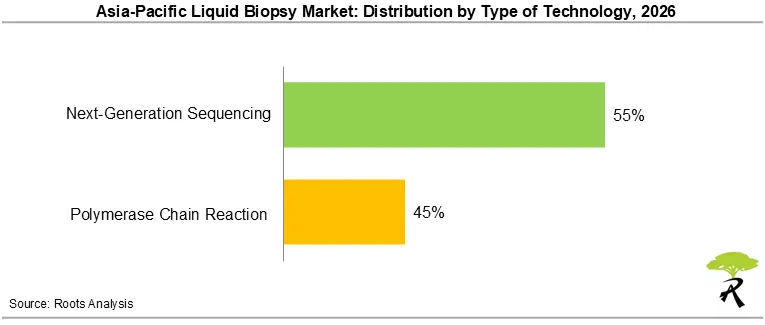
According to the Asia-Pacific liquid biopsy market analysis, next-generation sequencing accounts for 55% of the overall current market share. This can be attributed to the rapid expansion of oncology precision medicine programs, increasing availability of genomic testing infrastructure, and the high burden of cancers requiring comprehensive molecular profiling, particularly in countries such as China, Japan, and South Korea. The region has witnessed substantial government investment in genomic-medicine initiatives, resulting in broader adoption of NGS-based testing across tertiary hospitals and specialized cancer centers. In China, the National Precision Medicine Initiative and the expansion of NGS reimbursement in selected provinces have accelerated the clinical use of liquid biopsy for companion diagnostics and targeted-therapy selection.
Additionally, the Asia-Pacific region is home to leading genomics companies, including Burning Rock Biotech, GeneCast Biotechnology, and Amoy Diagnostics, which have commercialized NGS-based liquid biopsy assays tailored to the region's high prevalence of actionable mutations, particularly in lung cancer.
Given the continued expansion of national genomic-medicine programs, the increasing localization of sequencing technologies, and the growing adoption of precision oncology across emerging Asian markets, the next-generation sequencing segment is expected to grow substantially during the forecast period.
Currently, lung cancer accounts for the largest share of the Asia-Pacific liquid biopsy market because of the region's exceptionally high disease burden and the widespread adoption of biomarker-driven treatment strategies for non-small cell lung cancer (NSCLC). The Asia-Pacific region accounts for a substantial proportion of global lung cancer cases, particularly in China, where lung cancer remains a leading cause of cancer-related mortality. Moreover, East Asian populations have a significantly higher prevalence of actionable EGFR mutations in NSCLC than Western populations, increasing demand for liquid biopsy to detect genomic alterations, guide targeted-therapy selection, monitor treatment response, and identify acquired resistance mutations.
The lung cancer segment is expected to grow substantially during the forecast period because of the rising incidence of lung cancer, the expansion of national lung cancer screening programs, and the increasing adoption of precision oncology across the Asia-Pacific region. Continued growth in the use of targeted therapies and immunotherapies is driving demand for serial liquid biopsy testing to detect emerging resistance mutations, monitor minimal residual disease (MRD), and assess treatment response.
The Asia-Pacific liquid biopsy market is served by a broad base of solution providers. Companies profiled in the full report include Amoy Diagnostics, Gencurix, GeneCast Biotechnology, Lucene, MedGenome, and Singlera Genomics
Alongside the core market report, clients receive complimentary Excel data packs covering market landscape analysis, product competitiveness analysis, partnerships and collaborations, funding and investments, big pharma initiatives, key acquisition targets, and market forecast and opportunity analysis. A complimentary PowerPoint presentation summarizing the full report is also included, and 15% free customization scope is available on request.
This report was co-authored by Aanchal Chaudhary and Dakshita Dhawan, members of Roots Analysis healthcare and pharmaceutical research practice. Their work focuses on competitive intelligence, company benchmarking and market forecasting.
Roots Analysis is an independent secondary and primary market research publisher. This report is not affiliated with, endorsed by, or produced on behalf of any company named or profiled within it, including all key players, CDMOs, and industry expert interviewees referenced above.
Roots Analysis' findings draw on a combination of secondary research and primary interviews with industry experts, of the kind referenced above, to validate market sizing, segment shares, and forecast assumptions independently of any single company's disclosures.