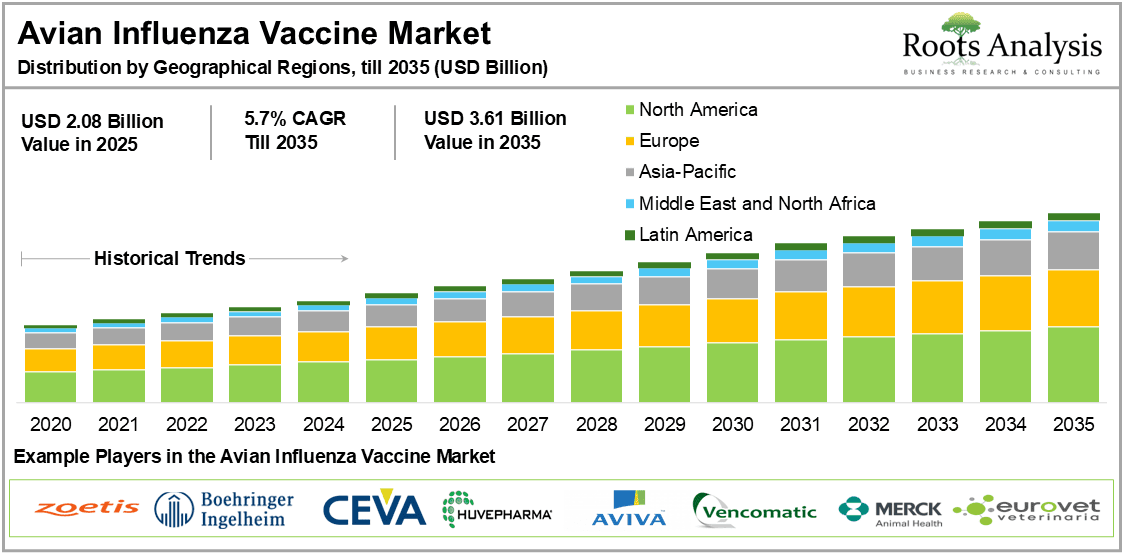
Avian Influenza Vaccine Market Overview
The global avian influenza vaccine market size, valued at USD 1.94 billion in 2024, is projected to reach USD 2.08 billion in 2025 and USD 3.61 billion by 2035, representing a CAGR of 5.7% during the forecast period.
To learn more about this report, request a free sample copy
Avian Influenza Vaccine Industry: In Summary
- The global market for avian influenza vaccines is undergoing a period of dynamic expansion, driven by the escalating frequency and severity of avian influenza outbreaks worldwide.
- The rapid increase in poultry production and consumption, necessitating vaccination programs to prevent economic losses, which further influence the avian influenza vaccine market growth.
- The ongoing innovations in vaccine technology, including DNA, mRNA vaccine and recombinant vaccine, offering improve efficacy and safety.
- The US Department of Agriculture (USDA) planning to invest USD 100 million to support innovation in poultry vaccines. This investment underscores the recognition of the need for advanced vaccine solutions in the face of ongoing threats.
- In terms of vaccines, inactivated vaccines accounts for the highest share of the market and the trend of dominance are likely to remain unchanged in the future.
- Recombinant vaccines are likely to gain traction in the upcoming years driven by the growing preferences for target specific vaccines.
- Partnerships and collaborations will remain the center focus in this industry to accelerate the vaccine research and development activities.
- North America is dominating the avian influenza vaccine market by holding 40% of overall revenue share. This can be attributed to the growing incidence of avian influenza that has necessitated the demand for advanced vaccines. In Asia-Pacific, the market is expected to grow at a higher CAGR due to the growing initiatives by the government for mitigating the risk of avian influenza.
- Market players, such as Zoetis (US), and Merck Animal Health (US) are encouraging co-joint agreements to expand their product portfolio and global presence.
- Intramuscular route of administration segment holds maximum share of the market. This is due to the growing preferences of direct drug delivery method for maximum efficiency of drugs.
- The future of the avian influenza industry seems promising due to the escalating poultry industry, rising initiatives by industrial players to develop advanced vaccines, drug delivery technologies, and consistent support from the government organizations.
Avian Influenza Vaccines Market Introduction
Avian influenza vaccines refer to a specialized biological preparation that are specifically formulated to generate an immune response against influenza virus. Notably, the influenza virus is also known as bird flu, a highly contagious disease, affecting poultry population and other avian species across the globe. This disease is generally caused by pathogenic strains, such as H5N1, significantly impacting animals and in some instances humans also. The contagious nature of the disease can impact on the entire poultry population, causing economic loss and species damage.
The frequent outbreak of the avian influenzas has necessitated the demand for advanced vaccines to prevent the widespread transmission of the virus among birds. It is worth noting that vaccination of poultry against the H5N1 influenza epizootic is a widely adopted practice in numerous countries. Furthermore, government organizations across different countries are initiating global vaccine programs to support the poultry population health, thereby positively influencing the market growth.
Owing to the ongoing demand, market player, and numerous research organizations are accelerating their research on avian influenza vaccine, which is expected to be a key driver for the avian influenza vaccine market.
For instance, in April 2025, The University of Cambridge–based DioSynVax and Singapore's ACM Biolabs have signed a strategic deal to jointly develop a next-generation universal avian flu vaccine. In addition to strategic partnerships, regulatory authorities are initiating vaccination programs to mitigate the risk of avian influenza. For instance, in July 2025, the US Department of Agriculture (USDA) announced a comprehensive vaccination plan to mitigate the risk of highly pathogenic avian influenza (HPAI) in poultry, with a formal release. These ongoing initiatives along with high demand for vaccines are likely to accelerate the avian influenza market steadily in the upcoming years.
Avian Influenza Vaccine Market: Report Attributes
| Key Report Attributes |
Details |
| Historical Trend |
Since 2020 |
| Forecast Period |
Till 2035 |
| Market Size 2025 |
USD 2.08 Billion |
| Market Size 2035 |
USD 3.61 Billion |
| CAGR (Till 2035) |
5.7% |
One of the key objectives of the avian influenza vaccine market report was to estimate the current size, opportunity, and the market growth potential, over the forecast period, till 2035. We have provided informed estimates on the likely evolution of the market for the forecast period.
The global avian influenza vaccine market analysis also features the likely distribution of the current and forecasted opportunity within the market across various segments, such as type of vaccine, route of administration, type of strain, distribution channel, end user, and leading players.
In order to account for future uncertainties associated with some of the key parameters and to add robustness to our model, we have provided three market forecast scenarios, namely conservative, base, and optimistic scenarios, representing different tracks of industry’s evolution.
Recent Developments in Avian Influenza Vaccine Market
Several recent developments in the field of avian influenza vaccine industry have occurred, and we outlined some of these below.
- In April 2025, USFDA granted fast track designation to self-amplifying mRNA vaccine candidate (ARCT-2304) for active immunization in birds to protect them from H5N1 subtype (bird flu).
- In February 2025, Zoetis (US) received Conditional License from the USDA for its newly launched avian influenza vaccine, killed virus, and H5N2 subtype for chickens.
- In January 2025, Modera received USD 590 million from the US government to develop mRNA vaccine for influenza strains, such as H5N1.
Avian Influenza Vaccine Market Segmentation Insights
The market report provides comprehensive information on avian influenza vaccine industrial players who are currently active across various segments of the industry as mentioned in the table below.
Avian Influenza Vaccine Market: Market Segmentation
| Market Segmentations |
Details |
| Type of Vaccine |
- Inactivated Vaccines
- Live Recombinant Vaccines
- Combination Vaccines
|
| Route of Administration |
- Intramuscular
- Subcutaneous
- Oral
|
| Application Area |
- Chicken
- Duck and Goose
- Others
|
| Type of Strain |
- H5 Strain
- H7 Strain
- H9 Strain
|
| Distribution Channel |
- Veterinary Clinics
- Online Pharmacies
- Retail Stores
|
| End User |
- Poultry Farms
- Veterinary Clinics
|
| Geographical Regions |
- North America
- Europe
- Asia-Pacific
- Middle East and North Africa
- Latin America
|
| Market in North America |
|
| Market in Europe |
- France
- Germany
- Italy
- Spain
- UK
- Rest of Europe
|
| Market in Asia-Pacific |
- China
- India
- Japan
- South Korea
- Rest of the Asia-Pacific
|
| Market in Middle East and North Africa |
- Egypt
- Saudi Arabia
- United Arab Emirates
|
| Market in Latin America |
|
Avian Influenza Vaccine Market Share Insights
Market Share by Type of Vaccine: Inactivated Vaccines Holds the Highest Share
- Based on the type of vaccine, the global market is segmented into inactivated vaccines, live recombinant vaccines, and combination vaccines. According to the avian influenza market report, presently inactivated vaccines hold nearly 40% share of the market. This can be attributed to the fact that inactivated avian influenza vaccines offer higher efficacy and safe to use. Veterinarians are broadly using inactivated vaccines to treat avian influenza, which is expected to be a key driver for this segment.
- However, in the future, live recombinant vaccines segment is likely to grow at a higher CAGR during the forecast period. This lucrative growth is due to the growing traction towards recombinational avian influenza vaccines as these types of drugs offer targeted immune response, ensuring higher efficacy to treat avian influenza. Additionally, the growing demand for safer and target-specific treatment is likely to rise the demand for live recombinant vaccines in the future.
Market Share by Route of Administration: Intramuscular Segment Holds Highest Share of the Market
- The global market is segmented across different types of routes of administration, such as intramuscular, subcutaneous and oral. Presently, intramuscular segment is dominating by holding maximum avian influenza market share. This dominance is due to the fact that intramuscular route offers higher precision and efficacy for immune response, which is essential for controlling diseases specifically in large scale poultry operations.
- Subcutaneous segment is likely to show the highest growth potential, anticipated to grow at a higher CAGR during the forecast period. This is potentially due to the efficacy in generating immune response and quick absorption of vaccines. The ongoing focus on targeted drug delivery is likely to fuel the demand for subcutaneous injections to treat avian species.
Market Share by Application Area: Chicken Segment Holds the Largest Share of the Market
- This segment highlights the distribution of global market across different application areas, such as chicken, duck and goose, and others. According to the avian influenza market analysis, chicken segment holds the highest share of the market, and the trend of dominance will remain unchanged in the future. This is largely due to expanding poultry operations across the globe. Notably, the risk of avian influenza is higher in poultry farms and once poultry birds are affected with avian influenza it spreads quickly, thereby affecting entire poultry operations. In order to mitigate the risk of avian influenza, there is high demand for vaccines in poultry farms.
- It is important to highlight here that growing awareness among farmers and governments regarding the importance of avian influenza vaccines for chickens to prevent outbreaks and ensure food security is likely to grow chicken segment at a higher CAGR in the future.
Market Share by Type of Strain: H5 Strain Holds the Highest Share
- Based on the type of strain, the global market is segmented into H5 strain, H7 strain, and H9 strain. According to the avian influenza market forecast, the H5 strain segment is currently holding the highest share of the market. This can be attributed to the high prevalence of H5N1 and its various clades such as H5N8, and H5N2 globally, causing significant outbreaks in poultry and even some human infections. Thus, growing incidence of H5 strain has bolstered the demand for H5 vaccines.
- It is interesting to note that the H5 strain segment will continue to grow at a higher CAGR during the forecast period. This growth potential is due to the fact that several vaccines particularly in regions like China, are developed as H5 + H7 combination vaccines. The development of combined vaccines further solidifies the market presence of H5 strain.
Market Share by Distribution Channel: Veterinary Clinics Holds the Highest Share
- Based on the distribution channel, the global market is segmented into veterinary clinics, online pharmacies, and retail stores. Among these, veterinary clinics hold the highest share of the avian influenza vaccine market. This is likely to be the result of increasing preferences of veterinary clinics for receiving vaccines. Moreover, the availability of physicians in the veterinary clinics for direct prescriptions has further solidified its highest share.
- Notably, in the future, online pharmacies segment is likely to grow at a higher CAGR during the forecast period. This is potentially driven by the rising adoption of digital platforms for prescriptions, convenience of purchase and affordability.
Market Share by End User: Poultry Farm Holds Maximum Share of the Market
- The global market is segmented based on the end user into poultry farms, veterinary clinics, research institutes, and government and regulatory bodies. Presently, the poultry farms segment holds the highest avian influenza market share. Commercial poultry farms, including broiler and layer operations, represent the vast majority of poultry production globally. These large-scale operations have a continuous and significant demand for avian vaccines to protect their flocks from diseases like avian influenza, Marek's disease, and infectious bronchitis, which can cause massive economic losses.
- Notably, poultry farms segment will continue to grow at a higher CAGR during the forecast period. For commercial farms, vaccination is a critical component of their biosecurity protocols and disease prevention strategies. The high density of birds in these operations makes them highly susceptible to rapid disease spread, thus necessitating robust vaccination programs.
Market Share by Geographical Regions: North America is Currently Dominating the Market
- The global market is categorized across different geographical regions, such as North America, Europe, Asia-Pacific, Middle East and North Africa, and Latin America. According to the projection, North America is dominating the market by holding 40% of the avian influenza market share. This can be driven by the advanced biosecurity measures to prevent flu risk in avian species across poultry farms and major vaccine manufacturers, and the large scale of poultry production in this region.
- In Asia-Pacific, the bird flu market is likely to grow at a higher CAGR during the forecast period. Asian countries, such as China and India are experiencing frequently outbreaks of various avian diseases, including highly pathogenic avian influenza, necessitating the demand for avian influenza vaccines in this region. Furthermore, government organizations are increasingly implementing and enforcing vaccination programs, especially for avian influenza, to protect their poultry industries and ensure food security.
Avian Influenza Vaccine Market: Report Deliverables
| Report Deliverables |
Details |
Excel Data Packs
(Complimentary) |
Available |
| Key Avian Influenza Vaccine Companies Profiled |
- Aviva (UK)
- Boehringer Ingelheim (Germany)
- Ceva Santé Animale(France)
- Charles River Laboratories International (US)
- Eurovet (Netherland)
- Huvepharma (Bulgaria)
- Harbin Veterinary Research Institute (HVRI) (China)
- Merck Animal Health (US)
- Merial (India)
- Ringpu Bio-Technology (China)
- Vencomatic Group (Netherland)
- Vetoquinol (France)
- Wuhan Biolake Biotechnology (China)
- Zoetis (US)
(A complete list of companies captured is available in the report) |
PowerPoint Presentation
(Complimentary) |
Available |
| Customization Scope |
15% Free Customization |
Avian Influenza Vaccine Market Major Takeaways
The “Avian Influenza Vaccine Market Report: Industry Trends and Global Forecasts, till 2035” market report features an extensive study of the current market landscape, market size, market share, market growth, market trends, market value, market forecast, market outlook, statistics, and future opportunities for avian influenza vaccine industry players. The market research report lays emphasis on the avian influenza vaccine that are being developed. Key takeaways of the market report are briefly discussed below.
Avian Influenza Vaccine Market Competitive Landscape
The market landscape of avian influenza is immensely competitive, featuring the presence of several well-established and large industrial players. Notably, the market players, such as Boehringer Ingelheim (Germany), Zoetis (US), and Merck Animal Health (US) are increasing research, development and vaccine manufacturing initiatives to develop avian influenza vaccines, indicating a competitive environment. However, the recent focus of industrial players will be on the development of live recombination and combination vaccines to target diseases with higher efficacy.
For instance, in February 2025, Boehringer Ingelheim (Germany) launched VAXXITEK HVT+IBD+H5, a trivalent poultry vaccine to protect avian population from Marek’s disease with single dose. This vaccine leverages COBRA technology to offer broad protection across multiple H5 clades, a significant advancement over traditional strain-specific vaccines. As more market players continue to increase research on innovative vaccines for avian influenza, it is expected that avian influenza market will remain competitive in the future.
Market Drivers: What are the Key Drivers for Growth in the Avian Influenza Vaccine Market?
Rising Frequent Avian Influenza Outbreaks
One of the potential avian influenza market driver that propel the market is frequent and severe outbreaks of avian influenza (especially H5N1) in poultry and wild birds. This frequent outbreak of avian influenza drives the demand for effective vaccines globally. Additionally, the expansion of zoonotic diseases and the broadening host range of AI viruses amplify the urgency for effective avian influenza vaccines for farm animals.
Increasing Poultry Production and Consumption
Notably, the rapid increase in poultry farming and meat consumption has further necessitated the requirement of vaccination programs to prevent economic losses due to influenza flu in birds. Furthermore, government organizations are increasingly supporting vaccine research, development, surveillance, and preventive vaccination campaigns, especially in high-risk regions. Some notable examples include U.S. government's investments in HPAI initiatives and the USDA's commitment to funding innovations in poultry vaccines.
Market Challenges: What Challenges Affect Avian Influenza Vaccine Production and Supply?
Supply Chain Disruption and Manufacturing Complexities
Some of the potential challenges that may hinder the avian influenza vaccine market growth includes, complexity associated with veterinary vaccines production and raw material shortage. It is important to highlight here that the research and development of novel avian influenza vaccines, specifically those tailored to rapidly evolving viral strains, are inherently capital-intensive processes. This financial burden can limit market access, especially for smaller and medium-sized poultry farmers, particularly in developing regions where affordability is a critical concern.
Regulatory Guidelines Complexity and Pathogen Variability
Notably, the stringent approval processes for new vaccines can delay market entry and increase development costs. In addition, the rapid mutation of avian influenza viruses requires continuous vaccine updates and strain matching, complicating disease control efforts. Notably, the challenges in avian influenza vaccine supply chain and regulatory compliance along with pathogen variability may impact the vaccine development and commercialization of the vaccines. Therefore, in order to mitigate the concern, industrial players are undertaking strategic initiatives to support the vaccine research and development while considering regulatory guidelines into the mind.
Market Opportunities: What Technological Advancements are Shaping the Avian Influenza Vaccine Market?
Increasing Innovation in Vaccine Technology
Despite challenges, the avian influenza industry market is continually witnessing an upward trajectory, driven by technological innovations. It is important to highlight that the market players are evolving vaccine technology and drug innovations which is expected to improve the efficacy, and safety of the vaccines. Notably, industrial players are leveraging recombinant technologies to develop recombinant, DNA vaccine and mRNA vaccines with improve efficacy, safety, and ease of administration. These innovations and advancements in inactivated and recombinant avian influenza vaccines are likely to fuel the market growth in the future.
Increased Partnerships and Collaboration
It is important to highlight here that industrial players are entering into the research and development partnerships to accelerate vaccine development and distribution. This increasing cooperation in research, development, and the establishment of strategic supplies, as demonstrated by the U.S. government's agreements with CSL Seqirus (UK), Sanofi (France), and GSK (UK) for H5N1 vaccine supply, are crucial for enhancing global preparedness for treating avian influenza. As market players continue to expand partnerships in this field, we believe the market will remain progressive in the future.
Market Size Analysis: How Is the Government Sector Impacting the Avian Influenza Vaccine Market?
In 2025, the avian influenza market is valued at USD 2.08 billion and is projected to reach USD 3.61 billion by 2035, representing a CAGR of 5.7% during the forecast period. This lucrative growth is due to the emerging market within Asian countries. It is important to highlight here that recurrent outbreaks of avian influenza in Asian countries are likely to boost the demand vaccines to treat wide range disease, impacting poultry production.
Furthermore, the avian influenza vaccine market growth driven by government initiatives. Notably, the government organizations are taking strategic initiatives and organizing vaccine programs to support large-scale immunization campaigns and procurement initiatives in Asian countries, thereby contributing to the growth of poultry vaccine market.
Avian Influenza Vaccine Market Report Coverage
The market report presents an in-depth analysis, highlighting the capabilities of various stakeholders in the avian influenza vaccine industry, across different geographies. Amongst other elements, the market report includes:
- An Infographic Executive Summary
- Regulatory Scenario
- Comprehensive Database of Leading Players
- Competitive Landscape
- Porter’s Five Forces Analysis
- Company Competitiveness Analysis
- Startup Ecosystem in the Avian Influenza Vaccine Market
- Company Profiles
- Patent Analysis
- Partnerships and Collaborations
- Grant Analysis
- Funding and Investment Analysis
- Clinical Trial Analysis
- Market Forecast and Opportunity Analysis
- Key Winning Strategies
- SWOT Analysis
Glossary
- H5N1: A highly pathogenic avian influenza (HPAI) virus subtype that has been responsible for widespread outbreaks in poultry and, in certain instances, has infected humans and other mammals.
- Inactivated Vaccines: Vaccines that contain killed (inactivated) virus particles. These particles are unable to cause disease but are still capable of stimulating a protective immune response in the vaccinated host.
- Live Attenuated Vaccines: Vaccines that utilize a weakened (attenuated) form of the virus. This weakened virus can replicate in the host without causing severe disease, thereby stimulating a robust and long-lasting immune response.
- Recombinant Vaccines: Vaccines produced through genetic engineering techniques. Specific viral genes encoding antigens are inserted into another organism (a virus vector or bacterium) to produce the desired vaccine components.
- mRNA Vaccines: Vaccines that utilize messenger RNA (mRNA) molecules. These mRNA molecules deliver genetic instructions to the body's cells, prompting them to produce a specific viral protein. This protein then triggers an immune response, preparing the body to fight off future infections.
- Zoonotic Disease: A disease that can be transmitted naturally from animals to humans.
From the Author’s Desk
Author’s View on Avian Influenza Vaccine Market
The avian influenza vaccine market is a dynamic and indispensable sector witnessing remarkable growth in the upcoming years. This expansion is primarily driven by the persistent and increasing prevalence of avian influenza outbreaks globally, coupled with the rising worldwide demand for poultry products, and bolstered by supportive government initiatives.
The significant opportunities proliferate, particularly in the rapidly expanding emerging markets of Asia-Pacific and Latin America. Furthermore, the continuous adoption and advancement of innovative vaccine technologies, such as mRNA platforms, represent a transformative force within the industry.
Frequently Asked Questions
What is avian influenza?
It is a form of highly contagious viral disease primarily affecting birds, caused by influenza A viruses. Moreover, it is also known as bird flu.What is the projected size of the global avian influenza vaccine market by 2035?
The global market for avian influenza is expected to reach USD 3.61 billion by 2035.Which regions dominate the avian influenza vaccine market globally?
Presently, North America is dominating the market driven by the growing poultry production in this region and risk of zoonotic diseases.What are the main types of avian influenza vaccines available in the market?
Inactivated, recombinant, combination, subunit and DNA vaccines are some common types of vaccines available for treating avian influenza. How does the poultry industry influence avian influenza vaccine demand?
The large scale consumption of poultry products and growing risk of zoonotic diseases have positively avian influenza vaccine demand. Avian influenza, particularly those caused by highly pathogenic avian influenza (HPAI) strains, lead to the discarding of millions of birds. The sheer scale of these losses creates a strong incentive for the industry to seek preventative measures, including vaccination. Who are the leading manufacturers in the avian influenza vaccine market?
Aviva (UK), Boehringer Ingelheim (Germany), Ceva Santé Animale (France), Charles River Laboratories International (US), Eurovet (Netherland), Huvepharma (Bulgaria), Harbin Veterinary Research Institute (HVRI) (China), Merck Animal Health (US), Merial (India), Ringpu Bio-Technology (China), Vencomatic Group (Netherland), Vetoquinol (France), Wuhan Biolake Biotechnology (China), and Zoetis (US).How do regulatory standards and safety concerns affect the avian influenza vaccine market?
Regulatory standards and safety concerns are important in avian influenza vaccine industry. Notably, the regulatory bodies provide severe guidelines to ensure responsible development, safeguard animals and human health.What are the emerging trends in recombinant and mRNA avian influenza vaccines?
Some of the emerging trends that are shaping industry growth includes the need for more effective, rapidly deployable, and adaptable solutions to combat the constantly evolving nature of the avian influenza virus.