


 Download Free Sample
 Buy Now
Nanomedicine for Targeted Drug Delivery Market Overview
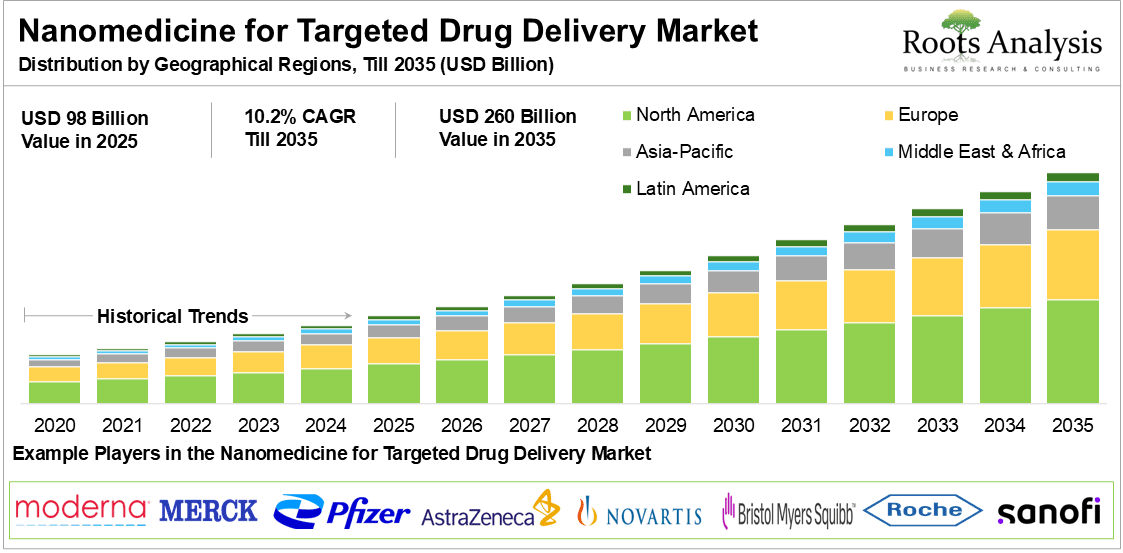
The global nanomedicine for targeted drug delivery market size, valued at USD 87 billion in 2024, is projected to reach USD 98 billion in 2025 and USD 260 billion by 2035, representing a CAGR of 10.2% during the forecast period.
 |
See What’s in the Full Report – Request Your Complimentary Insights!
Nanomedicine for Targeted Drug Delivery Market: In Summary
- The nanomedicine for targeted drug delivery market is experiencing significant growth, driven by the increasing demand for advanced drug delivery systems that improve efficacy and reduce side effects by delivering drugs directly to the target site. As a result, this market is expected to grow at a CAGR of 10.2% during the forecast period.
- In terms of type of product, the liposomes segment holds the largest market share due to their biocompatibility, ability to surpass blood-brain-barrier and widespread use in cancer therapy. However, polymeric nanoparticles are projected to show the highest CAGR, driven by advancements that enhance their stability and targeting capabilities.
- The oncology disorders segment will remain dominant in the future as nanomedicine is highly effective in delivering drugs directly to tumor sites. Further, the neurological disorders segment is expected to grow at the highest CAGR, as nanocarriers, such as liposomes, can cross the challenging blood-brain barrier to treat disorders.
- In terms of application area, drug delivery segment holds the largest market share, driven by the growing use of nanoparticles and liposomes for targeted delivery.
- North America dominates the market with nearly a 45% share due to the advanced healthcare infrastructure and significant R&D investments for the development of nanotechnology. However, the Asia-Pacific region is expected to exhibit the highest CAGR, fueled by increasing healthcare investments and government support for nanotechnology research.
- The key players, such as Pfizer (US), Novartis (Switzerland), and Jazz Pharmaceuticals (Ireland) are undertaking strategic initiatives to support the development of nanomedicine for targeted drug delivery.
- The future of nanomedicine for targeted drug delivery lies in continued innovation, particularly in combining therapeutic and diagnostic functions into single platforms (theranostics nanomedicine). The development of combination drugs and the application of AI will enhance therapeutic outcomes and open up new avenues for treatment.
Nanomedicine for Targeted Drug Delivery Market Introduction
Nanomedicine is experiencing significant growth, driven by the growing demand for target specific drug delivery system to enhance efficacy by delivering drug at the right area. It involves the use of nanomaterials, such as protein-based nanoparticles, liposomes, and dendrimers at the nanoscale (1-1000 nm) for delivering drugs at targeted sites. Moreover, the nanoparticles can be engineered to deliver drugs directly to diseased tissues or cells, thereby reduce the chances of damage to healthy cells.
Notably, the demand for nanomedicine for targeted drug delivery has increased due to the rising concern of chronic conditions, neurological conditions, and cancer. Notably, cancer has been a major cause of concern, affecting millions of individuals worldwide. As per the report of National Institute of Health, in 2025, around 2,04,910 new cancer cases are projected to occur in the US. It is important to highlight here that the traditional drug delivery systems for cancer have certain limitations, such as non-specific targeting, poor bioavailability, and significant adverse effects. Due to the smaller size and unique design, nanomedicine helps to overcome these challenges, thereby improve target efficacy and bioavailability of drugs.
Owing to its significances and rising demand for targeted drug delivery devices, several industrial players are undertaking initiatives to develop nanomedicine for drug delivery. For instance, in February 2025, IIT Madras (Indian Institute of Technology, Madras, India) researcher’s team have developed a patented nanotechnology for breast cancer treatment. Owing to the successful outcomes, this researcher team is seeking partnerships with pharmaceutical industries for clinical trials and commercialization. As more research organizations and industrial players continue to accelerate research on nanoparticle formulation for drug delivery, it is expected that nanomedicine for targeted drug delivery market will grow steadily in the upcoming years.
Nanomedicine for Targeted Drug Delivery Market: Report Attributes
| Key Report Attribute | Details | |
| Historical Trend | Since 2020 | |
| Forecast Period | Till 2035 | |
| Market Size 2025 | USD 98 Billion | |
| Market Size 2035 | USD 260 Billion | |
| CAGR (Till 2035) | 10.2% | |
One of the key objectives of the nanomedicine for targeted drug delivery market report was to estimate the current size, opportunity, and the market growth potential, over the forecast period, till 2035. We have provided informed estimates on the likely evolution of the market for the forecast period.
The global nanomedicine for targeted drug delivery market analysis also features the likely distribution of the current and forecasted opportunity within the market across various segments, such as type of product, therapeutic area, route of administration, application area, end user, geographical regions, and leading players.
In order to account for future uncertainties associated with some of the key parameters and to add robustness to our model, we have provided three market forecast scenarios, namely conservative, base, and optimistic scenarios, representing different tracks of industry's evolution.
Recent Developments in Nanomedicine for Targeted Drug Delivery Market
Several recent developments in the field of nanomedicine for targeted drug delivery industry have occurred, and we have outlined some of these below:
- In June 2025, Scientists at Xi’ an Jiaotong-Liverpool University and Nanjing University (China) developed a new drug delivery system using nanoparticles that has capability to improve how cancer treatments and other diseases are delivered.
- In May 2025, a team of researchers from India in collaboration with scientists from the UAE and Saudi Arabia developed a novel drug delivery system for colon cancer by using cross-linked nanoparticles derived from mastic gum, a natural resin.
- In January 2025, Ashvattha Therapeutics (US) secured up to USD 50 million to advance its clinical-stage hydroxyl dendrimer therapeutics (HDTs) in ophthalmology, neurology and inflammatory conditions. This company will use these funds for Phase II clinical studies of ophthalmology-focused nanomedicine, which is designed to address neovascular age-related macular degeneration (wet AMD) and diabetic macular edema (DME).
- In May 2025, a team of researchers from the Brown University successfully developed a latest nanotechnology-based approach to treat fungal infection, specifically those that occurred due to drug-resistant Candida species.
- In June 2025, the University of Texas Rio Grande Valley has received a USD 2.8 million grant from the Cancer Prevention and Research Institute of Texas. This grant will be used to launch the Drug Delivery and Nanomedicine Core (DDNC), a specialized research facility which is primarily focused on advancing cancer research, education and care through nanotechnology.
Nanomedicine for Targeted Drug Delivery Market Segmentation Insights
The market report presents an in-depth analysis of nanoparticle drug delivery systems providers who are currently active across various segments of the industry as mentioned below:
Nanomedicine for Targeted Drug Delivery Market: Market Segmentation
| Market Segmentation | Details | |
| Type of Product |
|
|
| Therapeutic Area |
|
|
| Route of Administration |
|
|
| Application Area |
|
|
| End User |
|
|
| Geographical Regions |
|
|
| Market In North America |
|
|
| Market In Europe |
|
|
| Market in Asia-Pacific |
|
|
| Market in Middle East & Africa |
|
|
| Market in Latin America |
|
|
Industry Experts on Nanomedicine for Targeted Drug Delivery Market
Leading experts across academia, industry, and regulatory agencies provide compelling perspectives on nanomedicine's future trajectory.
In an interview, Dr. Mansoor Amiji (Distinguished Professor and Director of the Nanomedicine Innovation Center at Northeast) stated that, the extensively researched nanoparticles and his lab's mission to develop clinically and commercially translatable drug delivery systems for patient benefit, focusing on creating commercially and clinically viable technologies through collaboration with companies and stakeholders.” The future of nanomedicine seems promising owing to the ongoing research.
Nanomedicine for Targeted Drug Delivery Market Share Insights
Market Share by Type of Product: Are Liposomes or Nanoparticles Capturing Larger Market Share in Drug Delivery?
- Based on the type of product, the global market is segmented into liposomes, polymeric nanoparticles, dendrimers, micelles, solid lipid nanoparticles, mesoporous nanoparticles, and other products. According to the nanomedicine targeted drug delivery market forecast, the liposomes segment holds the highest share of the market. This is due to higher biocompatibility and clinical applications in cancer therapeutics and neurological disorders. Its amphiphilic characteristics enable them to carry hydrophobic, hydrophilic, and lipophilic drugs for flexible drug delivery at targeted sites.
- Notably, the polymeric nanoparticles segment is showing a robust growth potential, anticipating registering higher CAGR during the forecast period. The recent advancements in nanoparticles have significantly improved stability, enhanced targeting capabilities, and ensure controlled drug release. These advancements are likely to propel its demand in the future as advanced drug delivery system.
Market Share by Therapeutic Area: Which Therapeutic Areas Drive Highest Demand for Nanomedicine Drug Delivery?
- This segment is sub-divided based on therapeutic area into oncology disorders, cardiovascular disorders, neurological disorders, infectious disorders, and others. According to the nanomedicine drug delivery industry analysis, the oncology disorders segment is dominating the market by holding maximum share. This is due the fact that cancer treatment requires targeted drug delivery systems to enhance efficacy and reduce toxicity. Nanomedicine helps to deliver drug at the tumor sites, which increases its demand for targeted oncology drug delivery.
- It is worth noting that the neurological disorders segment will grow at a higher CAGR in the future. The higher stability, controlled drug release and target efficacy is likely to be the key reason for widespread adoption of nanomedicine for neurological drug delivery.
Unlock Deeper Insights – Schedule Your Personalized Workshop Today!
Market Share by Route of Administration: Will Intravenous Segment Dominate the Market in the Future?
- Based on the route of administration, the global market is segmented into intravenous, oral, intranasal, intrathecal, and other route of administrations. According to the nanomedicine targeted drug delivery market report, the intravenous segment accounts for the highest share of the market and the trend is likely to remain unchanged in the future.
- It is important to highlight here that nanomedicine for targeted drug delivery market growth for intranasal route of administration is highest amongst other segments during the forecast period. This growth is likely to be the result of growing innovations, such as dry powder inhalers for targeted respiratory treatments.
Market Share by Application Area: How Liposome-Based Nanocarriers Overcome Blood-Brain Barrier Challenges in Neurological Drug Delivery?
- This market is further bifurcated across different application area, such as drug delivery, diagnostics, therapeutics, and others. Among these, the drug delivery segment holds around 35% nanomedicine drug delivery market share. This can be attributed to the growing usage of nanomedicine, specifically nanoparticles, and liposomes for targeted delivery of the drugs.
- It is worth mentioning that this segment will continue to grow at a higher CAGR in the future. This is potentially due to the ability of liposomes to cross the blood brain barrier for delivering drugs at targeted sites to treat neurological disorders has made it a promising solution to treat patients.
Market Share by End User: How Nanotechnology in Pharmaceutical Industry is Gaining Traction in the Future?
- According to nanomedicine for targeted drug delivery market forecast the global market is segmented based on end user into hospitals and clinics, research and academic institutes, diagnostic laboratories, pharmaceutical and biotechnology companies, and other end users. It is worth noting that the hospitals and clinics segment is securing maximum share of the targeted nanomedicine market growth. This can be attributed to the increasing demand for efficient and target specific target therapeutic delivery solutions. Nanomedicine offers specific benefits, such as minimal toxicity, high target specificity and high biocompatibility are increasing its adoption across hospitals and clinics to treat wide range of indications.
- Notably, the pharmaceutical and biotechnology companies segment is likely to grow at the fastest CAGR during the forecast period. It is worth noting that the innovations of nanotechnology in pharmaceutical industry for combined therapeutics and diagnostics is likely to propel the market growth of this segment.
Market Share by Geographical Regions: Which Regions are Leading Adoption of Nanomedicine for Targeted Drug Delivery?
- The global market is distributed across North America, Europe, Asia-Pacific, Middle East & Africa, and Latin America. Among these, North America is dominating the market by holding nearly 45% share of the market. Several factors, such as healthcare infrastructure, robust research and development investments, and supportive regulatory environment are propelling the market growth in this region.
- In Asia-Pacific, the nanomedicine for targeted drug delivery systems market is expected to grow at a highest CAGR during the forecast period. This lucrative growth is due to the increasing healthcare investments, government support for nanotechnology research and development initiatives, and rising prevalence of chronic conditions.
Nanomedicine for Targeted Drug Delivery Market: Report Deliverables
| Report Deliverables | Details | |
| Excel Data Packs (Complimentary) |
|
|
| Key Nanomedicine for Targeted Drug Delivery Companies Profiled |
|
|
| PowerPoint Presentation (Complimentary) | Available | |
| Customization Scope | 15% Free Customization | |
Nanomedicine for Targeted Drug Delivery Market Key Takeaways
The "Nanomedicine for Targeted Drug Delivery Market Report: Industry Trends and Global Forecasts, till 2035" market report features an extensive study of the current market landscape, market size, market share, market growth, market trends, market value, market forecast, market outlook, and future opportunities for market players. The market research report lays emphasis on the nanomedicine for targeted drug delivery that is being developed. Key takeaways of the market report are briefly discussed below.
Competitive Landscape: Is Market for Nanomedicine for Targeted Drug Delivery Competitive?
The market landscape of nanomedicine for targeted drug delivery features a wide array of well-established pharmaceutical companies and new entrants. Leading market players, such as Pfizer (US), Novartis (Switzerland), and Johnson & Johnson (US) are undertaking several research initiatives to develop nanomedicine for targeted drug delivery. However, the primary focus of industrial players will be on collaborations and innovations to expand usage of nanomedicine applications across diverse therapeutic applications. As more market players proliferate in the market, it is expected that the market will grow at a higher CAGR in the future.
Pay Only for What You Need – The Best Way to Optimize
Market Drivers: Are Chronic Diseases Driving Investment in Nanomedicine Targeted Delivery Platforms?
Nanomedicine for target drug delivery industry is experiencing robust growth driven by the rising prevalence of chronic diseases. Notably, the medical conditions, such as neurological disorders, cancer, cardiovascular diseases, and autoimmune diseases required advanced target specific drug delivery systems. Nanomedicine have precision targeting capabilities which make them effective in treating diseases with higher target specificity.
In addition, the rising shift towards oncology precision medicine is fueling the adoption of nanomedicine solutions. It is worth noting that precision medicine nanotechnology enables modification of drug delivery systems to meet individuals requirement. This patient specific approach helps to enhance treatment efficacy, which is further likely to drive the demand for nanomedicine for target drug delivery.
Collaborations and Partnerships: Are Combined Efforts of Industrial Players Driving the Market Growth?
The market for nanomedicine for targeted drug delivery is experiencing massive partnerships and collaborations between industrial players and academic research institutes. These collaborations are aimed to combining the research excellence of academic institutes and pharmaceutical industrial expertise to expand the development of nanoparticles for drug delivery.
It is important to highlight that in August 2025, the European Technology Platform on Nanomedicine organized a 90-minute flash brokerage to offer “last-partner seekers” three minutes to make contacts with pharmaceuticals and pitch companies to facilitate the partnerships for the Horizon Europe 2025 Health & Mission Cancer calls associated to nanomedicine. These nanomedicine for targeted drug delivery market trends are driving the market growth in the future.
Market Size Analysis: Why Combination Nanomedicine Approaches Show Enhanced Therapeutic Outcomes In Oncology Applications?
In 2025, the global nanomedicine drug delivery market size is valued at USD 98 billion and poised to reach USD 260 billion by 2035. The current focus of industrial players is on combination nanomedicine approach to enhance therapeutic outcomes in oncology applications. Notably, cancerous cells can develop resistance to a particular drug with time, which creates challenges in treating patients. In order to overcome these challenges, researchers are aiming for combination approach which involves co-delivery of medicine through nanoparticles as they can encapsulate the therapeutic agents. This combinational approach further reflects market growth in the upcoming years.
What Challenges Limits the Adoption of Nanomedicine Targeted Drug Delivery Systems?
Complex Regulatory Guidelines: How do Regulatory Pathways Affect Nanomedicine Drug Delivery Commercialization?
Nanomedicines lack specific regulatory frameworks due to their unique physicochemical properties and complex biological behavior. Regulatory authorities, such as the European Medicines Agency (EMA) and the US Food and Drug Administration (USFDA), tend to evaluate nanomedicine products. This creates challenges for the drug developers in defining the exact regulatory pathway and requirements for approval.
Long Term Safety and Toxicity Associated with Nanoparticles
It is worth noting that the long-term safety and toxicity associated with nanoparticles pose significant challenges for nanomedicine drug delivery market players. The nanoparticles offer targeted drug delivery benefits, their small size enables them to cross biological barriers and distribute widely in organs including the brain, liver, and kidneys. This raises concerns about long-term accumulation, chronic inflammation, and possible carcinogenic effects, which are not yet fully characterized.
Nanomedicine for Target Drug Delivery Market Trends
The biodegradable nanocarriers market is experiencing an upward trajectory driven by the ongoing trends listed below:
Integration of Artificial Intelligence: How is AI Integration Impacting Nanomedicine Drug Delivery Market Growth?
The integration of artificial intelligence in nanotechnology holds a promising future. This AI integration helps in understanding the nanomaterial-biological system interaction. This information collected through predictive modeling helps to optimize nanoparticles drugs formulation. Moreover, the advanced machine learning models, such as QSAR and MTK-QSBER improve prediction of nanoparticle cytotoxicity and in vivo behavior, supporting safer drug delivery system design and reducing costly late-stage failures.
Get an Instant Quote in 10 Minutes. Lowest Price Guaranteed
Expanding Therapeutic Applications Beyond Oncology
The market for nanomedicine for targeted drug delivery is further propelled by the expanding therapeutic applications beyond oncological disorders. It is worth noting that, the market players are exploring the application of nanoparticles and theranostic nanomedicine platforms to target wide range of therapeutic applications, such as infectious diseases, neurological disorders, and regenerative medicine applications. In addition, the gene therapy applications also represent significant growth opportunities for nucleic acid delivery to treat patients.
Nanomedicine for Targeted Drug Delivery Market Report Coverage
- An Infographic Executive Summary
- Regulatory Scenario
- Comprehensive Database of Leading Players
- Competitive Landscape
- Company Competitiveness Analysis
- Startup Ecosystem in the Nanomedicine for Targeted Drug Delivery Market
- Company Profiles
- Porter’s Five Forces Analysis
- Patent Analysis
- Partnerships and Collaborations
- Grant Analysis
- Funding and Investment Analysis
- Clinical Trial Analysis
- Market Forecast and Opportunity Analysis
- Adjacent Market Analysis
- Key Winning Strategies
- SWOT Analysis
Glossary
- Bioavailability: The extent and rate at which the active pharmaceutical ingredient is absorbed from a drug formulation and becomes available at the site of action for therapeutic effect.
- Biocompatibility: The ability of a nanomaterial or nanomedicine formulation to perform its intended function without eliciting adverse biological responses or toxic effects in the host organism.
- Blood-Brain Barrier (BBB): A selective barrier formed by endothelial cells that prevents most substances from entering the brain from the bloodstream, presenting a significant challenge for drug delivery to the central nervous system that nanomedicine seeks to overcome.
- Dendrimers: It is a tree-like macromolecular structure with well-defined architecture that serve as drug delivery vehicles, offering multiple attachment points for therapeutic agents and targeting ligands.
- Nanomedicine: The application of nanotechnology in healthcare for the diagnosis, treatment, prevention, and monitoring of diseases, utilizing materials and devices at the nanoscale (1-100 nanometers).
From the Author’s Desk
Author’s View on Nanomedicine for Targeted Drug Delivery Market
Nanomedicine for targeted drug delivery offer a broad scope driven by the growing shift towards personalization and target specific drugs demand. Currently, several research studies and clinical trials are undergoing which reflect positive outcomes in the upcoming years. Moreover, the market players are also focusing on the development of combinational drugs and implementing AI technology to enhance the development of nanoparticles for targeted drug delivery. Several partnerships are undergoing which further indicate the promising future of this industry. Despite growing industry, challenges such as lack of standard guidelines, off-target effect and high expenses need to be addressed for widespread adoption.
Customization Opportunities
At Roots Analysis, we genuinely care about your success and understand that your business requirements are unique. While our market research reports provide valuable insights, we recognize that they might not cover every aspect you need to make well-informed strategic decisions. To account for that, we offer 15% free report customization tailored to your specific needs. Whether you require additional quantitative analysis, qualitative insights, or any other information related to the electric vehicles market, reach out to us today at support@rootsanalysis.com


