
Lowest Price Guaranteed
Pages
257
Last Updated
September 2026
View Count
5567
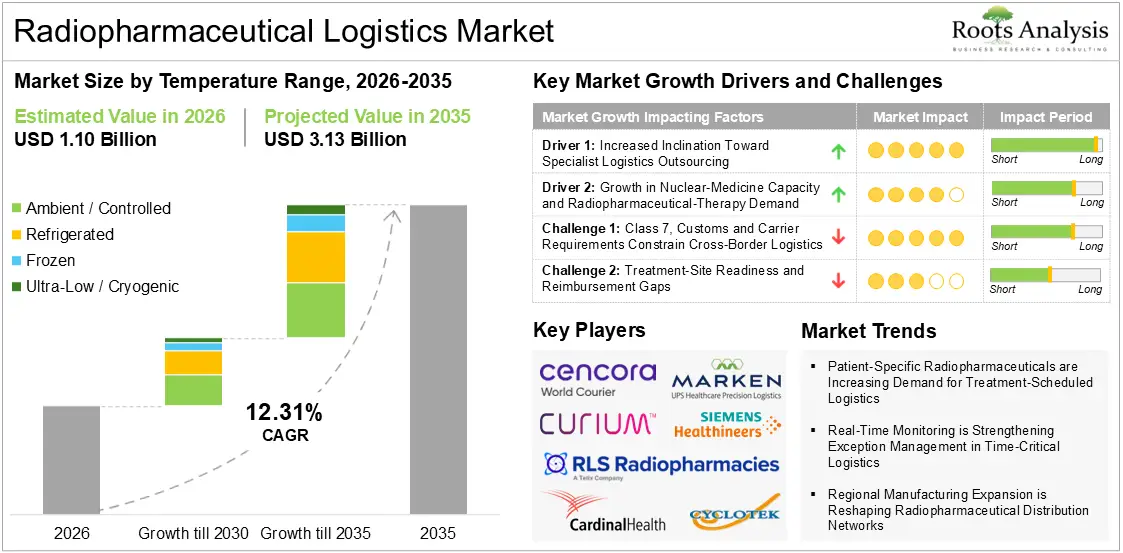
The global radiopharmaceutical logistics market, valued at USD 0.99 billion in 2025, is projected to reach USD 1.10 billion in 2026 and USD 3.13 billion by 2035, representing a CAGR of 12.31% during the forecast period 2026 to 2035. Market growth is expected to be supported by the expanding commercialization of diagnostic and therapeutic radiopharmaceuticals, increasing nuclear-medicine and treatment-site capacity, greater reliance on specialist outsourced logistics providers, and rising requirements for compliant handling, documentation and distribution across regulated supply chains.
To learn more about this report, request a free sample copy
Radiopharmaceutical logistics involves the controlled movement and handling of medical radiopharmaceuticals and isotopes under unusually narrow time, safety and product-integrity constraints. Radioactive decay limits the usable life of many products, while Class 7 transport requirements, validated temperature conditions, secure chain of custody and scheduled administration windows place additional demands on packaging, documentation, routing and delivery execution.
Recurring diagnostic radiopharmaceutical distribution remains a well-established part of nuclear-medicine supply chains, supported by radiopharmacies, imaging centers and routine dose-delivery networks. At the same time, the commercial expansion of therapeutic radiopharmaceuticals is introducing more complex logistics requirements. Patient-specific preparation, repeat treatment cycles, fixed administration schedules and cross-border movement require closer alignment between manufacturing release, shipment timing, specialized handling, condition monitoring and final delivery to treatment sites.
Radiopharmaceutical logistics is therefore progressing beyond the physical transportation of radioactive products towards coordinated management of the entire delivery process. Production timing, regulatory release, route planning, shipment condition and treatment-site readiness must be aligned within narrow operating windows. This growing need for synchronization is increasing the importance of real-time visibility, exception management and specialist handling in maintaining dose integrity and reliable treatment delivery.
The radiopharmaceutical logistics ecosystem brings together specialist logistics providers, integrated healthcare-logistics groups, radiopharmacy networks and manufacturer-led distribution systems. World Courier and Marken support multi-client transportation, regulatory coordination and shipment intervention, while Cardinal Health and Jubilant Radiopharma combine dose preparation with scheduled clinical delivery. Siemens Healthineers Radiopharma, Curium and Telix / RLS integrate manufacturing or dispensing with regional distribution infrastructure. These participants compete across transportation, monitoring and distribution services, but also collaborate when manufacturers require external air, ground, customs or last-mile support beyond their own networks. Further, investment in production sites, radiopharmacy capacity and precision-logistics technology are broadening geographic coverage and strengthening service integration across this specialized market.
The matrix below shows how leading radiopharmaceutical 3PL providers differ in their delivery infrastructure, radiopharmaceutical portfolios, compliance capabilities and geographic reach.
| Company | Headquarters | Global Network | Services Offered | Radiopharmaceuticals Handled |
| World Courier (subsidiary of Cencora) | London, UK | 120+ company-owned facilities | Class 7 handling; customs support; condition monitoring; backup routing | Third-party diagnostic and therapeutic radiopharmaceuticals |
| Marken (subsidiary of UPS Healthcare Precision Logistics) | US | 220+ countries and territories served | UN2915 Type A handling; live intervention; chain of custody; white-glove delivery | Third-party diagnostic, theranostic and therapeutic shipments |
| Cardinal Health Nuclear & Precision Health Solutions | US | 130 US-based nuclear pharmacies | Patient-specific dispensing; barcode traceability; direct department delivery | Company and partner PET / SPECT products; patient-specific doses; Ac-225 programs |
| Jubilant Radiopharma | US | 45+ US-based radiopharmacies | Radiopharmacy preparation; multi-vendor sourcing; clinical-site distribution | Own diagnostic and therapeutic products; third-party PET, SPECT and therapies |
| Curium | US | 45+ radiopharmacies | Integrated production and distribution; local dispensing; Lu-177 supply capability | Generators; PET / SPECT products; Lu-177 and therapeutic isotopes |
| Siemens Healthineers | Germany | 60 PET facilities | Short-half-life local production; scheduled dose delivery; site licensing controls | PET products including FDG and POSLUMA; third-party CDMO products |
| RLS Radiopharmacies (acquired by Telix Pharmaceuticals) | Australia | 30+ US-based radiopharmacies | Joint Commission-accredited network; licensed dispensing; third-party (3PL) logistics | Telix products; third-party PET, SPECT and therapeutic products |
| Cyclotek | Australia | 5+ Australia- / New Zealand-based facilities | GMP production; made-to-order compounding; interfacility backup | F-18 PET products including FDG, DCFPyL, FES, FET and NaF |
| Nihon Medi-Physics | Japan | 10+ PET laboratories | GMP production; RI safety controls; mutual backup for disruptions | SPECT and PET diagnostics; selected therapeutic RI products and devices |
Patient-specific therapeutic radiopharmaceuticals are shifting logistics from conventional shipment booking to treatment-linked service planning. Novartis states that individual radioligand-therapy doses are prepared for specific patients and require highly time-sensitive delivery, while Cardinal Health's central pharmacies prepare patient-specific doses for delivery to designated hospital departments. Logistics capacity must therefore be aligned with manufacturing release and administration windows, with service-level agreements defining cutoff times, hand-off responsibilities, escalation procedures and qualified backup routes. Clinical-site communication also becomes part of the delivery service because production delays, missed connections or late final-mile transfers can disrupt both dose usability and treatment schedules.
This shift is increasing the commercial value of providers that can manage the complete treatment-linked delivery sequence rather than physical transportation alone. Supplier evaluation is placing greater weight on reserved capacity, contingency execution, clinical-site coordination and reliable hand-offs, creating stronger differentiation for specialist and integrated networks supporting therapeutic programs.
Real-time monitoring is progressing from shipment-status reporting towards active exception management. World Courier combines location and condition visibility with control-tower oversight and alternative-route planning, while Marken integrates AIRTECH monitoring with its control-tower operations to identify route deviations, temperature excursions and unexpected delays. The structural change lies in connecting shipment data with predefined action. Shared milestones can identify which participant must respond, activate escalation procedures and preserve an auditable record across manufacturers, couriers, radiopharmacies and treatment sites. Visibility does not eliminate transport, handling or regulatory risk, but it can reduce the time between detecting a deviation and initiating corrective action.
These capabilities are making intervention readiness an important basis for logistics-provider differentiation. Customers are moving beyond asking whether tracking is available and assessing whether the provider offers staffed oversight, clear accountability, regulatory expertise and viable contingency capacity. Monitoring and control-tower capabilities can consequently strengthen service value when they demonstrably protect chain of custody and treatment timelines.
The expansion of regional production and radiopharmacy capacity is changing where logistics activity originates and how far finished doses must travel. Novartis has located radioligand-therapy manufacturing facilities near treatment markets and major transport infrastructure, while Curium's integration of Monrol expanded its PET footprint and added manufacturing and logistics infrastructure across Eastern Europe and the Middle East. Siemens Healthineers Radiopharma similarly operates a distributed network of cyclotron-equipped facilities designed to manufacture PET products nearer to imaging centres. These developments can reduce selected long-haul movements of short-lived finished doses, while increasing regional replenishment, precursor and isotope transfers, interfacility backup activity and tightly scheduled final-mile delivery from a larger number of nodes.
This redistribution is changing route economics and geographic partnership requirements rather than removing logistics demand. Networks with local licensed capacity, standardized quality controls and reliable backup coverage can support shorter delivery lanes while maintaining consistency across multiple production points. In addition, the outsourced opportunity is likely to follow new manufacturing and dispensing locations, increasing the importance of regional courier capacity and treatment-site connectivity.
The safe movement of radiopharmaceuticals depends on a consistent regulatory foundation that can be applied across road, air, rail and maritime transport. Following the publication of the revised transport regulations in March 2026, Hildegarde Vandenhove (Director of the IAEA Division of Radiation, Transport and Waste Safety) stated "The IAEA transport regulations provide the internationally recognized framework that enables radioactive material to be transported safely and efficiently across all modes of transport." This underscores the importance of harmonized safety requirements in enabling international radiopharmaceutical distribution. However, differences in national, modal and carrier-level implementation continue to make specialist documentation, package validation, route assessment and regulatory coordination central to reliable cross-border execution.
In addition, the radiopharmaceutical logistics market report includes transcripts of the following third-party discussions:
Based on the research, we have segmented the radiopharmaceutical logistics market into various key segments, outlined below.
| Market Segments | Sub-segment Details | |
| Type of Service | Transportation and Courier Services, Warehousing and Storage Services, Packaging Solutions, Inventory Management, Monitoring and Visibility Services, Regulatory, Customs and Documentation Services, Specialized Handling Services, and Other Logistics Services | |
| Transportation and Courier Services by Mode of Transportation | Road Transport, Air Freight, Sea Freight and Rail Freight | |
| Transportation and Courier Services by Delivery Type | Standard / Scheduled Transportation and Time-Critical / Just-in-Time Transportation | |
| Type of Radiopharmaceutical | Diagnostic Radiopharmaceuticals and Therapeutic Radiopharmaceuticals | |
| Radioisotope Half-Life | Ultra-Short Half-Life, Short Half-Life and Medium / Long Half-Life | |
| Temperature Range | Ambient / Controlled Room Temperature, Refrigerated, Frozen and Ultra-Low Temperature / Cryogenic | |
| End User | Pharmaceutical and Biotechnology Companies, Radiopharmacies and Centralized Preparation Laboratories, CDMOs and CMOs, Hospitals and Clinics, Research Institutes and Contract Research Organizations, and Other End Users | |
| Geographical Regions | North America, Europe, Asia-Pacific, Latin America, and Middle East and Africa | |
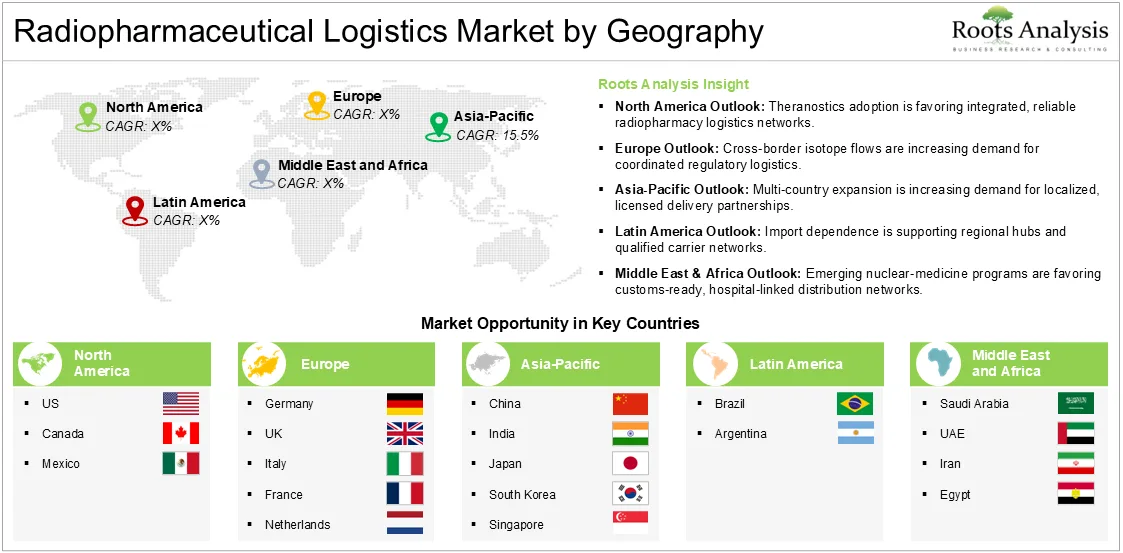
North America accounts for 39.0% of the radiopharmaceutical logistics market in 2026, supported by an established nuclear-medicine base and dense production, radiopharmacy and treatment infrastructure. Cardinal Health operates 130 nuclear pharmacies and 30 PET manufacturing facilities across the US, supporting recurring dose preparation and distribution over a broad clinical footprint. Novartis is also adding radioligand-therapy capacity near major patient markets. Together, this combination of mature clinical demand, distributed preparation capacity and established specialist delivery networks sustains North America's current revenue leadership.
Asia-Pacific is projected to record the fastest growth as nuclear-medicine utilization and regional supply capability expand simultaneously across Japan, Australia and Southeast Asia. For instance, Telix opened its first Asia-Pacific cyclotron facility in Yokohama in November 2025 and added an integrated Melbourne facility in July 2026. Meanwhile, Cyclotek's network supplies more than 150,000 patient doses annually across Australia and New Zealand and is also extending collaboration into Singapore. Together, these expansions demonstrate how distribution coverage is developing alongside clinical access across the region. Further, as the network develops from a smaller base, demand is rising for qualified local transport, reliable interfacility movements and specialist partnerships able to connect expanding radiopharmaceutical infrastructure with geographically dispersed clinical sites.
Transportation and courier services capture more than 40% of the current radiopharmaceutical logistics market, supported by their role across every shipment stage, from origin collection and principal line-haul to final delivery. The segment's leadership is reinforced by recurring diagnostic distribution, short product half-lives and treatment schedules that require frequent, precisely timed movements. Current specialist logistics models use same-day, next-flight-out and dedicated final-mile services to limit delays and preserve the diagnostic or therapeutic utility of the shipment. These requirements make transportation and courier services the largest segment of the radiopharmaceutical logistics process.
Regulatory, customs and documentation services are expected to grow at a faster rate as international radiopharmaceutical movements become more complex. Shipments must comply simultaneously with radioactive-material transport rules and pharmaceutical-quality requirements, while licensing, packaging, carrier acceptance and customs procedures can vary across countries and transport hubs. The updated IAEA transport framework and current industry practices highlight the need for pre-release regulatory checks, importer and exporter support, audit-ready documentation and secure chain-of-custody records. As cross-border therapeutic and isotope movements expand, these activities are progressing from embedded administrative tasks toward specialized services that directly influence route feasibility, shipment release and delivery reliability.
Road transport holds maximum share of transportation and courier services revenue in the current year, primarily because radiopharmaceutical distribution remains concentrated within local and regional delivery catchments. High-frequency movements between radiopharmacies, production facilities, hospitals and imaging centres are generally completed by road, particularly where multiple doses must be delivered across repeat clinical routes. Siemens Healthineers Radiopharma, for instance, distributes more than 2.1 million PET doses annually to over 3,000 imaging centres through its radiopharmacy network, illustrating the recurring regional shipment volumes that underpin ground transportation demand.
Air freight mode is poised to experience faster pace of growth during the forecast period, driven by the increasing movement of medical isotopes, precursors, manufacturing intermediates and finished radiopharmaceuticals between geographically separated production and treatment markets. In fact, World Courier's coordination of airlines, ground teams, radiopharmacies and hospitals across cross-border shipments demonstrates the central role of airline-haul in connecting these supply-chain stages. As international and long-distance movements form a larger share of shipment activity, the market is shifting towards integrated air-ground networks that combine Class 7 air capacity with compliant airport transfers and dependable collection and final delivery.
Standard / scheduled transportation holds the maximum share of transportation and courier services market size in 2026, reflecting the large volume of radiopharmaceutical doses supplied through recurring, pre-planned radiopharmacy and diagnostic-dose distribution. Jubilant Radiopharma's US radiopharmacy business supplies diagnostic and therapeutic unit doses to nuclear-medicine departments serving nearly four million patients annually. This predictable workload allows shipment consolidation, vehicles, drivers and receiving windows to be planned across a regular service schedule. Such route density improves fleet utilization and spreads compliance and handling costs across recurring deliveries, supporting the current dominance of scheduled transportation.
Time-critical / just-in-time transportation is gaining share at the fastest pace as more customers require expedited dispatch, recovery movements and delivery commitments that cannot be absorbed within standard route cycles. For instance, Marken offers distinct same-day, next-flight-out and white-glove final-mile services for radiopharmaceutical and nuclear-medicine shipments across more than 220 countries and territories, demonstrating the commercialization of dedicated urgent-service tiers. These movements typically require immediate carrier access, reserved operational capacity and higher-touch coordination, reducing opportunities for route consolidation and increasing service costs. The shift raises the value of providers with documented response times, broad urgent-delivery coverage and the capacity to accept unplanned or recovery shipments without disrupting scheduled operations.
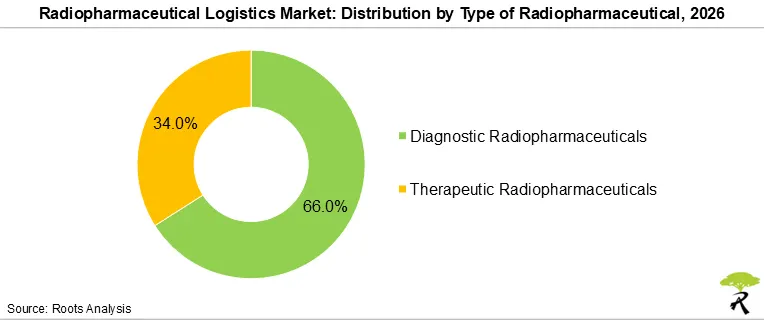
Diagnostic radiopharmaceutical logistics dominate the current global market, supported by the recurring use of PET and SPECT products across oncology, cardiology, neurology and other imaging pathways. Curium reports that its diagnostic portfolio serves approximately 14 million patients annually through a vertically integrated manufacturing and distribution network, illustrating the scale of repeat dose preparation and delivery generated by established nuclear-medicine practice. This broad utilization creates dense, recurring logistics flows across radiopharmacies, imaging centres and hospitals, making diagnostic products the largest current revenue base for transport, dispensing coordination and final delivery.
Therapeutic radiopharmaceutical logistics is projected to expand most rapidly as commercial and clinical programs broaden across beta- and alpha-emitting radionuclides. Cardinal Health quadrupled its weekly Ac-225 output after establishing routine production, while Curium announced a new European production line for Lu-177 PSMA therapy in June 2026. These investments indicate a widening therapeutic payload mix and more frequent movement of isotopes, intermediates and finished doses through specialized networks. The logistics opportunity arises from the greater service intensity associated with controlled release, isotope-specific handling, documentation and treatment-site supply, rather than from assuming that therapeutic product growth translates mechanically into logistics revenue.
Ambient / controlled room temperature logistics hold the largest market share of 52.0% in the current year, as a broad range of diagnostic and therapeutic radiopharmaceuticals can be transported within validated room-temperature conditions. Fludeoxyglucose F 18 Injection is stored at controlled room temperature, while the LUTATHERA (targeted radiopharmaceutical, developed by Novartis) label specifies storage below 25°C and prohibits freezing. The applicability of these conditions across widely distributed products creates a large shipment base that can be served through qualified ambient packaging and monitoring systems. Although radiation shielding, timing and chain-of-custody controls remain essential, the limited need for active refrigerated or frozen infrastructure supports the segment's current leadership.
Ultra-low temperature / cryogenic logistics segment is projected to register a higher CAGR till 2035. This faster pace is driven by the widening pipeline of complex therapeutics, investigational materials and specialized radiopharmaceutical products that require more tightly controlled storage, qualified thermal packaging and intensive excursion management. NorthStar's current radiopharmaceutical CDMO platform supports Phase I-III clinical manufacturing, dedicated logistics operations and Type A shipping with cold-chain capabilities, demonstrating how temperature-control requirements are being incorporated earlier into emerging product supply chains. As these programs progress, demand will rise for multitemperature qualification, calibrated monitoring and specialist handling, widening the capability gap between general radiopharmaceutical carriers and providers equipped to manage the most demanding temperature bands.
The use of predictive analytics and digital twins in healthcare supply chain is improving radiopharmaceutical logistics planning by allowing providers to test operational scenarios before dispatching. In March 2026, World Courier identified digital twins as relevant to highly regulated radiopharmaceutical supply chains because virtual network models can test assumptions and anticipate disruption before a shipment moves. Applied operationally, these tools could model authorization lead times, carrier restrictions, packaging endurance, alternative lanes, disruption exposure and capacity requirements. The capability is not yet established as a market-wide standard, but it could differentiate providers through predictive route qualification, risk-adjusted capacity reservation and stronger contingency economics. Technology suppliers may participate through platforms embedded within externally billed logistics services.
The study examines externally provided logistics services supporting medical radiopharmaceuticals and medical isotopes, including transportation, storage, packaging, monitoring, documentation and specialized handling. The analysis uses the proprietary Roots Analysis research framework, supported by proprietary databases repositories, company disclosures, regulatory publications, product information, industry literature and secondary sources. Market estimates and forecasts were tested against company activity, infrastructure development, commercialization trends, outsourcing patterns and operational and regulatory risks. For further details, see the complete research methodology adopted by Roots Analysis across its market reports.
| Key Report Attributes | Details | |
| Historical Trends | Since 2022 | |
| Forecast Period | Till 2035 | |
| Market Size 2026 | USD 1.10 Billion | |
| Market Size 2035 | USD 3.13 Billion | |
| CAGR (till 2035) | 12.31% | |
| Forecasted Regions |
|
|
| Key Companies Profiled |
|
|
| PowerPoint Presentation (Complimentary) |
|
|
| Customization Scope |
|
|
| Excel Data Packs (Complimentary) |
|
|