


 Download Free Sample
 Buy Now
Market Size
The global rapid microbiology testing solutions market, valued at USD 560 million in 2025, is projected to reach USD 603 million in 2026 and USD 1,463 million by 2035, representing a 10.3% CAGR during the forecast period 2026 to 2035.

See What’s in the Full Report – Request Your Complimentary Insights!
Market Report: Key Takeaways
- In terms of type of modality, biologics are likely to capture the highest (62%) share in the overall rapid microbiology testing solutions market. This is due to the fact that large-molecule production involves significant complexity and high contamination risks, requiring comprehensive biologics safety testing throughout the manufacturing process.
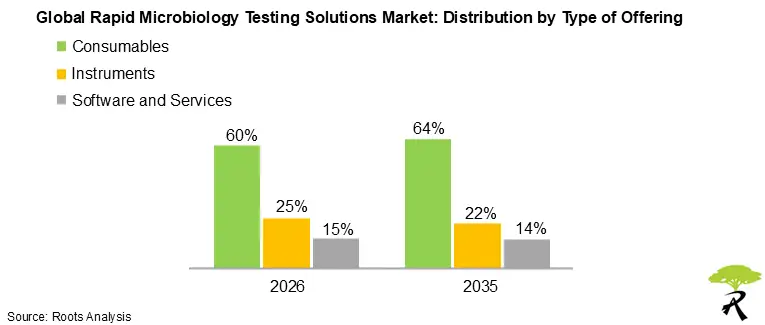
- In terms of type of offering, consumables dominate (60%) the rapid microbiology testing solutions domain. This is driven by the recurring requirement for standardized reagents and the rising volume of routine microbial testing across manufacturing workflows.
- In terms of type of instrument, the automated detection systems secure the majority share (35%) by revenue, owing to their ability to enable faster sample processing and reduce the risk of human error compared to manual testing methods.
- In terms of method of testing, the growth-based methods are likely to capture the majority (32%) of the revenue share, as these techniques offer a validated and highly sensitive alternative to traditional compendial methods for detecting viable organisms.
- In terms of application, sterility testing captures the majority (36%) share of the market, primarily due to its widespread use in ensuring the safety and quality of sterile pharmaceutical products prior to release.
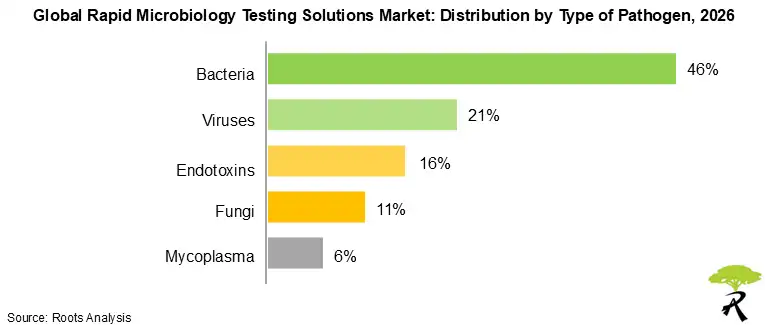
- In terms of type of pathogen, bacteria testing (46%) dominates the global market, driven by the high prevalence of bacterial contamination risks in pharmaceutical manufacturing environments and routine quality control workflows.
- In terms of geographical regions, North America holds about ~40% share in 2026, due to its well-established pharmaceutical manufacturing infrastructure, supportive regulatory framework, and significant investments in pharmaceutical research and development.
Want Information on Specific Region / Segment?
Market Overview
Microbiological testing represents a critical element of pharmaceutical product quality control, aimed at ensuring product safety, purity, and regulatory compliance prior to market release. However, conventional microbiology testing lab methods are inherently time intensive, often leading to prolonged batch release timelines and operational inefficiencies across pharmaceutical manufacturing workflows.
Rapid microbiological testing solutions have emerged as an effective alternative by enabling more reliable and rapid microbial detection of contamination during product testing. These solutions are increasingly adopted across small molecule drugs, biologics, and radiopharmaceuticals, where sterility testing, bioburden assessment, and microbial limit testing are essential to meet stringent regulatory requirements.
Despite challenges related to method validation and initial implementation costs, growing regulatory acceptance and the rising production of complex pharmaceutical products are accelerating adoption of rapid microbiological testing solutions. Consequently, the rapid microbiology testing solutions market is poised to witness healthy growth in the foreseen future.
Recent Developments
- In October 2025, Lonza acquired Redberry, an innovative company offering rapid microbiology testing solutions through solid-phase cytometry (SPC) technology.
- In August 2025, Rapid Micro Biosystems raised USD 45 million via debt financing through a five-year term loan facility with Trinity Capital. The company intended to utilize the proceeds to support the global commercial expansion of its Growth Direct® system and invest in manufacturing efficiencies.
- In August 2025, bioMérieux extended its collaboration with Moderna by entering into a product utilization agreement, which involves the installation of its BACT/ALERT® and VITEK® MS systems across Moderna’s global manufacturing sites.
Rapid Microbiology Testing Solutions Market Trends
- Partnerships and Collaborations: The rapid microbiology testing solution providers have forged several partnerships with other stakeholders in order to enhance their product portfolios. The is indicative of the growing preference for rapid turnaround times in pharmaceutical quality control. This trend was particularly evident in 2025, with solution providers signing a number of agreements; examples include the research and development agreement signed between Symcel and Johnson & Johnson (September 2025), and the distribution agreement signed between Rapid Micro Biosystems and Merck KGaA (February 2025).
- Increasing Adoption of Automation and Digital Integration: The rapid microbiology testing solutions industry is witnessing a growing shift towards automated and digitally integrated testing platforms. Manufacturers are increasingly adopting systems that combine automated sample handling, incubation, and rapid microbial detection, in order to improve testing consistency and reduce manual intervention. This trend is particularly evident in high-throughput pharmaceutical manufacturing environments, where automation supports standardized workflows, minimizes operator-dependent variability, and enables seamless integration with laboratory information management systems (LIMS).
Highlighting this trend, Diwakar Sharma, Country Head (Industrial Applications) at bioMérieux, stated that "Rapid microbial methods are transforming QC by combining speed, precision, and reliability." He further explained that "A truly modern QC workflow must bring time, traceability and teamwork together through digital integration." Moreover, he emphasized the evolving role of technology by stating that "Automation will handle repetitive tasks like sampling, testing, and documentation, freeing teams to focus on analysis and decision-making."
- Rising Adoption of Rapid Methods for Advanced Therapies: The expanding development and commercialization of biologics, increasing complexity of cell and gene therapy manufacturing, is driving increased adoption of rapid microbiology testing solutions. These products are characterized by shorter shelf lives, higher sensitivity to contamination, and complex manufacturing processes, which necessitate faster and more frequent microbiological testing. As a result, pharmaceutical manufacturer / microbiology testing lab is increasingly integrating rapid microbiology testing solutions to support timely quality decisions and maintain production continuity for advanced therapy products.
Your Business is Unique – Why Shouldn’t Your Report Be?
Industry Experts on Rapid Microbiology Testing Market
The increasing complexity of modern drug pipelines is creating an urgent requirement for rapid quality control in pharmaceutical manufacturing. Stacey Ramsey (Senior Manager, Microbial Applications Lab at Charles River Laboratories), highlights this transition, stating: “The pharmaceutical market is also tackling more challenging therapies than it targeted before, including orphan diseases, rare cancers, and infections previously thought to be untreatable. Herein lies a new challenge: for these therapies to succeed, quality control can no longer take 14 days. Rapid microbial methods (RMMs) are no longer a luxury but a necessity.”
Discussions with multiple stakeholders in this domain influenced the opinions and insights presented in this study. The rapid microbiology testing solutions market report includes detailed transcripts of interviews conducted with the following individuals:
- Founder and Managing Director, Small Organization, Germany
- Chief Operating Officer and Chief Financial Officer, Small Organization, Switzerland
- Senior Vice President of Sales, Small Organization, United States
- Head of Business Development, Small Organization, Canada
- Technical Sales & Marketing Coordinator, Small Organization, United Kingdom
- Founder and Chief Operating Officer, Small Organization, Netherlands
In addition, the market report includes transcripts of the following other third-party discussions:
- President, Small Organization, United States
- Senior Manager, Very Large Organization, United States
- Microbiology Supervisor, General Manager, Very Large Organization, United Kingdom
- Global Subject Matter Expert - Testing Solutions, Very Large Organization, Switzerland
- Senior Commercial Applications Expert, Very Large Organization, United States
- Manager, Global Product Management, Very Large Organization, Germany
- Country Head: Industrial Application, Very Large Organization, France
Market Drivers
- Rising Regulatory Support and Acceptance: Regulatory authorities across key pharmaceutical markets have increasingly supported the adoption of rapid microbiological testing solutions for product testing applications. Recently, in August 2025, the United States Pharmacopeia (USP) officially implemented General Chapters <72> and <73>, which establish the compendial framework for respiration-based and ATP-bioluminescence rapid methods. The growing acceptance of these methods for use within regulated quality control environments is reducing implementation-related concerns and encouraging pharmaceutical manufacturers to integrate rapid testing solutions into routine microbiological workflows.
- Increasing Demand for Faster Turnaround Times: Conventional microbiological testing methods are associated with extended incubation timelines, which delay batch disposition and increase inventory holding periods. The growing need to accelerate product release timelines, particularly for time-sensitive pharmaceutical products, is driving the adoption of rapid microbiology testing solutions that enable faster microbiological assessment.
- Technological Advancements in Testing Solutions: Technological advancements in detection systems, automation, and analytical capabilities have improved the reliability and performance of rapid microbiology testing solutions. Key innovations include the adoption of Matrix-Assisted Laser Desorption / Ionization Time-of-Flight (MALDI-TOF) mass spectrometry for rapid microbial identification and digital PCR (dPCR) for rapid sterility testing for cell and gene therapies that reduces results turnaround from weeks to hours. These advancements enable earlier detection of microbial contamination and support efficient testing workflows, thereby contributing to the growth of the rapid microbiology testing solutions industry.
Market Segmentation Analysis
Consumables to Drive the Rapid Microbiology Testing Market
- According to the rapid microbiology testing solutions market analysis, consumables hold the majority (60%) share of the market in 2026. This dominance is attributed to the recurring demand for reagents, kits, and test-specific consumables required for microbiological testing across pharmaceutical manufacturing workflows.
- In the foreseen future, consumables are also likely to witness the highest CAGR, showcasing substantial growth potential during the forecast period.
Automated Detection Systems Lead the Instrument Market
- Based on the rapid microbiology testing solutions market forecast, automated detection systems account for the largest share of the overall instruments market in 2026. The widespread adoption of these systems is primarily driven by their ability to deliver standardized results, reduce manual intervention, and support high-throughput microbiological testing in regulated pharmaceutical environments.
- Solid phase / flow cytometers are expected to witness higher growth during the forecast period. This anticipated growth can be attributed to their increasing applicability in advanced pharmaceutical testing workflows, where enhanced sensitivity and early-stage microbial detection are becoming increasingly crucial.
Growth-Based Methods Propelling Innovations in the Rapid Microbiology Testing Solutions Market
- Growth-based methods represent the largest rapid microbiology testing solutions market share in 2026. This is primarily due to their widespread adoption in pharmaceutical quality control, where rapid growth-based technologies enable earlier detection of microbial contamination while maintaining alignment with established microbiological principles.
- Viability-based methods are expected to witness higher growth during the forecast period, owing to their ability to deliver real-time microbial viability data.
Market Regional Insights
North America Dominates the Market
In 2035, North America is likely to have high rapid microbiology testing solutions market size, capturing around 40% of the overall market share. This dominance is attributed to the presence of a well-established pharmaceutical manufacturing base, early adoption of advanced quality control technologies, and a supportive regulatory environment that encourages the integration of rapid microbiological testing solutions.
Rapid Microbiology Testing Solutions Adoption in the Asia Pacific Region
The market in Asia-Pacific is expected to witness the highest CAGR (12.6%) during the forecast period. This growth is primarily driven by the rapid expansion of pharmaceutical manufacturing capacity, increasing investments in quality control infrastructure, and the growing presence of pharmaceutical and biotechnology companies across emerging economies in the region. For instance, Thermo Fisher Scientific recently launched a new Bioprocess Design Center in Hyderabad, India, while simultaneously expanding its existing centers in Singapore and South Korea. Such targeted expansions are anticipated to strengthen regional quality control capabilities, facilitating the widespread adoption of rapid testing solutions across the Asia-Pacific region.
Get an Instant Quote in 10 Minutes. Lowest Price Guaranteed
Rapid Microbiology Testing Solutions Market: Scope of the Report
| Key Report Attributes | Details | |
| Historical Trend | Since 2021 | |
| Forecast Period | Till 2035 | |
| Market Size 2026 | USD 603 Million | |
| Market Size 2035 | USD 1,463 Million | |
| CAGR (Till 2035) | 10.3% | |
| Key Players Profiled |
(A complete list of companies captured is available in the report) |
|
| Segments Covered |
|
|
| Excel Data Packs (Complimentary) |
|
|
| PowerPoint Presentation (Complimentary) |
Available | |
| Customization Scope | 15% Free Customization | |
Market Segments
Based on the research, we have segmented the Rapid Microbiology Testing Market into type of modality, type of offering, type of instrument, method of testing, type of pathogen, application area, end user and geographical regions.
By Type of Modality
- Biologics (Monoclonal Antibodies, Vaccines, Cell and Gene Therapies, and Other Biologics)
- Small Molecules
- Radiopharmaceuticals
By Type of Offering
- Consumables
- Instruments
- Software and Services
By Type of Instrument
- Automated Detection Systems
- PCR Instruments
- Mass Spectrometers
- Solid Phase Cytometers / Flow Cytometers
- Other Instruments
By Method of Testing
- Growth-based Methods
- Nucleic Acid-based Methods,
- Cellular Component-based Methods
- Viability-based Methods
- Immunological Methods
- Microfluidic Methods
- Other Methods
By Type of Pathogen
- Bacteria
- Viruses
- Fungi
- Endotoxins
- Mycoplasma
By Application
- Bioburden Testing
- Sterility Testing
- Microbial Identification
- Endotoxin Testing
- Mycoplasma Testing
By End User
- Drug Developers
- Contract Manufacturers
By Geographical Regions
- North America
- US
- Canada
- Europe
- Germany
- UK
- France
- Italy
- Spain
- Rest of Europe
- Asia-Pacific
- China
- Japan
- India
- South Korea
- Rest of Asia-Pacific
- Middle East and North Africa
- Saudi Arabia
- UAE
- Iran
- Rest of Middle East and North Africa
- Latin America
- Brazil
- Argentina
- Rest of Latin America


