Market Outlook
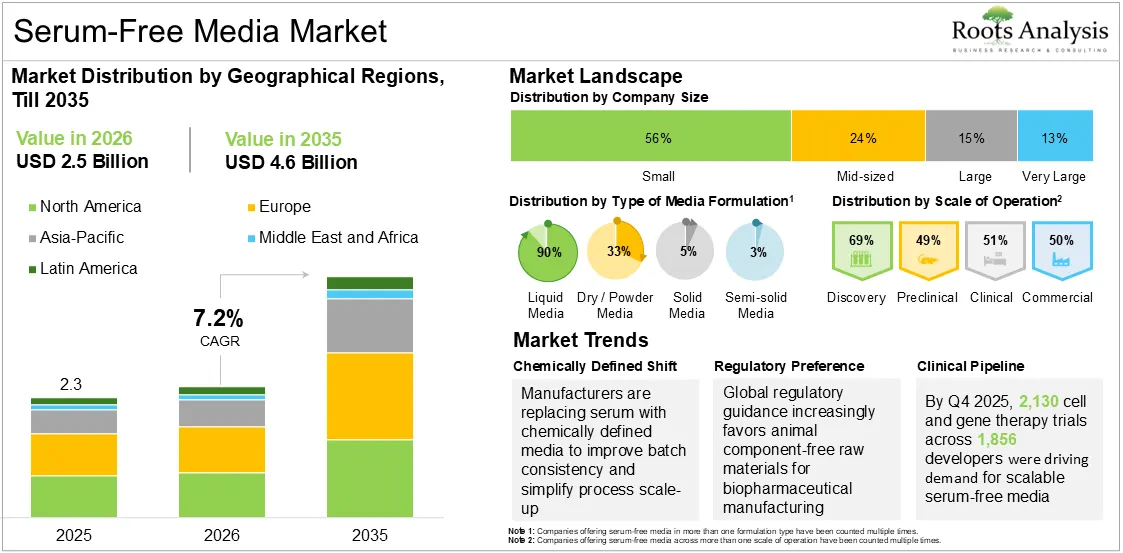
The global serum-free media market, valued at USD 2.3 billion in 2025, is projected to reach USD 2.5 billion in 2026 and USD 4.6 billion by 2035, representing a CAGR of 7.2% during the forecast period from 2026 to 2035.
To learn more about this report, request a free sample copy
Market Report: Key Takeaways
Market Size & Trends
- Based on type of serum-free media, CHO media captures the largest share of the current market.
- Based on state of media, liquid media accounts for the majority share of the serum-free media market.
- With respect to manufacturing model, in-house manufacturing captures the largest share of the current market.
- Amongst the type of outsourced media, off-the-shelf media accounts for the highest share of the serum-free media market.
- Amongst the expression systems, mammalian expression systems capture the highest share of the current market.
- Based on scale of operation, commercial scale accounts for the largest share of the serum-free media market.
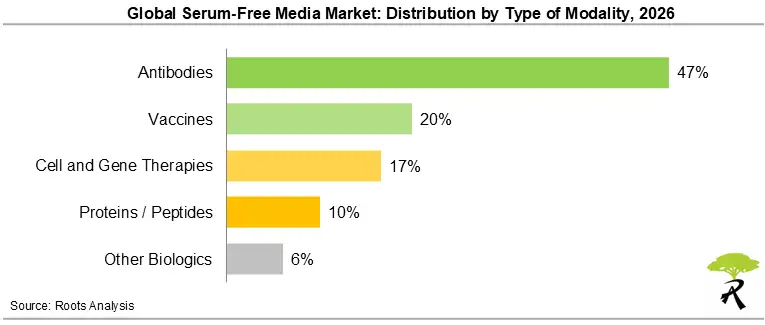
- With respect to type of modality, antibodies dominate the current market, accounting for more than 45% of the overall revenue.
- Based on application area, the therapeutics segment captures the largest share of the current market.
- In terms of therapeutic area, oncological disorders account for the largest share of the serum-free media market.
- Based on end user, industry players account for the largest share of the serum-free media market.
- In terms of type of industry player, drug developers capture the largest share of the current market.
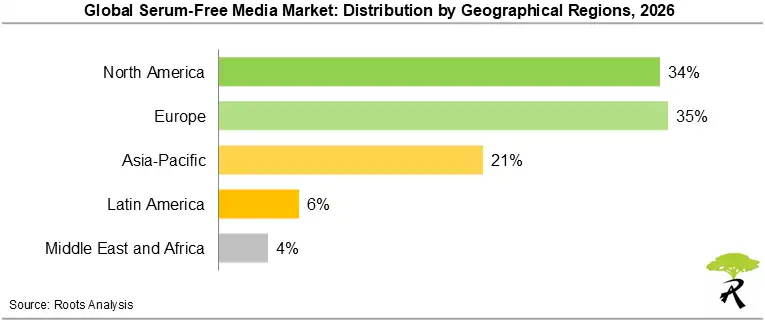
- Based on geographical regions, Europe currently holds the highest market share, accounting for 35% of the overall market.
Key Market Statistics
- Market Size in 2026: $ 2.5 billion
- Estimated Market Size in 2035: $ 4.6 billion
- CAGR (2026-2035): 7.2%
- Europe: Largest market in 2026
- Asia-Pacific: Fastest growing region
Market Introduction
Cell culture media provides the nutrients and components required to grow cells for the production of antibodies, vaccines, recombinant proteins, cell and gene therapies and other biologics. Historically, many processes relied on animal serum as a source of growth factors, hormones, lipids and carrier proteins. However, its undefined composition can introduce batch-to-batch variability, contamination risks and additional purification requirements. These limitations are encouraging researchers and manufacturers to shift towards serum-free media that offers greater control over culture conditions.
Serum-free media replaces serum with nutrients, proteins, lipids and growth factors formulated for specific cell types and production objectives. Chemically defined and animal-origin-free variants provide further control over raw-material composition and traceability. Suppliers offer these media in liquid, powdered and concentrated formats for CHO, BHK, NS0, Sp2/0 and other cell systems, supporting research, clinical development and commercial manufacturing.
This widespread integration is directly propelled by the rapid influx of complex biologics advancing through clinical and commercial pipelines. With the US Food and Drug Administration approving 12 novel biologics and 18 biosimilars in 2025, biomanufacturers face a strict mandate to utilize robust, animal component-free media to guarantee safety, traceability, and regulatory compliance. In response, suppliers are expanding their off-the-shelf portfolios while developing custom formulations tailored for antibodies, recombinant proteins, vaccines, viral vectors and cell therapies.
However, replacing serum is not a direct substitution. Developers must adapt cell lines, optimize culture conditions and validate growth, viability and productivity across operating scales. As a result, suppliers increasingly compete through application-specific formulations, raw-material consistency, technical support and scale-up capabilities. Continued emphasis on reproducibility, regulatory control and reduced use of animal-derived components is expected to support market growth.
Key Serum-Free Media Companies: Product Portfolio and Application Focus
| Company |
YoE |
HQ |
Serum-Free Media Portfolio |
Primary Cell Type |
Application Area |
| Cytiva |
1968 |
US |
HyClone™ CHO media, including CCM5 CHO media |
CHO cells |
Recombinant protein and biopharmaceutical production |
| FUJIFILM Biosciences |
1970 |
US |
BalanCD™ CHO Growth A, PRIME-XV® media |
CHO cells, MSCs and immune cells |
Antibodies, recombinant proteins and cell therapy |
| Merck |
1668 |
Germany |
EX-CELL® CD CHO, EX-CELL® NS0 and related media |
CHO and NS0 cells |
Antibody and recombinant protein production |
| Sartorius |
1870 |
Germany |
PowerCHO™, ProCHO™, 4Cell® and CellGenix® media |
CHO cells and therapeutic immune cells |
Biologics and advanced therapy manufacturing |
| STEMCELL Technologies |
1993 |
Canada |
ImmunoCult™, MesenCult™ and TeSR™ media |
T cells, MSCs and pluripotent stem cells |
Cell therapy, regenerative medicine and research |
| Thermo Fisher Scientific |
2006 |
US |
Gibco™ CHO, hybridoma and CTS™ serum-free media |
CHO cells, hybridomas and immune cells |
Antibodies, recombinant proteins and cell therapies |
Abbreviations: YoE: Year of Establishment; HQ: Headquarters
Market Segmentation
Based on the research, we have segmented the serum-free media market into type of serum-free media, scale of operation, type of modality, expression system, end user, type of industry player, state of media, manufacturing model, type of outsourced media, application area, therapeutic area, geographical regions, and key players.
By Type of Serum-Free Media
- BHK Media, CHO Media, NS0 Media, Sp2/0 Media, Other Media
By State of Media
- Liquid Media, Semi-solid Media, Solid Media
By Manufacturing Model
By Type of Outsourced Media
- Off-the-Shelf Media, Custom Media
By Expression System
- Mammalian Expression Systems, Microbial Expression Systems, Other Expression Systems
By Scale of Operation
- Clinical Scale, Commercial Scale
By Type of Modality
- Antibodies, Vaccines, Cell and Gene Therapies, Proteins / Peptides, Other Biologics
By Application Area
- Diagnostics, Therapeutics
By Therapeutic Area
- Autoimmune and Inflammatory Disorders, Hematological Disorders, Metabolic Disorders, Oncological Disorders, Other Disorders
By End User
- Industry Players, Academic Players
By Type of Industry Player
- Contract Manufacturers, Drug Developers, Hybrid Players
By Geographical Regions
- North America, Europe, Asia-Pacific, Latin America, Middle East and Africa
Serum-Free Media Market Key Insights
What are the Key Drivers for Serum-Free Media Market Growth?
- Increasing Need for Raw-Material Control and Process Consistency: Serum can introduce variability in composition, material identity and contamination risk, creating challenges for processes that must deliver consistent cell growth and product quality across batches. Serum-free media allows manufacturers to use more controlled nutritional and hormonal formulations, improve raw-material traceability and simplify downstream purification. This is particularly important as biologics and advanced therapy developers prepare processes for clinical and commercial manufacturing. The US Food and Drug Administration has also highlighted adventitious-agent transmission, lot-to-lot consistency and material identity as key considerations when human- or animal-derived materials are used in cell and gene therapy manufacturing.
- Expansion of Application-Specific Cell Culture Workflows: Different cell lines and modalities require distinct combinations of nutrients, growth factors and supplements, increasing demand for specialized serum-free formulations rather than universal media products. Suppliers are developing solutions for CHO-based antibody production, vaccine and viral-vector manufacturing, stem-cell expansion and immune-cell therapies, while also offering custom media optimization. For instance, in May 2026, FUJIFILM Biosciences and NextCell Pharma launched a commercial platform combining umbilical-cord-derived stromal cells with PRIME-XV MSC Expansion XSFM, a serum-free medium intended to improve consistency and accessibility in regenerative medicine and cell therapy research.
What are the Main Challenges to Market Growth?
- Cell-Line Adaptation and Performance Validation Requirements: Transitioning from serum-containing to serum-free media is not a simple substitution, as each cell type requires specific nutrients, growth factors and culture conditions to maintain optimal growth and productivity. Manufacturers need to screen multiple serum-free formulations, gradually adapt cell lines and reoptimize feeding strategies before achieving performance comparable to existing processes. In addition, extensive validation is required to demonstrate consistent cell growth, product quality and process reproducibility. These activities increase development time, cost and technical complexity, discouraging some manufacturers from replacing validated serum-based workflows.
- Formulation Complexity and Scale-Up Constraints: High-performance serum-free media may contain large combinations of amino acids, vitamins, lipids, trace elements and recombinant proteins whose concentrations must remain stable during preparation, storage and bioreactor operation. A 2025 study noted that intensified media can contain 50 to 100 compounds, making experimental screening expensive and laborious, while concentrated nutrients may form precipitates that limit usable formulations. These challenges increase demand for specialized formulation expertise, high-purity raw materials and extensive stability testing, raising the cost of custom media development and complicating transfer from laboratory cultures to commercial-scale manufacturing.
Recent Developments in Serum-Free Media Market
- In July 2026, RoosterBio entered into a distribution agreement with Qkine to give US customers a single-source platform for cells, bioprocess media and animal origin-free growth factors. The partnership improves access to defined inputs used in stem cells, exosome and advanced therapy workflows.
- In July 2026, Qkine announced global distribution of Media City Scientific's FRS™ Pioneer, a chemically defined, animal-free fetal bovine serum replacement. The agreement broadens access to reproducible serum-replacement tools for routine cell culture in traditional basal media.
- In May 2026, RoosterBio and Made Scientific announced a strategic technology and supply partnership to integrate RoosterBio's MSC and extracellular vesicle platforms into Made Scientific's CDMO offering. The platform includes xeno-free MSC expansion media and chemically defined EV collection media for scalable advanced therapy manufacturing.
Industry Experts on Serum-Free Media Market
Driven by increasing regulatory expectations, translational research activity and the need for greater batch-to-batch consistency, the serum-free media market is shifting from basic serum replacement toward more defined and reproducible formulations.
Emphasizing this shift, Uri Lee (Chief Executive Officer, Xcell Therapeutics), stated, "The ideal media should be chemically defined, in which all components are known and defined. This allows them to mitigate risk of contamination, supply, and traceability issues. It also enables research to be highly reproducible, with a reduction in lot variation."
Discussions with multiple stakeholders in this domain influenced the opinions and insights presented in this study. The serum-free media market report includes detailed transcripts of the following third-party discussions:
- Chief Executive Officer, Mid-sized Company, South Korea
- Founder, Small Company, Switzerland
- Director of Scientific Affairs, Very Large Company, US
- Senior Product Manager; GMP Business Unit Lead, Mid-sized Company, Germany
- Senior Product Manager, Very Large Company, US
- Senior Product Manager, Cell Therapy, Large Company, US
- Innovation Manager, Very Large Company, Germany
- GMP Business Unit Lead; Regulatory Affairs Manager / Material Compliance, Mid-sized Company, Germany
- Team Leader, Research and Development, Mid-sized Company, Germany
- Senior Research Scientist, Very Large Company, US
Market Share Insights
Which Type of Serum-Free Media Accounts for the Largest Share in the Serum-Free Media Market?
- The CHO media segment occupies the largest share (65%) of the current market. This leadership is driven by the widespread use of CHO cells as the preferred expression system for manufacturing monoclonal antibodies and other recombinant biologics. CHO cells offer high protein expression, human-like post-translational modifications, scalability and a well-established regulatory track record, making them the platform of choice for commercial biologics production. As a result, demand for optimized CHO-specific serum-free media continues to grow across research, clinical development and large-scale commercial manufacturing.
- The NS0 media segment is projected to grow at a higher CAGR of 8.4% during the forecast period. This growth will primarily be due to the conversion of established GS-NS0 processes into serum-free or chemically defined formulations. NS0 cells have distinct cholesterol and nutrient requirements, making cell-line-specific optimization important for maintaining productivity and consistency while reducing serum-related variability.
Which Type of Modality Accounts for the Largest Share in the Serum-Free Media Market?
- The antibodies segment accounts for 47% of the current market. Antibody production consumes media repeatedly across inoculum expansion, seed trains and large-scale fed-batch bioreactors. Media performance also affects viable cell density, titer and critical quality attributes. Once a media-feed combination is qualified within a commercial process, changing it can require comparability and validation work, supporting sustained, high-volume demand.
- The cell and gene therapies segment is likely to grow at a relatively faster pace during the forecast period. Cell and gene therapy manufacturing often requires the proliferation of sensitive, donor-derived cells (while preserving phenotype, viability and potency) during which serum can introduce batch variability and complicate raw-material traceability. Developers therefore increasingly require serum-free, xeno-free and application-specific formulations for immune-cell expansion, stem-cell culture and viral-vector production as programs move toward standardized commercial manufacturing.
Regional Analysis: Which Regions are Leading the Serum-Free Media Market?
Europe: Dominating the Market by Securing Highest Share
According to our projections, Europe is likely to capture 35% of the serum-free media market in the current year. The region benefits from a concentrated base of biologics and advanced therapy manufacturers operating under stringent raw-material qualification requirements. For these companies, media are quality-critical inputs; changing a formulation or supplier can trigger process re-optimization, comparability studies and regulatory documentation. This favors suppliers offering GMP-grade products, formulation consistency, traceability and regional supply security. Notably, Sartorius is expanding cell culture media manufacturing capacity in Germany with additional powder-milling, cleanroom and storage infrastructure, indicating continued demand for reliable local supply.
Asia-Pacific: Emerging as the Fastest Growing Region
The market in Asia-Pacific is likely to grow at a relatively higher CAGR during the forecast period. This growth will be driven by the rapid expansion of biologics, biosimilar, vaccine and cell therapy manufacturing capacity across China, India, South Korea and Singapore. As regional manufacturers move from clinical-scale development to commercial production, they require larger and more consistent volumes of serum-free media for seed-train expansion, upstream processing and repeated manufacturing campaigns. This transition also increases the need for chemically defined formulations that reduce lot-to-lot variability, support reproducible technology transfer and meet the documentation standards required for regulated international markets. Additionally, continued investments by global biopharmaceutical companies and regional contract manufacturers in expanding mammalian cell and advanced therapy manufacturing capacity are expected to further reinforce this demand for both standardized and application-specific serum-free media.
Scope of Serum-Free Media Market Report
| Key Report Attribute |
Details |
| Historical Trend |
Since 2021 |
| Forecast Period |
Till 2035 |
| Market Size 2026 |
$ 2.5 billion |
| Market Size 2035 |
$ 4.6 billion |
| CAGR (Till 2035) |
7.2% |
| Segments Covered |
- Type of Serum-Free Media
- Scale of Operation
- Type of Modality
- Expression System
- End User
- Type of Industry Player
- State of Media
- Manufacturing Model
- Type of Outsourced Media
- Application Area
- Therapeutic Area
- Geographical Regions
|
| Key Players |
- Ajinomoto
- Cytiva
- HiMedia Laboratories
- Irvine Scientific (Acquired by Fujifilm)
- Lonza
- Merck
- Sartorius
- Thermo Fisher Scientific
(A complete list of players captured is available in the report) |
PowerPoint Presentation
(Complimentary) |
Available |
| Customization Scope |
15% Free Customization |
Excel Data Packs
(Complimentary) |
Available |
Frequently Asked Questions
What is serum-free media?
Serum-free media are cell culture formulations that support cell growth without animal serum. They improve raw-material control, reduce batch-to-batch variability and support more consistent biopharmaceutical research and manufacturing processes.What is the current size of the serum-free media market, and what are the forecasts till 2035?
The global serum-free media market is estimated to be valued at USD 2.5 billion in 2026 and is likely to reach USD 4.6 billion by 2035.What is the CAGR of the serum-free media market?
The serum-free media market is expected to grow at a CAGR of 7.2% during the forecast period from 2026 to 2035.What are the key growth drivers in the serum-free media market?
Key growth drivers include the expanding production of antibodies and other biologics, increasing demand for consistent and traceable cell culture inputs, reduced dependence on animal-derived components and growing adoption of application-specific media formulations.Which geographical region is emerging as a key market for serum-free media?
Currently, Europe holds the largest share, accounting for 35% of the serum-free media market. Asia-Pacific is anticipated to grow at a relatively faster pace during the forecast period.Who are the key players in the serum-free media market?
Ajinomoto, Cytiva, HiMedia Laboratories, Irvine Scientific, Lonza, Merck, Sartorius and Thermo Fisher Scientific are among the key players in the serum-free media market.