
Lowest Price Guaranteed
Pages
257
Last Updated
August 2026
View Count
5702
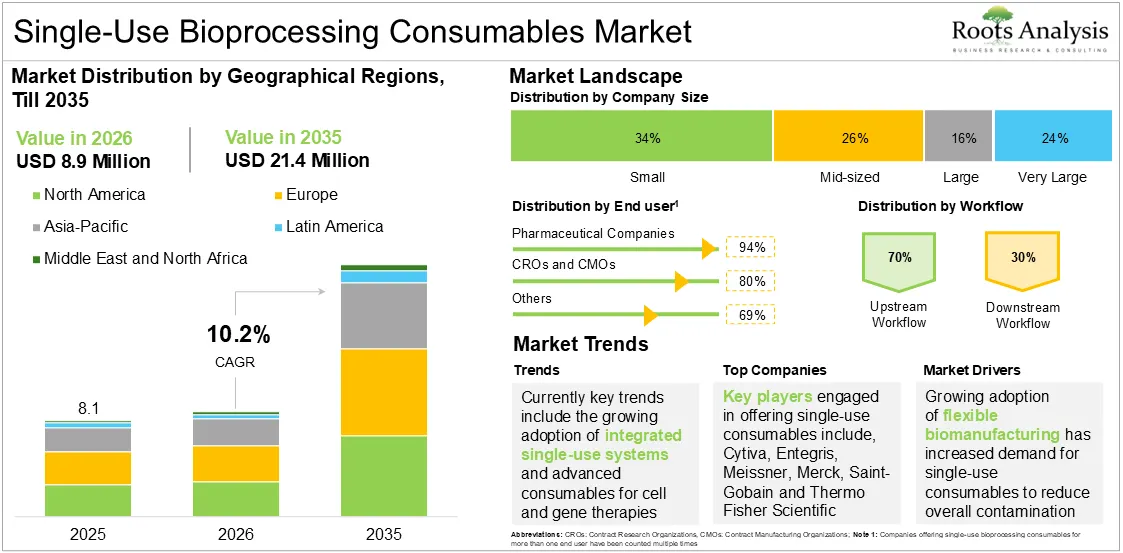
The global single-use bioprocessing consumables market, valued at USD 8.1 billion in 2025, is projected to reach USD 8.9 billion in 2026 and USD 21.4 billion by 2035, representing a CAGR of 10.2% during the forecast period from 2026 to 2035.
To learn more about this report, request a free sample copy
Biopharmaceutical manufacturing increasingly requires production systems that can accommodate multiple products, changing batch volumes and shorter development timelines. Single-use bioprocessing consumables, including bags, tubing, connectors, filters, sensors and sampling assemblies, support this flexibility by providing product-contact pathways that reduce cleaning requirements, lower cross-contamination risk and accelerate equipment changeovers.
Adoption is expanding as pharmaceutical companies, biotechnology firms and contract manufacturers increase production of monoclonal antibodies, vaccines, recombinant proteins and advanced therapies. Because many consumables are replaced after each manufacturing cycle, they generate recurring demand across upstream processing, downstream purification, media and buffer preparation, fluid transfer, storage and final formulation.
Recent capacity expansions demonstrate the growing commercial importance of the category. In June 2025, Sartorius expanded its Aubagne facility in France, nearly doubling its cleanroom space to approximately 9,000 m² and increasing capacity for single-use bags used in cell culture and storage. In April 2025, Thermo Fisher Scientific introduced the 5 L DynaDrive™ single-use bioreactor, extending a standardized reactor and film platform across scales of 1–5,000 L. Although the bioreactor is equipment, expansion of a standardized platform can increase recurring demand for compatible bags, films and fluid-path assemblies.
The market is also expected to benefit from modular manufacturing facilities, expanding biologics pipelines and greater use of intensified and continuous bioprocesses. Suppliers are developing more integrated and scalable portfolios; for example, Qosina added more than 250 products during the first half of 2025, including tubing, manifolds, bag ports, valves and connectors for medical and bioprocessing applications. Continued improvements in material compatibility, supply-chain traceability and standardized connection technologies are expected to strengthen the role of single-use consumables in commercial biomanufacturing.
| Consumable / Platform | Supplier | YoE | HQ | Core Consumables | Principal Applications | Commercial Relevance |
| Flexsafe® | Sartorius | 1870 | Germany | 2D and 3D bags | Liquid storage, shipping, and fluid management | Supports scalable closed liquid handling across process stages. |
| Thermo Scientific™ BioProcess Containers | Thermo Fisher Scientific | 2006 | US | Pre-sterilized containers and assemblies | Media and buffer preparation, storage, and transfer | Provides configurable containers for development and manufacturing workflows. |
| One-Touch® | Meissner | 1984 | US | Custom assemblies, bags, tubing, and connectors | Filtration and fluid transfer | Provides preconfigured fluid paths for regulated production environments. |
| WMArchitect™ | Watson-Marlow Fluid Technology Solutions | 1956 | UK | Engineered single-use fluid paths | Pumping, metering, and fluid transfer | Integrates flow-control equipment with customized disposable path design. |
Abbreviations: YoE: Year of Establishment, HQ: Headquarters
Based on the research, the single-use bioprocessing consumables market is segmented by workflow, type of modality, type of application, end user and geographical regions.
Driven by the increasing adoption of single-use technologies that offer greater manufacturing flexibility, reduced contamination risk, and lower cleaning and validation requirements, the single-use bioprocessing consumables market is poised for significant growth in the coming years.
Emphasizing this, Narayana Rao (Vice President, Avantor), stated that: "The shift to single-use products has allowed for benefits such as improved batch turnaround times, reduced risk of product cross-contamination, and greater sustainability with less water and steam being used than more traditional bioproduction methods. Single-use technologies are more flexible as well as quicker to set up at a lower cost than traditional stainless-steel equipment."
Discussions with multiple stakeholders in this domain influenced the opinions and insights presented in this study. The single-use bioprocessing consumables market report includes detailed transcripts of interviews conducted with the following individuals:
In addition, the market report includes transcripts of the following other third-party discussions:
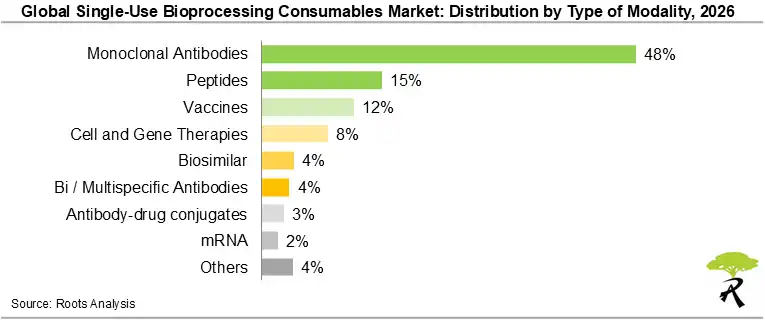
In 2026, the monoclonal antibodies segment accounts for the largest share, representing close to 50% of the single-use bioprocessing consumables market. Monoclonal antibodies are commonly produced using standardized mammalian cell-culture processes, particularly using CHO cell systems, which are compatible with scalable single-use bioreactors and associated fluid-management systems.
Each production batch requires disposable bioreactor bags, media- and buffer-preparation bags, tubing assemblies, sterile connectors, filters, sampling systems and storage containers, generating substantial recurring demand. In April 2025, AGC Biologics announced plans to install two 5,000-litre single-use bioreactors at its new Yokohama facility in Japan to support large-scale mammalian and monoclonal antibody manufacturing.
The mRNA segment is expected to register the highest CAGR, at 12.6%, during 2026–2035. Growth is supported by expansion of the mRNA pipeline beyond COVID-19 vaccines into personalized cancer vaccines, respiratory vaccines, rare-disease treatments and other therapeutic applications, increasing the number of clinical and commercial manufacturing campaigns.
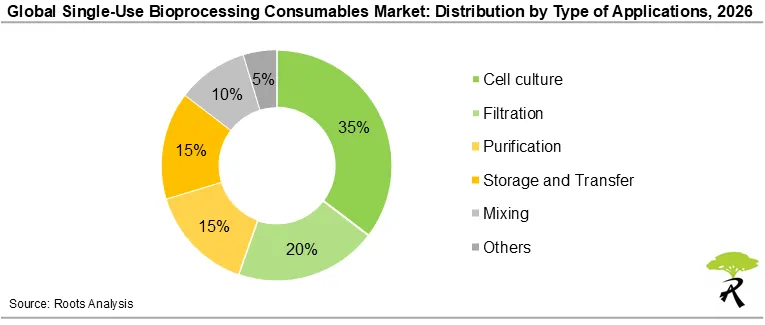
The cell culture segment accounts for the largest share of the market in 2026 and is also expected to register the highest CAGR during the forecast period. Cell culture is a consumable-intensive upstream operation used in the production of multiple biologic modalities.
The adoption of single-use bioreactors in cell-culture operations from process development through commercial manufacturing scales has increased the volume and value of consumables used per batch. Thermo Fisher Scientific's DynaDrive platform supports cell-culture operations across capacities ranging from 5–5,000 litres, while Sartorius' Flexsafe STR systems integrate disposable bags, sensors, tubing and sterile connectors within a single cell-culture assembly.
Europe is projected to account for the largest share, approximately 35%, of the single-use bioprocessing consumables market in 2026. This position reflects the region's concentration of biologics manufacturers, vaccine developers and CDMOs across Germany, Switzerland, Denmark, France, Ireland and Belgium. Their multiproduct facilities generate recurring demand for bags, tubing, filters, connectors and fluid-transfer assemblies.
Asia-Pacific is expected to be the fastest-growing regional market through 2035. Growth is supported by expansion of biologics, biosimilars, vaccines and advanced-therapy manufacturing capacity across China, India, Japan, South Korea and Singapore. For instance, Singapore reports more than 60 biopharmaceutical manufacturing plants, including facilities producing biologics, cell therapies and antibody-drug conjugates.
The report profiles Cytiva, Entegris, Meissner, Merck, Saint-Gobain, Sartorius, Thermo Fisher Scientific, and Watson-Marlow Fluid Technology Solutions.
Alongside the core market report, purchasers receive complimentary Excel data packs covering the single-use bioprocessing consumables market landscape, company competitiveness analysis, recent developments, and market sizing and opportunity analysis. A complimentary PowerPoint presentation summarizing the full report is also included, and 15% free customization scope is available on request.
This report was authored by Tanvi Chadha, a member of Roots Analysis' healthcare and pharmaceutical research practice. Her work focuses on competitive intelligence, company benchmarking and market forecasting.
Roots Analysis is an independent secondary and primary market research publisher. This report is not affiliated with, endorsed by, or produced on behalf of any company named or profiled within it, including all key players and industry expert interviewees referenced above.
Roots Analysis' findings draw on a combination of secondary research and primary interviews with industry experts, of the kind referenced above, to validate market sizing, segment shares, and forecast assumptions independently of any single company's disclosures.