report-pricing-dollar

Single-Use Bioprocessing Equipment Market Size, Share and Growth Trend Analysis Report By Region and Segmentation Forecasts (2026 - 2035)

Single-Use Bioprocessing Equipment Market by Workflow (Upstream Bioprocessing and Downstream Bioprocessing), Type of Modality (Monoclonal Antibodies, Peptides, Vaccines, Cell and Gene Therapies, Biosimilars, Bi-/Multispecific Antibodies, Antibody-drug Conjugates, mRNA and Others), Type of Application (Cell Culture, Filtration, Purification, Storage and Transfer, Mixing and Others), End User and Geographical Regions - Trends and Forecast, 2026-2035

  • Lowest Price Guaranteed

  • Pages
    221

  • Last Updated
    August 2026

  • View Count
    3128

Market Outlook

The global single-use bioprocessing equipment market, valued at USD 4.2 billion in 2025, is projected to reach USD 4.5 billion in 2026 and USD 9.5 billion by 2035, representing a CAGR of 8.7% during the forecast period from 2026 to 2035.
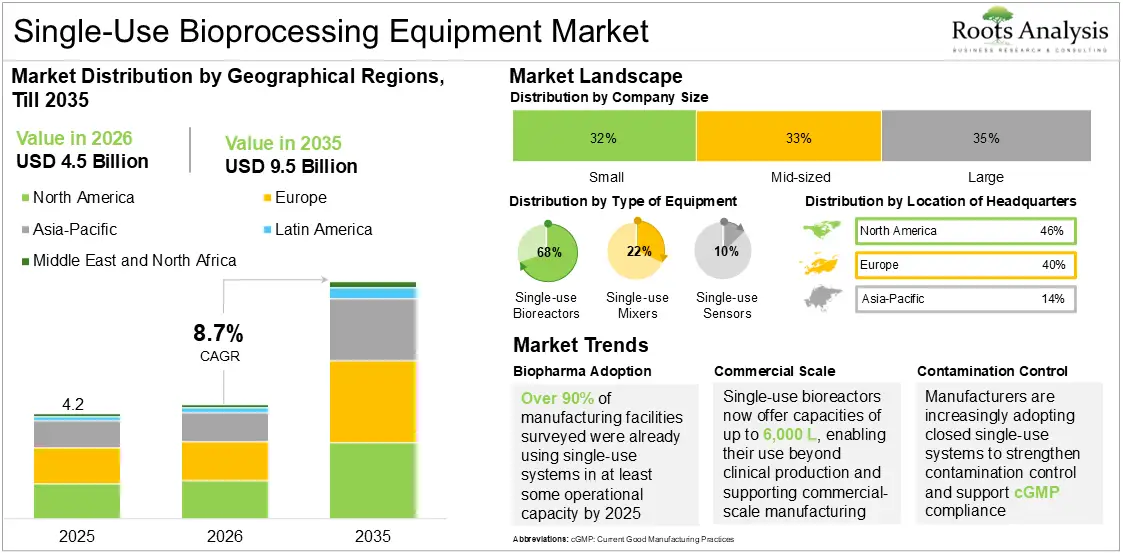
Single-Use Bioprocessing Equipment Market Growth, 2025 to 2035

To learn more about this report, request a free sample copy
Market Report: Key Takeaways

Market Size and Trends

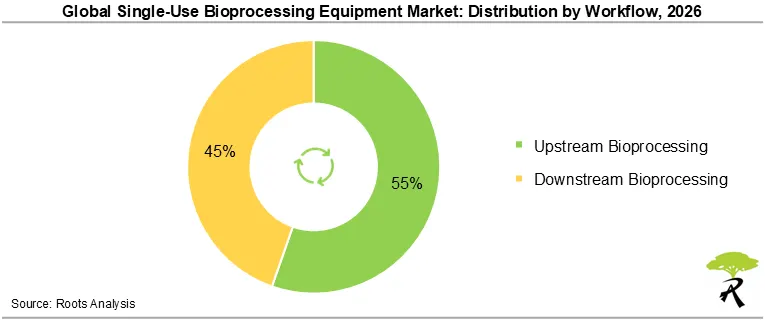
  • By workflow, upstream bioprocessing accounts for the largest share, accounting for 55% of the current market.
  • By modality, monoclonal antibodies currently represent the leading segment.
  • By application, cell culture accounts for the largest share, representing 35% of the current single-use bioprocessing equipment market.
  • By end user, pharmaceutical and biopharmaceutical companies currently constitute the leading segment.
  • By region, Europe currently accounts for the largest market share.
Global Single-Use Bioprocessing Equipment Market Share by Workflow, 2026

Key Market Statistics

  • Market Size in 2026: $ 4.5 billion
  • Estimated Market Size in 2035: $ 9.5 billion
  • CAGR (2026-2035): 8.7%
  • Europe: Largest market in 2026
  • Asia-Pacific: Fastest growing region

Market Introduction

Single-use bioprocessing equipment comprises pre-sterilized and disposable product-contact systems used for the manufacturing of biologics. These include single-use bioreactors, mixers, bags, filtration devices, transfer assemblies, storage systems, connectors, sensors and associated control equipment. This equipment supports cell culture, purification, fluid transfer and other upstream and downstream operations undertaken by pharmaceutical companies, biopharmaceutical developers and contract manufacturers.

Demand has strengthened as biologics manufacturers seek capacity that can be installed, qualified and reconfigured more rapidly than conventional stainless-steel infrastructure. BioPhorum reported that global bioreactor capacity more than doubled over the previous five years, while productivity improvements created a five- to tenfold increase in demand for consumables, cell-culture media, media supplements and other raw materials. Consequently, each production campaign generates recurring demand for bags, tubing, filters and assemblies.

Product development is advancing toward larger single-use scales, intensified cultures and digitally connected equipment. In April 2026, Cytiva and Rockwell Automation introduced the Figurate automation platform to connect equipment from multiple vendors and support processes from development through commercial manufacturing without redesigning the control architecture. Such interoperability can reduce technology-transfer work and improve equipment utilization in multi-product facilities.

Adoption also depends on reliable container integrity, material compatibility, sterilization capacity and supplier change control. ICH Q13 highlights the need for appropriate control strategies where single-use connections and components may create contamination risks. Manufacturers must therefore balance deployment speed with extractables assessment, integrity testing, supply continuity and waste-management requirements. Continued investment in biologics manufacturing and improvements in equipment performance are expected to support further market expansion.

Key Single-Use Bioreactor Platforms

Platform Provider YoE HQ Volume Range Application
Xcellerex X-platform Cytiva 1968 US 50 L and 200 L Fed-batch and perfusion cell culture
DynaDrive Single-Use Bioreactor Thermo Fisher Scientific 2006 US 5 L to 5,000 L Pilot and commercial mammalian cell culture
BIOSTAT STR Sartorius 1870 Germany 12.5 L to 2,000 L Batch, fed-batch and intensified processing
Mobius iFlex Bioreactor Merck 1668 Germany 50 L to 2,000 L Fed-batch and perfusion processes
Custom Single Run Bioreactor ABEC 1974 US 50 L to 6,000 L Large-scale biologics manufacturing
BioBLU c Single-Use Bioreactors Eppendorf 1945 Germany 0.1 L to 40 L Process development and cell expansion
Vertical-Wheel Bioreactor PBS Biotech 2006 US 0.1 L to 80 L Cell therapy and shear-sensitive cultures
BIOne Single-Use Bioreactor Distek 1976 US 10 L Process development and scale-down modeling

Abbreviations: YoE: Year of Establishment; HQ: Headquarters

Market Segmentation

Based on the research, the single-use bioprocessing equipment market is segmented by workflow, type of modality, type of application, end user and geographical regions.

By Workflow

  • Upstream Bioprocessing and Downstream Bioprocessing

By Type of Modality

  • Monoclonal Antibodies, Peptides, Vaccines, Cell and Gene Therapies, Biosimilars, Bi-/Multispecific Antibodies, Antibody-drug Conjugates, mRNA, and Others

By Type of Application

  • Cell Culture, Filtration, Purification, Storage and Transfer, Mixing, and Others

By End User

  • Pharmaceutical and Biopharmaceutical Companies, CROs and CMOs, and Others

By Geographical Regions

  • North America, Europe, Asia-Pacific, Latin America, Middle East and Africa

Single-Use Bioprocessing Equipment Market Key Insights

What are the Key Drivers for Single-Use Bioprocessing Equipment Market Growth?

  • Expansion of Biologics and Biosimilar Manufacturing Pipelines: Each biologic entering clinical or commercial production requires cell-culture, filtration, fluid-transfer and storage infrastructure. In 2025, the European Medicines Agency recommended 104 medicines for authorization, including 38 products with new active substances and 41 biosimilars. Twenty-three of those biosimilars contained denosumab, demonstrating the continued manufacturing relevance of monoclonal antibodies. This expanding and diversified product base supports recurring demand for single-use vessels, filters, tubing and bags, particularly in shared manufacturing facilities.
  • Flexible Capacity Additions by Contract Manufacturers: Single-use systems enable contract manufacturers to add capacity without extensive cleaning utilities or permanently dedicated equipment. In June 2026, WuXi Biologics completed the first GMP campaign at a facility with 9,000 L of total single-use bioreactor capacity designed for 80–100 batches annually. Comparable investments by AGC Biologics and other contract manufacturers demonstrate that single-use platforms are increasingly supporting commercial, multi-client manufacturing.

What are the Main Challenges to Market Growth?

  • Integrity, Extractables and Change-Control Requirements: Disposable flow paths contain films, connectors, seals, sensors and filters that can affect sterility and product quality. Manufacturers must assess extractables and leachables across operating temperatures, contact times and process fluids while maintaining component integrity. Supplier changes to resins, films, manufacturing sites or sterilization methods may also trigger revalidation and additional documentation. Equipment providers must therefore offer comprehensive material characterization, traceability and effective change-notification systems.
  • Supply Chain Dependence for Critical Consumables: Single-use bioprocesses depend on specialized bags, filters, tubing, connectors and sensor assemblies from a limited number of qualified suppliers. Disruptions in raw materials, manufacturing capacity or logistics can delay production because substitute components often require requalification. Dual sourcing and higher inventories reduce exposure but increase procurement complexity, inventory costs and operational risk.

Recent Developments in Single-Use Bioprocessing Equipment Market

  • In June 2026, Single Use Support launched the next-generation RoSS.BLST controlled-rate blast freezer for single-use bioprocess containers. The system provides programmable controlled-rate freezing to temperatures as low as minus 80 degrees Celsius and addresses higher-capacity storage requirements for bulk drug substances and intermediates.
  • In April 2026, Avantor unified its Masterflex portfolio of pumps, single-use assemblies and fluid-management systems. The portfolio includes standard, configurable and engineered-to-order options, along with PROFINET-enabled connectivity intended to simplify equipment selection and automation across bioprocessing workflows.
  • In March 2026, Cytiva and Yoshindo announced plans to establish a FlexFactory-based biosimilar manufacturing facility in Japan. The project will use single-use technology for monoclonal antibody biosimilar drug-substance production and is likely to begin supplying products from 2028.
  • In March 2026, Stämm introduced its high-throughput bioprocessor for automated adherent and suspension cell culture. The research-use platform operates at 50 mL to 250 mL scales and uses bubble-free perfusion, illustrating innovation in compact, automated single-use processing for decentralized development workflows.

Industry Experts on Single-Use Bioprocessing Equipment Market

Supply resilience has become a commercial requirement because growth in production can create disproportionate demand for bags, filters, connectors and other irradiated consumables. Long-term planning and supplier collaboration are therefore becoming central to capacity planning.

Sigma Mostafa, PhD (Chief Scientific Officer, KBI Biopharma), stated that, "It really comes down to demand planning; essentially, being able to plan as far ahead as possible. It involves building a true partnership with vendors."

Discussions with multiple stakeholders in this domain influenced the opinions and insights presented in this study. The single-use bioprocessing equipment market report includes detailed transcripts of the following third-party discussions:

  • Founder, Small Company, US
  • Global Head of Sales, Large Company, US
  • Head of Global PureSU, Large Company, UK
  • Head of Marketing, Very Large Company, Germany
  • Product Management Director, Large Company, US
  • Product Line Manager, Mid-sized Company, Austria
  • Field Applications Scientist, Large Company, US
  • Scientist, Mid-sized Company, US
  • Former Chief Executive Officer and Co-Founder, Mid-sized Company, US
  • Former Sales Director, Small Company, Scotland

Market Share Insights

Which Workflow Accounts for the Largest Share in the Single-Use Bioprocessing Equipment Market?

Upstream bioprocessing accounts for the largest share, representing around 55% of the market in 2026. This leadership reflects the extensive use of disposable bioreactors, media bags and fluid-handling systems throughout biologics production. The recurring replacement of these components across research, clinical and commercial manufacturing further supports demand.

Upstream bioprocessing is also expected to register the highest CAGR during the forecast period. Growth is supported by the increasing adoption of intensified bioprocessing and the continued expansion of biologics, vaccine and cell therapy manufacturing, which are expected to drive demand for single-use upstream systems.

Which Type of Application Accounts for the Largest Share in the Single-Use Bioprocessing Equipment Market?

The cell-culture segment holds the largest share, representing around 35% of the market in 2026. This position reflects the central role of cell culture in biologics manufacturing, where single-use bioreactors, media bags and fluid-management systems are used extensively throughout production.

Cell culture is also expected to register the highest CAGR during the forecast period. Growth is supported by increasing biologics production, greater adoption of high-density and perfusion processes and continued investment in flexible single-use manufacturing facilities.
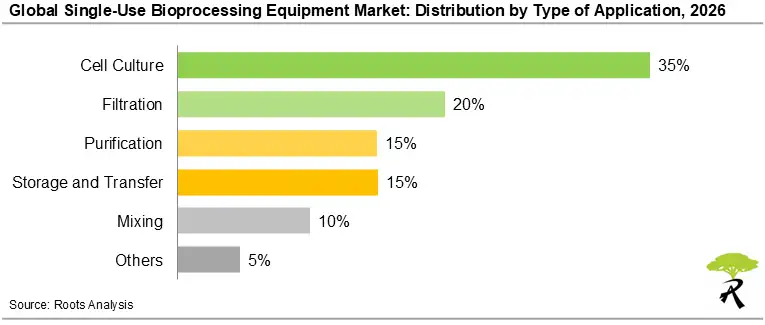
Global Single-Use Bioprocessing Equipment Market Share by Type of Application, 2026

Regional Analysis: Which Regions are Leading the Single-Use Bioprocessing Equipment Market?

Europe Dominates the Market by Securing Highest Share

Europe accounts for the largest share of the single-use bioprocessing equipment market in 2026 and is expected to retain a leading position during the forecast period. The region benefits from an established biopharmaceutical manufacturing ecosystem, extensive biologics and biosimilar production capacity and a strong network of contract development and manufacturing organizations. Investment in pharmaceutical research, supportive regulatory initiatives and the expansion of flexible manufacturing facilities have accelerated the adoption of single-use technologies across clinical and commercial production.

Asia-Pacific Emerged as the Fastest Growing Region

The Asia-Pacific single-use bioprocessing equipment market is expected to register the highest CAGR during the forecast period. Growth is supported by the expansion of biologics, biosimilar, vaccine and cell therapy manufacturing capacity across China, Japan, South Korea and India. Governments and biopharmaceutical companies are investing in manufacturing facilities to strengthen domestic production capabilities and reduce dependence on imported biologics. As manufacturers transition toward commercial-scale production, adoption of flexible single-use manufacturing platforms is expected to accelerate.

Scope of Single-Use Bioprocessing Equipment Market Report

Key Report Attribute Details
Historical Trend Since 2022
Forecast Period Till 2035 
Market Size 2026 $ 4.5 billion
Market Size 2035 $ 9.5 billion
CAGR (Till 2035) 8.7%
Segments Covered
  • Workflow
  • Type of Modality
  • Type of Application
  • End User
  • Geographical Regions
Key Players
  • Avantor
  • Cytiva
  • Eppendorf
  • Merck
  • Pall
  • Premas Biotech
  • REPROCELL
  • Sartorius
  • Satake MultiMix
  • Thermo Fisher Scientific
(A complete list of players captured is available in the report)
PowerPoint Presentation
(Complimentary)
Available
Customization Scope 15% Free Customization 
Excel Data Packs
(Complimentary)
Available

Frequently Asked Questions

What is single-use bioprocessing equipment?

Single-use bioprocessing equipment includes pre-sterilized disposable bioreactors, bags, filters, mixers, tubing, connectors and fluid-management systems used in biologics manufacturing.

How big is the single-use bioprocessing equipment market?

The global single-use bioprocessing equipment market is estimated to be worth USD 4.5 billion in 2026.

What is the projected growth of the single-use bioprocessing equipment market?

The market is projected to grow at a CAGR of 8.7% from 2026 to 2035 and reach USD 9.5 billion by 2035.

Which workflow accounts for the largest market share?

Upstream bioprocessing holds the largest share, accounting for 55% of the single-use bioprocessing equipment market.

Which region leads the single-use bioprocessing equipment market?

Europe currently accounts for the largest share, due to its established pharmaceutical manufacturing, research, regulatory and contract-manufacturing ecosystem.

Who are the key companies in the market?

Key companies include Avantor, Cytiva, Eppendorf, Merck, Pall, Premas Biotech, REPROCELL, Sartorius, Satake MultiMix and Thermo Fisher Scientific.