
Lowest Price Guaranteed
Pages
220
Last Updated
September 2026
View Count
5625
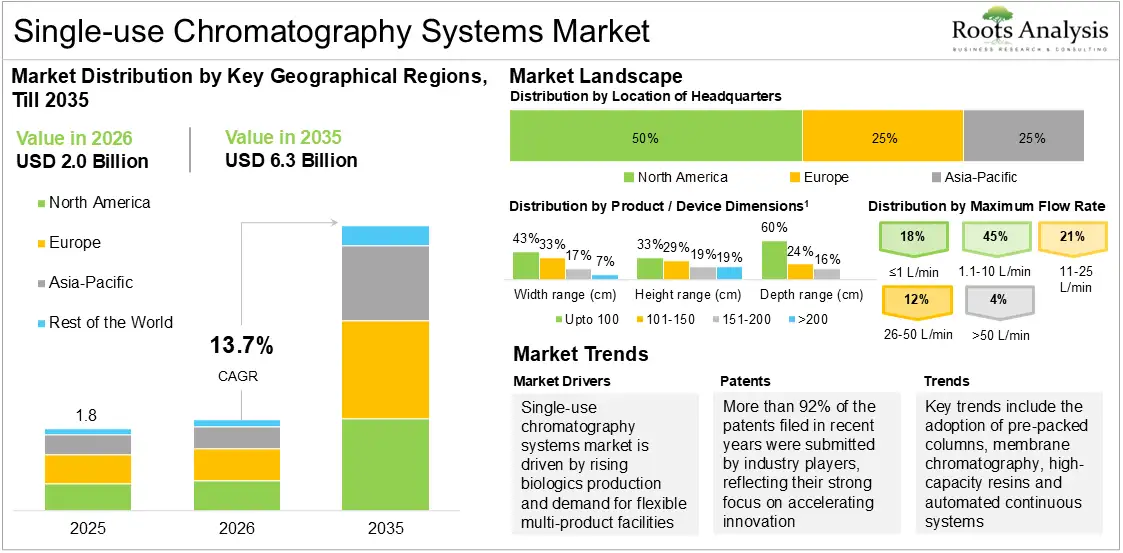
The global single-use chromatography systems market, valued at USD 1.8 billion in 2025, is projected to reach USD 2.0 billion in 2026 and USD 6.3 billion by 2035, representing a CAGR of 13.7% during the forecast period from 2026 to 2035.
To learn more about this report, request a free sample copy
Single-use chromatography systems are becoming an increasingly important part of modern biopharmaceutical purification workflows, as manufacturers look for faster, cleaner, and more flexible alternatives to conventional stainless-steel chromatography infrastructure. This shift is being supported by the continued growth of biologics and advanced therapies. As biologics pipelines expand, demand is increasing for chromatography platforms that can support rapid process development, smaller batch sizes, contamination control, and faster transition from clinical to commercial manufacturing.
The broader single-use bioprocessing ecosystem is also maturing, which is creating a favorable environment for single-use chromatography adoption. A 2025 BioPlan survey cited by BioProcess Online indicated that more than 90% of manufacturing facilities surveyed were already using single-use systems in at least some part of their operations, suggesting that single-use technologies have become a standard element of modern biomanufacturing rather than a niche option. Further, in June 2025, Sartorius Stedim Biotech completed a major capacity expansion in France, nearly doubling cleanroom space to around 9,000 square meters to meet growing demand for single-use bioprocessing solutions.
Within downstream processing, single-use technologies are increasingly being used across filtration, buffer handling, fluid transfer, storage, and selected chromatography applications. Recent assessments indicate that most downstream processing steps in single-use facilities can now be performed using disposable flow paths, filtration assemblies and holding vessels. At the clinical scale, Protein A chromatography can also be conducted using pre-packed, single-use column systems. However, large-scale chromatography remains one of the slower downstream steps to transition fully to single-use formats, which creates both a challenge and a growth opportunity for suppliers developing scalable single-use chromatography systems.
Driven by rising biologics approvals, growing CDMO capacity, increasing use of single-use bioprocessing infrastructure, and the need to reduce turnaround time in purification workflows, the single-use chromatography systems market is expected to witness sustained growth during the forecast period.
| Value Chain Area | Representative Companies | Role in the Ecosystem |
| System and skid suppliers | Cytiva, Merck, Pall Corporation | Provide single-use chromatography systems, manifolds, automation and process controls |
| Pre-packed column suppliers | Repligen, Cytiva, Thermo Fisher Scientific, Astrea Bioseparations, Tosoh Bioscience | Provide ready-to-use columns for screening, clinical production and GMP manufacturing |
| Membrane chromatography providers | Sartorius, Pall Corporation, Merck | Offer membrane adsorbers and membrane-compatible systems for capture and polishing |
| Resin and ligand providers | Thermo Fisher Scientific, Cytiva, Sartorius, Astrea Bioseparations | Provide affinity, ion exchange, HIC and specialty purification chemistries |
| Process development tools | Astrea Bioseparations, Thermo Fisher Scientific, Sartorius | Provide mini-columns, screening kits, high-throughput formats and method development support |
Based on the research, we have segmented the single-use chromatography systems market into scale of operation, end user, and key geographical regions.
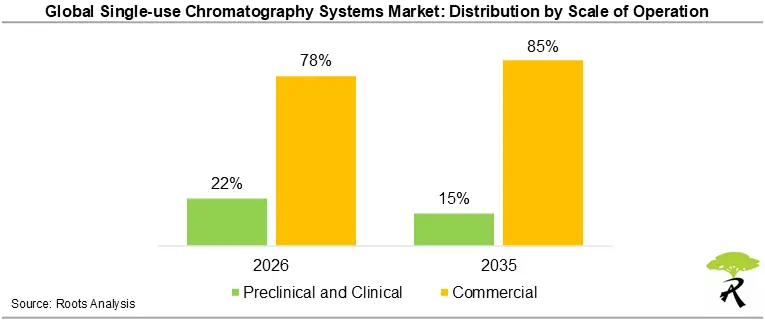
By Scale of Operation
By End User
By Key Geographical Regions
Driven by growing adoption of automated, single–use chromatography platforms that integrate streamlined sample handling and process controls to improve run–to–run consistency and minimize manual intervention, the single–use chromatography systems market is poised for significant growth in the coming years.
Hélène Pora (VP Technical Communication & Regulatory Strategy, Pall Biotech) stated: "For every manufacturer it is critical to evaluate processes and see where they can take the greatest advantage of the single-use technologies from the earliest point, while also considering the scalability of the process(es) in question. We suggest taking a quality by design (QbD) approach to designing and implementing proven, market-driven processes that are supported by the right products and services."
Discussions with multiple stakeholders in this domain influenced the opinions and insights presented in this study. The single-use chromatography systems market report includes detailed transcripts of interviews conducted with the following third-party discussions:
According to our projections, Europe holds the largest share of the single-use chromatography systems market owing to its strong biopharmaceutical manufacturing base, early adoption of single-use bioprocessing technologies, and the presence of leading technology suppliers. The region is home to globally recognized manufacturers such as Sartorius (Germany), Cytiva (Sweden), Merck KGaA (Germany), and Pall Corporation (European operations), which have driven innovation and widespread commercialization of disposable downstream purification technologies.
Europe also hosts a large number of biologics manufacturers and CDMOs, including Lonza, Rentschler Biopharma, Boehringer Ingelheim, and Recipharm, which increasingly rely on single-use chromatography systems to support flexible, multi-product manufacturing of monoclonal antibodies, vaccines, and advanced therapies. Furthermore, the region has been at the forefront of implementing continuous bioprocessing and modular manufacturing strategies, driving demand for disposable purification solutions that reduce cleaning validation requirements and manufacturing downtime.
The Asia-Pacific single-use chromatography systems market is expected to grow at a significant pace during the forecast period owing to the rapid expansion of biologics manufacturing capacity, increasing investment in biosimilars and advanced therapeutics, and strong government initiatives to strengthen domestic biopharmaceutical production. Countries such as China, South Korea, India, and Singapore are investing heavily in large-scale manufacturing facilities for monoclonal antibodies, recombinant proteins, vaccines, and cell and gene therapies, creating substantial demand for flexible single-use purification technologies. For example, China's 14th Five-Year Plan for the Development of the Bioeconomy prioritizes high-end biomanufacturing and domestic biologics production, while South Korea's K-Bio Strategy aims to establish the country as a global biomanufacturing hub by expanding biologics manufacturing capacity and CDMO capabilities. India is also accelerating adoption of advanced bioprocessing technologies through the National BioPharma Mission, which supports biologics innovation and manufacturing infrastructure.
| Key Report Attribute | Details | |
| Historical Trend | Since 2022 | |
| Forecast Period | Till 2035 | |
| Market Size 2026 | $ 2.0 billion | |
| Market Size 2035 | $ 6.3 billion | |
| CAGR (Till 2035) | 13.7% | |
| Segments Covered |
|
|
| Key Players |
|
|
| PowerPoint Presentation (Complimentary) |
Available | |
| Customization Scope | 15% Free Customization | |
| Excel Data Packs (Complimentary) |
Available | |