


 Download Free Sample
 Buy Now
Synthetic Biology for Vaccine Development Market Overview
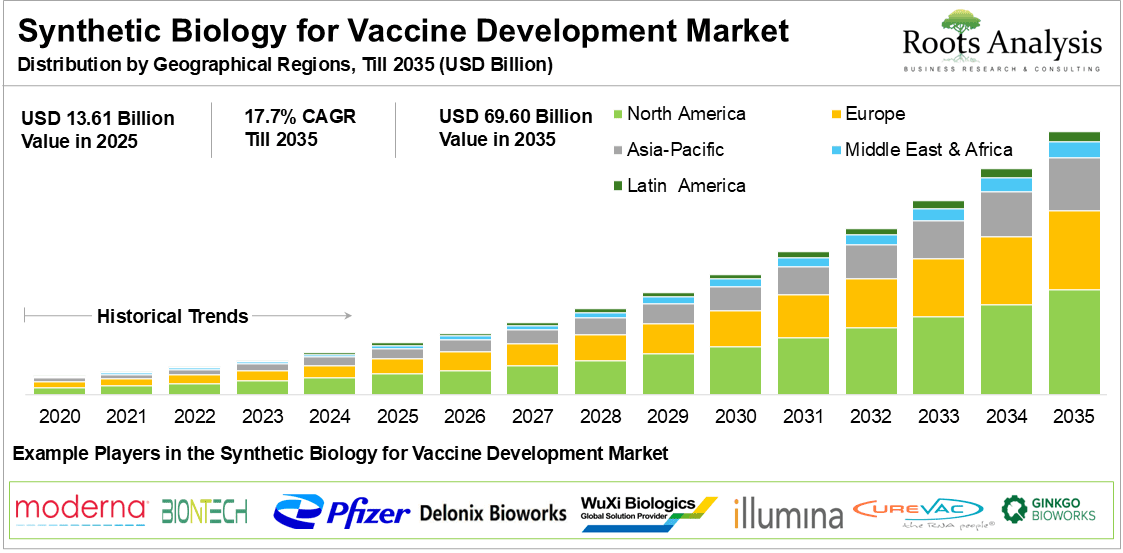
The global synthetic biology for vaccine development market size, valued at USD 11.09 billion in 2024, is projected to reach USD 13.61 billion in 2025 and USD 69.60 billion by 2035, representing a CAGR of 17.7% during the forecast period.
 |
Synthetic Biology for Vaccine Development Market: In Summary
- This unprecedented growth is driven by the proliferation of nucleic acid vaccine technologies, the adoption of mRNA vaccines, and significant technological advancements in genome editing tools like CRISPR-Cas9.
- In terms of type of vaccine, the mRNA vaccines hold the largest market share (49%) due to their speed, accuracy, and high-throughput capabilities. However, viral vector vaccines are anticipated to show the most robust growth in the future.
- In terms of types of technology, gene synthesis holds the highest share, driven by its speed and precision. Genome editing, particularly with technologies like CRISPR-Cas9, is projected to register the highest CAGR.
- Biotechnology and pharmaceutical companies hold 55% of the market share, with a strong focus on personalized therapies and effective vaccines. However, academic and research institutes are expected to grow at an unprecedented CAGR due to increasing research initiatives.
- North America is the current market leader, holding a 40% share. Its dominance is fueled by strong government initiatives, continuous R&D, and substantial biomanufacturing infrastructure. The Asia-Pacific region is emerging as the fastest-growing market, driven by increasing government initiatives in countries like India and China, and a rising need for advanced vaccines to combat infectious diseases.
- The market is highly competitive, with notable players including AstraZeneca (UK), BioNTech (Germany), Delonix Bioworks (China), Wuxi Biologics (China). These market players are undertaking strategic initiatives to strengthen their product portfolio.
- Partnerships and collaborations between pharmaceutical giants and synthetic biology companies to expand their vaccines pipeline and explore use of vaccines beyond infectious diseases, which are further likely to grow the market in the future.
- The future opportunities lie in integrating AI and machine learning with vaccine development to predict antigenic targets and optimize RNA sequences. Another key area is the focus on next-generation mRNA platforms, such as self-amplifying RNA, and exploring their application beyond infectious diseases to target conditions like cancer and autoimmune diseases.
Synthetic Biology for Vaccine Development Market Introduction
Synthetic biology is a form of multidisciplinary approach that combines engineering principles and technology with biology. This combination approach aims to design and construct modified natural biological systems (DNA and RNA sequencies) and devices. The key aspect of synthetic biology is to create responsive biological systems including drugs and vaccines that can help to treat / prevent diseases. Synthetic biology has revolutionized vaccine development companies landscape by addressing the limitations associated with traditional manufacturing approach, such as slow timelines, high-cost and less flexibility to modify sequences for tailored vaccines.
The primary role of Synthetic Biology for Vaccine Development is rapid antigen design and optimization using gene synthesis and codon optimization technologies. Furthermore, researchers can chemically synthesize genes for specific antigens, such as viral spike proteins without cultivation in organisms cells. The demand for synthetic biology for vaccine development has significantly increased due to the rising demand for vaccines to prevent spreading of infectious diseases.
See What’s in the Full Report – Request Your Complimentary Insights!
In order to fulfill the growing demand, several market players have shown active interest in the field to initiate technological innovations. The primary focus of industrial players is on the development of computational tools, such as CRISPR gene editing for the modification of genetic material. For instance, in February 2025, researchers team at MIT’s McGovern Institute and the Broad Institute of MIT and Harvard found TIGR (Tandem Interspaced Guide RNA), an RNA guides system with diverse functionalities in gene editing. The consistent technological innovations followed by the rising need for advanced vaccines for diseases prevention is likely to fuel the synthetic biology for vaccine development market in the future.
Synthetic Biology for Vaccine Development Market: Report Attributes
| Key Report Attributes | Details | |
| Historical Trend | Since 2020 | |
| Forecast Period | Till 2035 | |
| Market Size 2025 | USD 13.61 Billion | |
| Market Size 2035 | USD 69.60 Billion | |
| CAGR (Till 2035) | 17.7% | |
One of the key objectives of the synthetic biology for vaccine development market report was to estimate the current size, opportunity, and the market growth potential, over the forecast period, till 2035. We have provided informed estimates on the likely evolution of the market for the forecast period.
The global synthetic biology for vaccine development market analysis also features the likely distribution of the current and forecasted opportunity within the market across various segments, such as type of vaccine, type of tool, type of technology, end user, geographical regions, and leading players.
In order to account for future uncertainties associated with some of the key parameters and to add robustness to our model, we have provided three market forecast scenarios, namely conservative, base, and optimistic scenarios, representing different tracks of industry's evolution.
Recent Developments in Synthetic Biology for Vaccine Development Market
Several recent developments in the field of personalized vaccine development solutions industry have occurred and we have outlined some of these below:
- In May 2025, Ansa Biotechnologies (US), announced the launch of its 50 kb DNA synthesis early access program, offering customers extremely long and complex DNA sequences in less than four weeks. These DNA products are essential for synthetic genomics, and next-generation cells, and gene therapies.
- In February 2025, MojiaBio announced to develop SGD 44.8 million state-of-the-art sustainable biomanufacturing technology platform (SBTP) that combines synthetic biology and bioprocessing innovations with the agency for science, technology and research.
- In March 2025, Researchers at the University of Cologne and University Hospital Cologne determine that mRNA-based COVID-19 vaccine induced acquired immune responses and persistent epigenetic changes in innate immune cells.
- In January 2025, Esphera SynBio launched a project to enhance mRNA vaccine manufacturing by leveraging its proprietary technology to reengineer mRNA vaccines that instruct patient cells to produce modified nanomedicines after delivery. This project is supported the CDQM quantum leap program that involves collaborative efforts between Canadian companies and global biopharmaceutical organizations.
Synthetic Biology for Vaccine Development Market Segmentation Insights
The market report presents an in-depth analysis of distributed vaccine manufacturing models providers who are currently active across various segments of the industry as mentioned below:
Synthetic Biology for Vaccine Development Market: Market Segmentation
| Market Segmentation | Details | |
| Type of Vaccine |
|
|
| Type of Tool |
|
|
| Type of Technology |
|
|
| End User |
|
|
| Geographical Regions |
|
|
| Market In North America |
|
|
| Market In Europe |
|
|
| Market in Asia-Pacific |
|
|
| Market in Middle East & Africa |
|
|
| Market in Latin America |
|
|
Industry Experts on Synthetic Biology for Vaccine Development Market
Synthetic biology for vaccine development industry is gaining traction driven by the growing technological innovations.
During a recent interview with Dr. Jenny Molloy (Senior Research Associate at the Department of Chemical Engineering and Biotechnology, University of Cambridge) highlighted the key role of synthetic biology in vaccines and therapeutic. He said, “The Global Future Council on Synthetic Biology has focused a lot of our attention on how to embed the values of sustainability, equity, humility and solidarity into the future bioeconomy policy agenda, providing a compass rather than a map, because we think this is important to ensure that synthetic biology is being harnessed to create a world in which we want to live”
Synthetic Biology for Vaccine Development Market Share Insights
Market Share by Type of Vaccine: What Makes mRNA Platform Technologies Superior for Pandemic Preparedness Strategies?
- This segment highlights the distribution of global market across different type of vaccine, such as mRNA vaccines, DNA vaccines, viral vector vaccines, live attenuated vaccines, subunit vaccines and other vaccines. Currently, the mRNA vaccines accounts for the highest synthetic biology vaccine development market share. This can be attributed to the growing approval of mRNA vaccines and therapeutics to treat wide range of diseases. Notably, the mRNA platform technologies offer several advantages, such as high-throughput, speed, cell-free synthesis, and accuracy.
- In the future, viral vector vaccines segment is likely to show robust growth, anticipating registering higher CAGR in the future. Viral vectors possess the ability to mimic natural infection; it can stimulate both T-cell and antibody responses to offer long term protection against pathogens. Some of the successful viral vector vaccines are COVID-19, and Ebola vaccine.
Have Questions? Let’s Get Them Answered.
Market Share by Type of Tool: Why Do Oligonucleotides and Synthetic DNA Continue to Dominate the Market?
- The global market is further bifurcated into different type of tools, such as oligonucleotides and synthetic DNA, cloning technology kits, synthetic cells, enzymes and other tools. According to our projection, the oligonucleotide and synthetic DNA segment dominates the market by holding 35% of the overall revenue share. This can be attributed to the fact that oligonucleotide and synthetic DNA are primarily used as the core part of Synthetic Biology for Vaccine Development.
- It is worth noting that this segment will continue to grow at a higher CAGR during the forecast period. This lucrative growth is due to the growing usage of oligonucleotides for the development of modified genes, and synthetic genomes to manipulate DNA and biochemical processes.
Market Share by Type of Technology: How CRISPR Gene Editing Accelerates Synthetic Vaccine Antigen Design Timelines?
- Based on the type of technology, the global market is segmented into gene synthesis, genome editing, protein engineering, nanotechnology, bioinformatics and other technologies. Among these, the gene synthesis segment holds the highest share of the market driven by its ability to create customized DNA sequences with higher speed, precision, and flexibility. Gene synthesis also helps in codon optimization to ensure that gene is expressed accurately, leading to higher vaccine production.
- It is worth noting that the genome editing segment is likely to register highest CAGR in the future. This can be attributed to the fact that genome editing technology, such as CRISPR-Cas9 enables high-throughput modifications of genetic material and act as molecular scissors that help to cut DNA / RNA at specific locations.
Market Share by End User: Does Biotechnology and Pharmaceutical Companies Dominate the Market in Future?
- The end user segment demonstrate that the global market is distributed into biotechnology & pharmaceutical companies, academic & research institutes, and government & public health organizations. According to the synthetic biology vaccine development market forecast, the biotechnology and pharmaceutical companies segment is occupying 55% of the market share. This dominance stems from the rising focus on the development of personalized therapies, and effective vaccines to treat wide range of disease indication.
- In the future, the academic & research institutes segment will grow at an unprecedented CAGR during the forecast period. This can be attributed to the growing research on synthetic biology and bio-based products for the development of innovative vaccines.
Regional Analysis: What's the Investment Outlook for Cell-Free Vaccine Production Systems in Different Regions?
The global market is distributed across North America, Europe, Asia-Pacific, Middle East & Africa, and Latin America. This regional outlook reflects the ongoing trends in the specific region.
North America: Maintain Dominance in the Market
According to the synthetic biology vaccine development industry analysis, the North America region is dominating the market by holding 40% share of the market. This highest share stems from the rising government initiatives to support the development of synthetic biology vaccines. Moreover, the growth of market in this region is further bolstered by the increasing research initiatives on synthetic biology to explore its application beyond infectious diseases. Additionally, the continuous expenditure in biomanufacturing infrastructure is likely to maintain the leadership position of this region.
Europe: Holds the Substantial Share of the Market
Europe region holds significant share of the synthetic biology vaccine development market growth. Notably, the supportive regulatory framework and increasing coordinated research programs, such as Horizon Europe’s SYNBEE (Synthetic Biology Entrepreneurial Ecosystem) project is likely to be a key growth factor of the market in this region.
Want Information on Specific Region / Segment?
Asia-Pacific: Emerging as the Fastest Growing Region
In Asia-Pacific, the market for Synthetic Biology for Vaccine Development demonstrates a highest CAGR during the forecast period. This lucrative growth reflects from the growing initiatives of government organizations established in Asian countries, such as India and China is likely to drive the market growth at a higher rate. It is important to highlight here that the market players are aiming for technological innovations, such as CRISPR-based vaccine engineering and computational vaccine design tools that aid in designing tailored vaccines. Additionally, the rising risk of infectious diseases has necessitated the demand for advanced vaccines, which further likely to fuel the market growth during the upcoming years.
Synthetic Biology for Vaccine Development Market: Report Deliverables
| Report Deliverables | Details | |
| Excel Data Packs (Complimentary) |
|
|
| Key Synthetic Biology for Vaccine Development Companies Profiled |
|
|
| PowerPoint Presentation (Complimentary) | Available | |
| Customization Scope | 15% Free Customization | |
Synthetic Biology for Vaccine Development Market Key Takeaways
The "Synthetic Biology for Vaccine Development Market Report: Industry Trends and Global Forecasts, till 2035" market report features an extensive study of the current market landscape, market size, market share, market growth, market trends, market value, market forecast, market outlook, statistics, and future opportunities for market players. The market research report lays emphasis on the personalized vaccine development solutions that are being developed. Key takeaways of the market report are briefly discussed below.
Market Competitive Landscape: Are Biotech Partnerships Accelerating Synthetic Biology Vaccine Commercialization?
The market for synthetic biology vaccine development is immensely competitive, featuring a mix of small, mid-sized and large companies. It is worth noting that pharmaceutical companies are encouraging partnerships and collaborations to expand their pipelines and exploring synthetic biology based vaccines beyond infectious diseases.
- Many tech giants are also focusing on synthetic biology platforms that enhance the production of vaccines with improved immunostimulatory capabilities.
- Market players, such as BioNTech (Germany), Illumina (US) and Merck (US) are leveraging mRNA technology for the development of tailored vaccines.
- Emerging companies, such as Esphera SynBio (Canada) and Ginkgo Bioworks (US) are focusing on next-generation vaccine platforms to improve existing vaccine technology through novel delivery mechanisms.
As more market player continue to undertake strategic initiatives in this field, it is expected that synthetic biology for vaccine development market will grow at a steady rate.
Market Size Analysis: What is the Investment Landscape for Synthetic Biology Startups Developing Next-Generation Vaccine?
The global synthetic biology vaccine development market size is valued at USD 13.61 billion in 2025. Notably, the consistent focus on the development of advanced vaccine development technologies using synthetic biology is likely to drive the market at a CAGR of 17.7% during the forecast period. It is interesting to note here that industrial players, specifically startup companies have a keen focus on platform technologies and vaccine delivery tools, such as mRNA delivery systems.
Market players, such as Moderna (US), Gingko Bioworks (US), CureVac (Germany) and Illumina (US) are aiming for laboratory automation systems and technology platforms that support the synthetic biology vaccine development. The combined initiatives of industrial players is likely to maintain a competitive edge in synthetic DNA vaccine technology industry.
What are the Major Synthetic Biology Vaccine Development Market Growth Factors?
Some of the potential market drivers that are propelling the market growth includes constant proliferation of nucleic acid vaccine technologies and adoption of mRNA vaccines for targeting diseases. It is worth noting that synthetic biology combines biofoundry vaccine manufacturing platforms and recombination engineering principles to design modified vaccines with higher speed and precision. Additionally, the technological advancements in genome editing tools, such as CRISPR-Cas9 and genome sequencing for higher precision and safety help to create safe and effective live-attenuated vaccines and viral vectors for targeted drug delivery.
Why Overcoming Regulatory Hurdles in Commercializing Synthetic Biology-Based Vaccines is Important?
Synthetic biology is a modern concept for the development of vaccines as it offers high speed and precision. The ability to develop mRNA / DNA vaccines within short interval of time has catered the attention of industrial players. Despite lucrative growth, the complex guidelines for the approval of vaccine technologies platforms and synthetic biology from the USFDA and the EMA. Navigating this complex regulatory landscape can cause delays in vaccine approval and commercialization.
Therefore, it is crucial for the market players to focus on the regulatory framework and implement digital vaccine development workflow systems and computational tools to ensure that vaccines are safe and effective for human use. In addition, the industrial players are adopting pre-submission meeting processes / rolling review processes that allow them to submit their research data as soon as it becomes available. This new approach helps accelerate the approval process by providing deeper understanding of results in real-time using computational tools.
Synthetic Biology Vaccine Development Market Trends
Synthetic biology offers precise control in modifying the nucleic acid segments to develop engineered vaccines. The innovation in mRNA vaccine technology platforms to engineer modular biological systems are defining foundational application to tailor vaccines beyond infectious disease prevention. Some of the notable trends that are shaping industrial growth are listed below:
Advancements in mRNA Technology for Next Generation Vaccines
Market players are consistently focusing on the development of advanced mRNA technology platforms / next-generation mRNA platforms, such as self-amplifying RNA that can generate long-lasting immune responses with lower dose. Moreover, researchers are widely emphasis on exploring mRNA vaccines for targeting cancer and autoimmune diseases, which further likely to grow the market in the future.
Integration of AI and Machine Learning: AI-Powered Vaccine Development Synthetic Biology
The integration of AI and machine learning with mRNA vaccine technologies platform can help to predict antigenic targets, RNA sequences and optimize protein for higher stability and expression. This computational approach also helps to reduce cost and timeline required for vaccine design, allowing rapid development of vaccines, and screening of vaccines during clinical trials. In addition, viral vector platforms are likely to gain traction in the future to enhance the development of viral vaccines.
Get an Instant Quote in 10 Minutes. Lowest Price Guaranteed
How Does Emerging Partnerships Between Pharma Giants and Synthetic Biology Vaccine Companies Accelerate Market Growth?
In 2025, this industry is witnessing several partnerships and collaborations in synthetic biology vaccine development industry. These strategic initiatives are likely to expand the applications of synthetic biology in vaccines. For instance, in Aprile 2025, Delonix Bioworks (China) and Wuxi Vaccines (China) entered into a strategic partnership to advance their next generation engineered outer membrane vesicle technology. This strategic partnership will leverage WuXi’ Vaccines integrated manufacturing and development capabilities with Delonix’s innovation bacterial vaccine platform to scale production. As more market players continue to drive technological innovations by harnessing partnerships, this market will remain progressive in the future.
Synthetic Biology for Vaccine Development Market Report Coverage
- An Infographic Executive Summary
- Regulatory Scenario
- Comprehensive Database of Leading Players
- Competitive Landscape
- Porter’s Five Forces Analysis
- Company Competitiveness Analysis
- Startup Ecosystem in the Synthetic Biology for Vaccine Development Market
- Company Profiles
- Patent Analysis
- Partnerships and Collaborations
- Grant Analysis
- Funding and Investment Analysis
- Clinical Trial Analysis
- Market Forecast and Opportunity Analysis
- Adjacent Market Analysis
- Key Winning Strategies
- SWOT Analysis
Glossary
- CRISPR-Cas9: A gene-editing technology that allows precise modifications to DNA sequences, enabling targeted genetic engineering in vaccine development.
- DNA Vaccine: A vaccine platform using synthetic plasmid DNA encoding antigenic proteins that are expressed in host cells to stimulate immune responses.
- Lipid Nanoparticles (LNPs): It is a form of delivery vehicles composed of ionizable lipids, helper phospholipids, cholesterol, and PEGylated lipids that protect and deliver mRNA vaccines to cells.
- Messenger RNA (mRNA) Vaccine: A vaccine containing synthetic mRNA that instructs cells to produce specific proteins triggering immune responses.
- Self-Amplifying RNA (saRNA): It is a form of RNA vaccine that encode both the antigen and replication machinery, enabling intracellular amplification and reduced dosage requirements.
- Virus-Like Particles (VLPs): It is an engineered viral structure with immunoprotective traits of native viruses but without infectious components.
From the Author’s Desk
Author’s View on Synthetic Biology for Vaccine Development Market
The fundamental shift towards synthetic biology to develop modified vaccines represent one of the most significant opportunities in the upcoming years. The current scenario highlights the technological innovations in the synthetic biology industry, such as CRISPR gene editing, and artificial intelligence. Moreover, industrial players will also emphasize improving drug delivery technologies for targeted delivery of the synthetic vaccines. However, the key strength lies in partnerships and collaborations to address the ongoing challenges in the vaccine development through synthetic biology and accelerate the vaccines approval.
Customization Opportunities
At Roots Analysis, we genuinely care about your success and understand that your business requirements are unique. While our market research reports provide valuable insights, we recognize that they might not cover every aspect you need to make well-informed strategic decisions. To account for that, we offer 15% free report customization tailored to your specific needs. Whether you require additional quantitative analysis, qualitative insights, or any other information related to the electric vehicles market, reach out to us today at support@rootsanalysis.com


