
Lowest Price Guaranteed
Pages
196
Last Updated
May 2025
View Count
13608
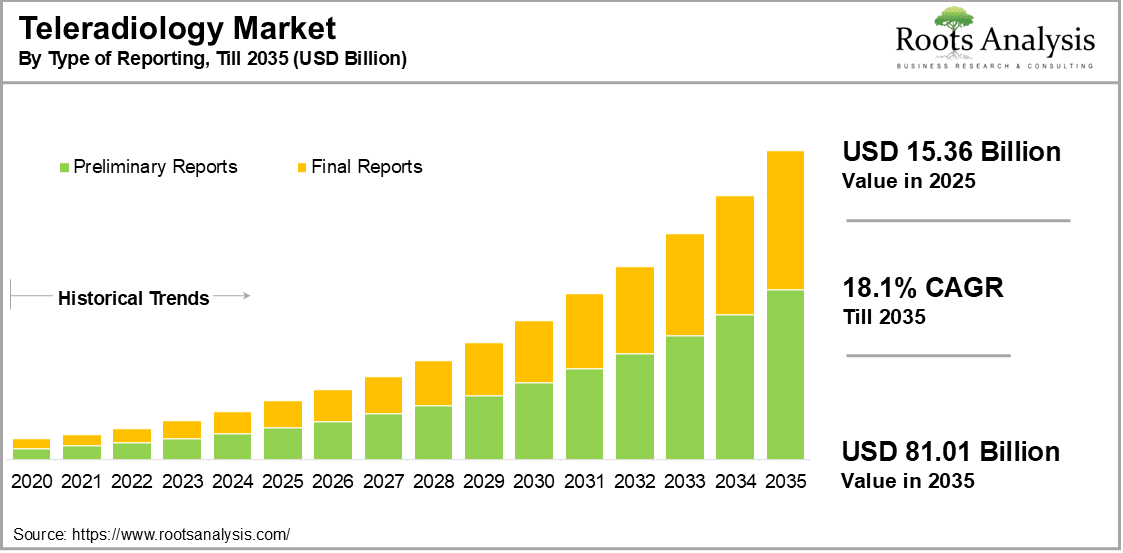
The global teleradiology market size, valued at USD 12.46 billion in 2024, is projected to reach USD 15.36 billion in 2025 and USD 81.01 billion by 2035, representing a CAGR of 18.1% during the forecast period.
 |
To learn more about this report, request a free sample copy
Teleradiology is an emerging market driven by the growing shift towards remote disease diagnosing and digital technologies for consultation. The rising burden of chronic conditions across the globe has further necessitated the requirement for teleradiology products and technology for early diagnosis and monitoring disease progression.
Teleradiology refers to the practice of transmitting and rendering medical images obtained from CT scans, X-rays and MRIs remotely by radiologists. Notably, teleradiology embarks on a modern pathway to diagnose patients and offers consultation without visiting physically. Additionally, the growing integration of artificial intelligence technology into teleradiology and enhancement of 5G networks further supports remote diagnosis and real-time analysis to make an informed treatment decision.
Driven by the ongoing trajectory towards teleradiology, several industrial players are focusing on innovations to accelerate the adoption across the globe. However, the primary focus of industrial players will be on integrating picture archiving and communication systems (PACS) to enhance diagnosis and real-time consultation with utmost clarity. For instance, in September 2024, Carpl.ai secured CE mark for newly launched enterprise imaging AI platform that can be integrated with any PACS system by universal AI viewers. This enterprise imaging AI platform allows radiologists to accept, modify and reject AI outputs and optimize tasks, such as images examination prioritization.
Furthermore, In August 2024, Hexarad (radiology technology company) secured EUR 13 million during ground funding round let by European healthtech growth equity investor MTIP alongside existing shareholders. This investment will be utilized to offer end-to-end radiology software suite that covers a proprietary radiology information system (RIS), Hexarad Hub for urgent reporting, Hexarad Edge integration engine, and Hexarad Portal for auto-allocation globally.
Driven by the ongoing investments and emerging opportunities, we believe that teleradiology industry will continue to expand at a robust pace during the forecast period.
The market report provides comprehensive information on teleradiology companies who are currently active across various segments of the industry as mentioned in the table below.
| Key Report Attributes | Details | |
| Historical Trend | Since 2020 | |
| Forecast Period | Till 2035 | |
| Market Size 2025 | USD 15.36 Billion | |
| Market Size 2035 | USD 81.01 Billion | |
| CAGR (Till 2035) | 18.1% | |
| Type of Product |
|
|
| Type of Consulting |
|
|
| Type of Report |
|
|
| Type of Coverage |
|
|
| Type of Patient |
|
|
| Mode of Purchase |
|
|
| Type of Configuration |
|
|
| Type of Technology |
|
|
| Type of Service |
|
|
| Application Area |
|
|
| By End User |
|
|
| Geographical Regions |
|
|
| Key Companies Profiled |
|
|
| PowerPoint Presentation (Complimentary) |
Available | |
| Customization Scope | 15% Free Customization | |
| Excel Data Packs (Complimentary) |
Available | |
One of the key objectives of the teleradiology market report was to estimate the current size, opportunity, and the market growth potential, over the forecast period, till 2035. We have provided informed estimates on the likely evolution of the market for the forecast period.
The global market analysis report also features the likely distribution of the current and forecasted opportunity within the market across various segments, such as type of product (teleradiology services, hardware, and software (PACHS and RIS)), type of consulting (general reporting, consultation, auditing and others), type of report (preliminary reports and final reports), type of coverage (daytime coverage and after hours / nighttime coverage), type of patient (pediatric, geriatric, and adults), mode of purchase (group purchase, and individual purchase), type of configuration (cloud-based, web-based and standalone), type of technology (computed tomography (CT), ultrasound, X-ray, nuclear imaging and magnetic resonance imaging (MRI)), type of service (in-house, onshore and offshore), application area (bone imaging, cardiac imaging, neuroimaging, oncology imaging and chest imaging), end user (hospitals, radiology clinics and ambulatory imaging centers), geographical regions (North America, Europe, Asia-Pacific, Middle East and North Africa, and Latin America) and leading players.
In order to account for future uncertainties associated with some of the key parameters and to add robustness to our model, we have provided three teleradiology market forecast scenarios, namely conservative, base, and optimistic scenarios, representing different tracks of industry’s evolution.
All actual figures have been sourced and analyzed from publicly available information forums and primary research discussions. The financial figures mentioned in this market report are in USD, unless otherwise specified.
Based on the type of product, the global market is segmented into teleradiology services, hardware, and software (PACHS and RIS). According to our teleradiology market report, presently teleradiology services market segment is dominating the market. This can be attributed to the preferences of third-party services for utilizing teleradiology platforms / products for remote diagnosis. Additionally, teleradiology services eliminate the requirement of installing in-house technologies and hiring skilled personnel, which further enhance their adoption rate across the globe.
However, in the long run, software segment is likely to grow at a higher CAGR during the forecast period. This is potentially due to the growing focus on integrating software technologies, such as PACHS and RIS in teleradiology to streamline workflows and remote diagnostics, thereby bridging the gap between medical imaging and designing treatment plans.
The global market is distributed across different types of consulting, such as general reporting, consultation, auditing and others. According to our projection, the general reporting segment accounts for the highest teleradiology market share. Teleradiology allows radiologists to analyze and interpret medical scans efficiently from remote areas.
Additionally, teleradiology has made general reporting more efficient and cost-effective, which further increases its adoption for general reporting. It is important to highlight here that this segment is likely to remain dominant and is expected to grow at a higher CAGR during the forecast period.
This segment highlights the distribution of global market across different types of reporting, such as preliminary reporting and final reporting. According to our teleradiology market size analysis, currently preliminary reporting segment occupies the highest share (55%) of the market. Preliminary reporting is essential, especially during emergency care, where healthcare professionals require real-time clinical interventions.
Notably, preliminary reports offer instant access to radiological images, allowing healthcare experts to provide early treatment. Additionally, the expanding adoption of teleradiology services / software across emergency departments in hospitals for timely diagnosis has further contributed to the highest share of this segment.
However, it is worth noting that the final reporting segment is likely to register a higher CAGR driven by the increasing demand for teleradiology for comprehensive radiological interpretation to make precise treatment decisions.
Based on the type of coverage, the global market for teleradiology is segmented across, daytime coverage and after hours / nighttime coverage. Among these, daytime coverage segment holds the largest share of the teleradiology market. This can be attributed to the large pool of patients seeking diagnosis services during daytime for treatment.
However, in the long run, after hours / nighttime coverage segment is anticipated to grow at a higher CAGR during the forecast period. This is primarily due to the AI-powered imaging platforms allowing healthcare professionals to avail teleradiology services for patients 24 hours a day, which make teleradiology a remarkable approach to diagnose patients during emergencies at night.
On the basis of patient type, the global teleradiology industry size is segmented into pediatric, geriatric, and adults. According to our market report, currently the adults segment occupies the highest share of the market. This can be attributed to the increasing incidence of chronic conditions among adults that necessitated the demand for teleradiology services for diagnosing and monitoring diseases remotely.
The global market is categorized across different modes of purchase, such as group purchase and individual purchase. Currently, group purchase is dominating the market for teleradiology, and the trend of dominance is likely to remain unchanged during the forecast period.
Based on the type of configuration, the global teleradiology market size is segmented into cloud-based, web-based and standalone. According to our market analysis, cloud-based segment dominates the industry and is expected to maintain dominance during the forecast period. Cloud-based configuration offers easy accessibility, is cost-effective and can integrate easily with existing healthcare systems for remote diagnosis.
However, web-based configuration is likely to grow at a substantial CAGR during the forecast period. This is likely to be the fact that web-based configurations offer remote access for timely diagnosis of diseases and monitoring disease progression.
The global market is segmented across different types of technology, such as computed tomography (CT), ultrasound, X-ray, nuclear imaging and magnetic resonance imaging (MRI). Presently, X-ray segment occupies 38% of the overall teleradiology market share and is likely to remain dominant during the forecast period. This can be attributed to the fact that X-rays are cost-effective and widely used diagnosing procedure for diagnosing cardiovascular diseases, cancer screening, orthopedic issues examination, chest imaging and dental imaging.
It is worth mentioning that computer tomography segment is expected to register a higher CAGR during the forecast period. Computed tomography offer clear imaging of complex body organs, such as cardiac cavities, brains, lungs and kidneys. The clearer images provided by computed tomography play a significant role in diagnosis and treatment planning, which is expected to drive the demand for computed tomography during the forecast period.
Based on the type of service, the global market is segmented into in-house, onshore and offshore. According to our teleradiology industry analysis, presently the onshore segment accounts for the highest share (nearly 50%) of the market. This can be attributed to the fact that onshore teleradiology services offer faster reporting times and accurate initial evaluation of medical images, which play a significant role in treatment of patients.
Additionally, the growing initiatives for the development of onshore teleradiology services is expected to drive its demand in the future. Considering the future demand, this segment will continue to grow at a higher CAGR during the forecast period.
The global market is further bifurcated across different application areas, such as bone imaging, cardiac imaging, neuroimaging, oncology imaging and chest imaging. According to our market analysis, the bone imaging segment is dominating the market by holding nearly 30% share of the market. This is potentially due to the rising incidence of orthopedic disorders and sports injuries that has prompted the demand for remote diagnostic services to diagnose patients beyond geographical boundaries.
However, in the long run, neuroimaging and oncology imaging segments are expected to show lucrative growth during the forecast period. This can be attributed to the rising adoption of teleradiology services for diagnosing neurological disorders and oncology to offer remote consultation to the patients.
Based on the end user, the global market is distributed across hospitals, radiology clinics and ambulatory imaging centers. According to our projection, presently hospitals segment (over 60%) holds the highest share of the teleradiology market size. This can be attributed to the fact that small hospitals / rural hospitals are the primary user of teleradiology services to enhance patient care remotely. Furthermore, teleradiology services play a significant role in diagnosis of patients with head trauma and medical emergencies when in-house radiologist staff is not available.
However, in the future, ambulatory imaging centers segment is expected to grow at a substantial CAGR during the forecast period. This lucrative growth is due to the lack of radiologists and demand for cost-effective imaging solutions to facilitate imaging procedures.
Based on geographical regions, the global market is distributed across different regions, such as North America, Europe, Asia-Pacific, Middle East and North Africa, and Latin America. Currently, North America is dominating the market by holding 41% of overall revenue share. This can be attributed to the growing technological advancements and significant investment in healthcare infrastructure to enhance disease diagnosis beyond hospital settings.
However, in Asia-Pacific, the market for teleradiology is expected to grow at a higher CAGR during the forecast period. This can be attributed to the increasing government initiatives for the expansion of healthcare IT infrastructure to support teleradiology services. Additionally, the growing adoption of digital technologies for early diagnosis is likely to fuel the demand across Asian countries.
The “Teleradiology Market Report: Industry Trends and Global Forecasts, till 2035” market report features an extensive study of the current market landscape, market size, market share, market growth, market trends, market value, market forecast, market outlook, statistics, and future opportunities for teleradiology companies. The market research report lays emphasis on the teleradiology solutions that are being developed. Key takeaways of the market report are briefly discussed below.
With rising demand for remote diagnosis, several market players are increasing their initiatives in teleradiology industry which makes this market highly competitive. Currently, the market landscape is consolidated with the presence of several small, mid-sized and large industrial players. Majority of these industrial players are aiming to leverage artificial intelligence, robust connectivity and secure networks to make teleradiology more precises and regulated.
In order to leverage competitive edge, several industrial players are focusing on partnerships and collaborations. For instance, in November 2024, InHealth and Apollo Radiology International entered into a strategic partnership to combine InHealth’s teleradiology services with Apollo Radiology Internation to expand services globally. Overall, the market seems progressive and competitive, offering lucrative opportunities to market players for striking innovations.
Teleradiology market is gaining momentum driven by the growing incidence pf chronic conditions across the globe. As per the statistics of American Cancer Society for 2025, over 2 million new cases of cancer will be diagnosed in the US this year and more than 6,00,000 patients of cancer will die this year. This surge in the cancer cases has necessitated the demand for teleradiology for diagnosing patients at early stage and monitor patient treatment progress through teleradiology services. Additionally, the growing shift towards digital technologies for disease diagnosis and treatment has further contributed to the growth of teleradiology industry.
Despite the heightened demand, the teleradiology market is witnessing several challenges that need to be addressed. One of the significant challenges includes risk of patient data breaching. Additionally, advanced teleradiology infrastructure requires substantial upfront investment in secure networks, technology and training healthcare staff.
Thus, high initial investment may limit the adoption rate of teleradiology across the globe. Furthermore, teleradiology services and products providing companies are required to take compliance measures, such as HIPAA to ensure patient data confidentiality.
Some of the notable teleradiology growth factors include growing integration of AI technology and healthcare cybersecurity enhancement. It is worth mentioning that industrial players are focusing on integrating AI technologies with teleradiology products and services to accelerate real-time analysis. Furthermore, the market players are aiming to implement robust cybersecurity measures to prevent patient data breaching and phishing attempts. Additionally, the industrial players are emphasizing rendering 3D imaging technology, AR / VR integration for a detailed anatomical understanding of medical imaging.
Currently, the teleradiology industry is estimated to be valued at USD 15.36 billion in 2025 and is poised to reach USD 81.01 billion by 2035, expecting to grow at a CAGR of 18.1% during the forecast period. It is worth mentioning that teleradiology is widely gaining attention to support remote diagnosis.
Given the opportunities in this field, several market players are entering into the industry for technological innovations and services expansions. For instance, in January 2025, OnRad acquired Direct Radiology (a group of teleradiology previously owned by Philips). The acquisition combines a team of around 240 radiologists to expand teleradiology capacity and achieve operational efficiencies.
Examples of key players engaged in this domain (which have also been captured in this report) include 4ways Healthcare, Agfa-Gevaert Group, All-American Teleradiology, Cerner, Everlight Radiology, GE Healthcare, Matrix (Teleradiology Division of Radiology Partners), Medica Group, Mednax Services, ONRAD, Philips, RamSoft, Teleradiology Solutions, USARAD Holdings and Virtual Radiologic. This market report includes an easily searchable excel database of all the companies focusing on the development of teleradiology products.
The market report presents an in-depth analysis, highlighting the capabilities of various companies engaged in this domain across different segments. Amongst other elements, the market report includes:
Several recent developments have taken place in the field of teleradiology. We have outlined some of these recent initiatives below.