Satellite Navigation System Market, till 2035: Distribution by Type of Orbit (Geostationary Earth Orbit (GEO), Medium Earth Orbit (MEO), and Other orbits), by Type of Solution (Services and System), by Type of Constellation (Global Navigation Satellite Systems (GNSS), Regional Navigation Satellite Systems (RNSS), Satellite-based Augmentation Systems (SBAS)), by Areas of Application (Agriculture, Automotive, Location-Based Services, Rail, Surveying, and Other applications), by Type of Enterprise (Large Enterprises, Small and Medium Enterprises (SMEs)), and Key Geographical Regions (North America, Europe, Asia, Latin America, and Middle East and North Africa and Rest of the World) Industry Trends and Global Forecasts.
Satellite Navigation System Market Overview
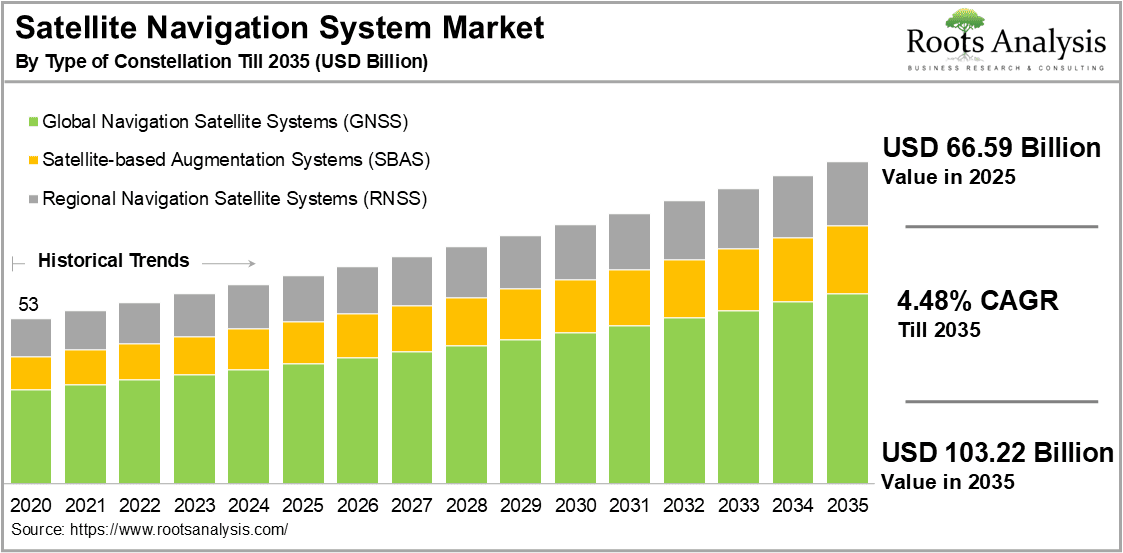
The global satellite navigation system market size, valued at USD 63.6 billion in 2024, is projected to reach USD 66.59 billion in 2025 and USD 103.22 billion by 2035, representing a CAGR of 4.48% during the forecast period. The new research study consists of detailed market analysis, mega trends, patent analysis, porter five forces, SWOT analysis, value chain analysis and other strategic frameworks.
See What’s in the Full Report – Request Your Complimentary Insights!
A satellite navigation system, commonly referred to as satnav, utilizes satellites to autonomously determine the geographic position of an object or target. When such a system provides global coverage, it is termed a Global Navigation Satellite System (GNSS). As of 2025, five GNSS systems are operational, including the Global Positioning System (GPS) by the United States, GLONASS by Russia, Galileo by the European Union, the BeiDou Navigation Satellite System (BDS) by China, and the Indian Regional Navigation Satellite System (IRNSS). These systems provide high-precision location data, including latitude, longitude, and altitude.
The rise of autonomous vehicles, such as self-driving cars, drones, and Unmanned Aerial Vehicles (UAVs), significantly drives the demand for satellite navigation systems, as they require highly accurate and reliable GNSS data for navigation, obstacle detection, and route planning. This demand is further amplified by emerging sectors like commercial drone delivery services, maritime autonomous ships, and UAVs in agriculture, leading to innovations like Real-time Kinematic (RTK) positioning for enhanced accuracy. The ability to provide precise location data, even in challenging environments such as urban canyons or dense forests, is crucial for the safe and efficient operation of autonomous systems.
Additionally, satellite navigation plays a vital role in various other applications, including aviation, maritime navigation, surveying, and emergency services, where precise positioning is essential. As technology continues to evolve, satellite navigation system technology is expected to become even more sophisticated, offering improved accuracy and reliability to support a wide range of industries and applications.
Furthermore, the satellite navigation system manufacturers are increasingly adopting advanced analytics to enhance operational decision-making. Airlines and airports are utilizing cloud-based analytics tools to process vast amounts of data from various sources, enabling them to gain insights into passenger behavior, operational efficiency, and market trends. This data-driven approach allows for more informed strategic planning and resource allocation. As a result, stakeholders can optimize flight schedules, improve customer service, and enhance overall operational performance.
Satellite Navigation System Market Segmentation Insights
The market report on satellite navigation systems presents an in-depth analysis of the various companies that are involved in offering satellite navigation systems and related services, across different segments, as defined in the table below:
Satellite Navigation System Market: Report Attributes / Market Segmentations
The market segmentation includes various types of orbits such as geostationary earth orbit (GEO), medium earth orbit (MEO), and other orbits. According to our global satellite navigation system market size analysis, the medium earth orbit (MEO) market will augment the segment's growth with the largest market share of over 74.56% by the next decade. This market growth is largely due to its critical role in global navigation satellite systems (GNSS), such as GPS, Galileo, and BeiDou, which rely heavily on MEO satellites to provide precise and reliable positioning, navigation, and timing services on a global scale.
On the other hand, the low earth orbit (LEO) segment is expected to witness the fastest CAGR of around 5.78% during the forecast period. LEO satellites are increasingly being deployed due to their ability to provide low-latency and high-precision positioning data, which is crucial for emerging applications such as autonomous vehicles, drones, and real-time tracking systems.
Market Share by Type of Solution
The market is segmented into various types of solutions such as services and systems. According to our satellite navigation system market growth forecast, the systems segment will augment the market growth with the largest market share of over 75.6% by the next decade. This segment includes Global Navigation Satellite Systems (GNSS), ground control segments, and user segment equipment, which form the backbone of satellite navigation infrastructure. The widespread adoption of GNSS across various industries such as transportation, defense, and consumer electronics are contributing to its dominance.
Furthermore, the services segment is expected to witness a growth of CAGR of 6.8% during the forecast period. This growth is fueled by the increasing demand for positioning services, timing services, and navigation services, particularly in emerging applications like autonomous vehicle navigation, drones and precision agriculture.
Market Share by Type of Constellation
The market is segmented into various types of constellations, such as global navigation satellite systems (GNSS), regional navigation satellite systems (RNSS), and satellite-based augmentation systems (SBAS). According to our analysis, the global navigation satellite systems (GNSS) segment will hold 64.6% market share of satellite navigation system during the forecast period. This dominance is attributed to its widespread adoption and critical role in providing global coverage for navigation, positioning, and timing services. The GNSS market size growth can be further attributed to GNSS’s ability to offer precise location data on a global scale, making it indispensable for applications like autonomous vehicles, aviation, and maritime navigation.
Furthermore, the satellite-based augmentation systems (SBAS) segment is expected to witness the fastest CAGR of around 6.2% during the forecast period. The increasing demand for precise positioning and navigation in these sectors, combined with advancements in technology and investments in SBAS infrastructure, drives its rapid growth.
Market Share by Areas of Application
The satellite navigation market by application is segmented into agriculture, automotive, location-based services, rail, surveying, and other applications. According to our analysis, the automotive segment will hold 44.6% satellite navigation system market share during the forecast period. This growth is driven by its extensive use of Global Navigation Satellite Systems (GNSS) in vehicles for navigation, tracking, and safety features. The increasing demand for autonomous vehicles further amplifies this dominance, as these vehicles rely heavily on precise and reliable GNSS data for navigation and obstacle detection.
On the other hand, it is worth highlighting that the agriculture segment is expected to witness the fastest CAGR of around 6.5% during the forecast period. This growth is driven by the increasing adoption of precision agriculture practices, which rely on satellite navigation systems to optimize crop yields, manage resources more efficiently, and reduce waste. The integration of satellite navigation with technologies like drones and autonomous farming equipment enhances precision and efficiency, leading to rapid expansion in this sector.
Market Share by Type of Enterprise
The market is fragmented into two types of enterprises, namely large and small and medium enterprises. Currently, the large enterprise segment is expected to dominate the segment with 60.34% of the market share. However, small and medium enterprise segments are expected to witness a relatively higher (6.19%) growth rate until 2035. This is ascribable to their agility, innovation, focus on niche markets, and ability to adapt to changing customer preferences and market conditions.
Market Share by Geographical Regions
This segment highlights the distribution of satellite navigation system market share by regions, such as North America, Europe, Asia, Latin America, Middle East and North Africa, and the rest of the world. According to our regional analysis, the Asia satellite navigation system market currently exhibits dominance with 37.69% of overall market share.
The market is driven by the region’s growing adoption of consumer electronics especially smartphones as all modern smartphones are equipped with navigation systems powered by satellites. Additionally, the growing use of satnavs in the thriving e-commerce sector will also be augmenting the market growth in the forecasted period.
Satellite Navigation System Market Key Insights
The “Satellite Navigation System Market, Till 2035: Industry Trends and Global Forecasts” report features an extensive study of the current market landscape, market size and future opportunity within the market forecast period. The market report highlights the efforts of several stakeholders involved in this rapidly emerging segment of the advanced communications industry. Key takeaways of the market report are briefly discussed below.
Satellite Navigation System Market Drivers
The global satellite navigation market growth is expected to be driven by several key factors including the modernization and expansion of global navigation satellite systems (GNSS) which are critical for providing accurate and reliable positioning, navigation, and timing (PNT) services. The rising adoption of autonomous vehicles, including self-driving cars, drones, and unmanned aerial vehicles (UAVs), significantly boosts demand for highly precise GNSS data for navigation, obstacle detection, and route planning.
Additionally, the increasing reliance on location-based services in consumer electronics, e-commerce logistics, and urban mobility solutions further accelerates market growth. Emerging applications in precision agriculture, disaster management, and aviation are also propelling demand for advanced satellite navigation systems.
Competitive Landscape of Satellite Navigation System Market
According to the satellite navigation system competitive landscape analysis, with the presence of several small and large companies, the market is experiencing intense competition and changing market dynamics. From large multinational companies to local players, companies are striving to enhance their competitive edge.
In terms of market share, large enterprises and multinational companies are dominating the market. The key players are using strategies such as partnerships, acquisitions, ventures, innovations, novel product launches, R&D and geographical expansions to solidify their position in the industry.
Satellite Navigation System Market Challenges
Despite the strong market growth projection, there are several satellite navigation market challenges. One of the primary concerns is signal interference and jamming, which can compromise the accuracy and reliability of navigation data, posing significant risks to safety-critical applications like aviation and autonomous vehicles. Additionally, satellite navigation systems are vulnerable to cyber threats, which can lead to data breaches and disruptions in service.
The complexity and high cost of developing and maintaining satellite constellations also present significant barriers, especially for smaller players. Furthermore, regulatory challenges and geopolitical tensions can affect the deployment and operation of satellite navigation systems, particularly in regions with restricted access or conflicting national interests. Environmental factors, such as solar flares and space debris, also pose risks to satellite operations, necessitating robust mitigation strategies to ensure continued service reliability.
Regional Analysis: Asia is Expected to Dominate the Market with the Largest Satellite Navigation System Market Share
With respect to regional analysis of satellite navigation system, Asia is likely to dominate the market for the forecast period. The rapid growth of cloud aviation in this region is being driven by the high demand for satellite navigation system deployments as well as the increasing investments in space technologies by countries, including China, India, and Japan. The region’s strong focus on space exploration, communication, and EO missions propels the market. Furthermore, India has made significant progress in navigation satellites such as NAVIC. It was created for essential applications such as marine, aviation, and automotive.
Leading Players in Satellite Navigation System Market
Examples of leading satellite navigation system manufacturers (which have also been captured in this market report, arranged in alphabetical order) include Airbus, Broadcom, Cobham, Furuno Electric, Garmin, HERE Technologies, Hexagon, L3Harris Technologies, Laird, Lockheed Martin, Northrop Grumman, NovAtel, Qualcomm Technologies, Raytheon Technologies, Rockwell Collins, Septentrio, Texas Instruments, Thales Group, TomTom, Topcon Positioning Systems, Trimble, and u-blox.
Recent Developments in Satellite Navigation System Market
In February 2025, Japan launched new satellite, Michibiki 6, to improve its navigation system.
In January 2025, ISRO launched its new generation navigation satellite NVS-02 by GSLV-F15 from Sriharikota.
In November 2024, ISRO announced the launch of 7 NaVIC satellites to build India’s own navigation system for citizens.
In September 2024, SpaceX signed a deal with the European Space Agency (ESA) to launch two Galileo satellites as part of Europe’s navigation system.
Satellite Navigation System Market Report Coverage
The market report presents an in-depth analysis, highlighting the capabilities of various companies engaged in this domain, across different segments. Amongst other elements, the market report includes:
A preface providing an introduction to the full report, satellite navigation system market, 2020-2024 (Historical Trends) and 2025-2035 (Forecasted Estimates).
An outline of the systematic research methodology adopted to conduct the study on the satellite navigation systems, providing insights on the various assumptions, methodologies, and quality control measures employed to ensure the accuracy and reliability of our findings.
An overview of economic factors that impact the overall satellite navigation system industry, including historical trends, currency fluctuation, foreign exchange impact, recession, and inflation measurement.
An executive summary of the insights captured during our research. It offers a high-level view of the current state of the satellite navigation system market and its likely evolution in the mid-long term.
A detailed assessment of the market landscape of satellite navigation systems, based on several relevant parameters, including year of experience, company size, location of headquarters, and ownership structure.
Elaborate profiles of prominent players engaged in the satellite navigation system market, featuring information on their year of establishment, location of headquarters, company size, company mission, company footprint, management team, contact details, financial information, operating business segments, satellite navigation systems market portfolio, moat analysis, recent developments, and an informed future of satellite navigation system.
A qualitative assessment of the various megatrends ongoing in the satellite navigation system industry, including SaaS dominance, public cloud adoption and increasing integration of AI and data analytics.
An analysis highlighting the key unmet needs across satellite navigation system industry, featuring market research on satellite navigation system industry insights generated from real-time data on unmet needs as identified from social media posts, recent publications, industry blogs and the views of key opinion leaders expressed on online platforms.
An in-depth analysis of various patents that have been filed / granted related to satellite navigation systems and its components, based on various parameters, such as type of patent, patent publication year, patent age and leading players
A detailed analysis of recent developments in the satellite navigation system domain, based on relevant parameters such as year of initiative, type of initiative (partnerships and collaborations, expansions, funding and product launches), geographical distribution and most active players (in terms of number of recent developments).
Key winning strategies framework that helps in analyzing the level of competition within an industry, by tracing the key market activities including partnership, funding, expansion of leading players
A qualitative analysis, highlighting the five competitive forces prevalent in satellite navigation system industry, including threats for new entrants, bargaining power of suppliers, bargaining power of customers, threats of substitution and rivalry among existing competitors.
A discussion on affiliated global satellite navigation system market trends, key drivers and challenges, under a SWOT framework, which are likely to impact the industry’s evolution, along with a Harvey ball analysis, highlighting the relative effect of each SWOT parameter on the overall satellite navigation system industry.
A value chain analysis, featuring a discussion on various stakeholders involved in the development of satellite navigation systems, from suppliers to end-users.
A detailed estimate of the current market size and the potential future of satellite navigation system market initiatives over the next decade. Based on multiple parameters we have provided an informed estimate on the market evolution during the forecast period 2025-2035. The report also features the likely distribution of the current and forecasted opportunity within the satellite navigation system domain. Further, in order to account for future uncertainties and to add robustness to our model, we have provided three forecast scenarios, namely conservative, base, and optimistic scenarios, representing different tracks of the industry’s growth.
Detailed projections of the current and future market across various types of orbits such as geostationary earth orbit (GEO), medium earth orbit (MEO), and other orbits
Detailed projections of the current and future market across various types of solutions such as services and systems.
Detailed projections of the current and future market across various types of constellations, such as global navigation satellite systems (GNSS), regional navigation satellite systems (RNSS), and satellite-based augmentation systems (SBAS).
Detailed projections of the current and future market across various areas of application, such as agriculture, automotive, location-based services, rail, surveying, and other applications.
Detailed projections of the current and future market across various types of enterprises such as large enterprises and small and medium enterprises.
Detailed projections of the current and future satellite navigation system market across various geographical regions, such as North America (US, Canada, Mexico and other North American countries), Europe (Austria, Belgium, Denmark, France, Germany, Ireland, Italy, Netherlands, Norway, Russia, Spain, Sweden, Switzerland, UK and other European countries), Asia (China, India, Japan, Singapore, South Korea and other Asian countries), Middle East and North Africa (Egypt, Iran, Iraq, Israel, Kuwait, Saudi Arabia, UAE and other MENA countries), Latin America (Brazil, Chile, Colombia, Venezuela and other Latin American countries) and rest of the world (Australia, New Zealand and other countries).
At Roots Analysis, we genuinely care about your success and understand that your business requirements are unique. While our satellite navigation system market research report provide valuable insights, we recognize that they might not cover every aspect you need to make well-informed strategic decisions. To account for that, we offer 15% free report customization tailored to your specific needs. Whether you require additional quantitative analysis, qualitative insights, or any other information related to the satellite navigation system industry, reach out us today at: support@rootsanalysis.com
2. RESEARCH METHODOLOGY
2.1. Chapter Overview
2.2. Research Assumptions
2.3. Database Building
2.3.1. Data Collection
2.3.2. Data Validation
2.3.3. Data Analysis
2.4. Project Methodology
2.4.1. Secondary Research
2.4.1.1. Annual Reports
2.4.1.2. Academic Research Papers
2.4.1.3. Company Websites
2.4.1.4. Investor Presentations
2.4.1.5. Regulatory Filings
2.4.1.6. White Papers
2.4.1.7. Industry Publications
2.4.1.8. Conferences and Seminars
2.4.1.9. Government Portals
2.4.1.10. Media and Press Releases
2.4.1.11. Newsletters
2.4.1.12. Industry Databases
2.4.1.13. Roots Proprietary Databases
2.4.1.14. Paid Databases and Sources
2.4.1.15. Social Media Portals
2.4.1.16. Other Secondary Sources
2.4.2.4. Techniques
2.4.2.4.1. Interviews
2.4.2.4.2. Surveys
2.4.2.4.3. Focus Groups
2.4.2.4.4. Observational Research
2.4.2.4.5. Social Media Interactions
2.4.2.5. Stakeholders
2.4.2.5.1. Company Executives (CXOs)
2.4.2.5.2. Board of Directors
2.4.2.5.3. Company Presidents and Vice Presidents
2.4.2.5.4. Key Opinion Leaders
2.4.2.5.5. Research and Development Heads
2.4.2.5.6. Technical Experts
2.4.2.5.7. Subject Matter Experts
2.4.2.5.8. Scientists
2.4.2.5.9. Doctors and Other Healthcare Providers
2.4.2.6. Ethics and Integrity
2.4.2.6.1. Research Ethics
2.4.2.6.2. Data Integrity
3.5. Robust Quality Control
3.6. Key Market Segmentations
3.7. Limitations
4. MACRO-ECONOMIC INDICATORS
4.1. Chapter Overview
4.2. Market Dynamics
4.2.1. Time Period
4.2.1.1. Historical Trends
4.2.1.2. Current and Forecasted Estimates
4.2.2. Currency Coverage
4.2.2.1. Overview of Major Currencies Affecting the Market
4.2.2.2. Impact of Currency Fluctuations on the Industry
4.2.3. Foreign Exchange Impact
4.2.3.1. Evaluation of Foreign Exchange Rates and Their Impact on Market
4.2.3.2. Strategies for Mitigating Foreign Exchange Risk
4.2.4. Recession
4.2.4.1. Historical Analysis of Past Recessions and Lessons Learnt
4.2.4.2. Assessment of Current Economic Conditions and Potential Impact on the Market
4.2.5. Inflation
4.2.5.1. Measurement and Analysis of Inflationary Pressures in the Economy
4.2.5.2. Potential Impact of Inflation on the Market Evolution
4.2.6. Interest Rates
4.2.6.1. Overview of Interest Rates and Their Impact on the Market
4.2.6.2. Strategies for Managing Interest Rate Risk
4.2.7. Commodity Flow Analysis
4.2.7.1. Type of Commodity
4.2.7.2. Origins and Destinations
4.2.7.3. Values and Weights
4.2.7.4. Modes of Transportation
4.2.8. Global Trade Dynamics
4.2.8.1. Import Scenario
4.2.8.2. Export Scenario
4.2.9. War Impact Analysis
4.2.9.1. Russian-Ukraine War
4.2.9.2. Israel-Hamas War
4.2.10. COVID Impact / Related Factors
4.2.10.1. Global Economic Impact
4.2.10.2. Industry-specific Impact
4.2.10.3. Government Response and Stimulus Measures
4.2.10.4. Future Outlook and Adaptation Strategies
6. INTRODUCTION
6.1. Chapter Overview
6.2. Overview of Satellite Navigation System Market
6.2.1. Type of Orbit
6.2.2. Type of Solution
6.2.3. Type of Constellation
6.2.4. Areas of Application
6.2.5. Type of Enterprises
6.3. Future Perspective
7. REGULATORY SCENARIO
SECTION III: MARKET OVERVIEW
8. COMPREHENSIVE DATABASE OF LEADING PLAYERS
9. COMPETITIVE LANDSCAPE
9.1. Chapter Overview
9.2. Satellite Navigation System Market: Overall Market Landscape
9.2.1. Analysis by Year of Establishment
9.2.2. Analysis by Company Size
9.2.3. Analysis by Location of Headquarters
9.2.4. Analysis by Ownership Structure
10. WHITE SPACE ANALYSIS
11. COMPANY COMPETITIVENESS ANALYSIS
12. STARTUP ECOSYSTEM IN THE SATELLITE NAVIGATION SYSTEM MARKET
12.1. Satellite Navigation System Market: Market Landscape of Startups
12.1.1. Analysis by Year of Establishment
12.1.2. Analysis by Company Size
12.1.3. Analysis by Company Size and Year of Establishment
12.1.4. Analysis by Location of Headquarters
12.1.5. Analysis by Company Size and Location of Headquarters
12.1.6. Analysis by Ownership Structure
12.2. Key Findings
SECTION IV: COMPANY PROFILES
13. COMPANY PROFILES
13.1. Chapter Overview
13.2. Airbus*
13.2.1. Company Overview
13.2.2. Company Mission
13.2.3. Company Footprint
13.2.4. Management Team
13.2.5. Contact Details
13.2.6. Financial Performance
13.2.7. Operating Business Segments
13.2.8. Service / Product Portfolio (project specific)
13.2.9. MOAT Analysis
13.2.10. Recent Developments and Future Outlook
* similar detail is presented for other below mentioned companies based on information in the public domain
13.3. Broadcom
13.4. Cobham
13.5. Furuno Electric
13.6. Garmin
13.7. HERE Technologies
13.8. Hexagon
13.9. L3Harris Technologies
13.10. Laird
13.11. Lockheed Martin
13.12. Northrop Grumman
13.13. Qualcomm Technologies
13.14. Raytheon Technologies
13.15. Rockwell Collins
13.16. Texas Instruments
13.17. Thales Group
13.18. TomTom
13.19. Topcon Positioning Systems
13.20. Trimble
13.21. u-blox
18.8. Investment Feasibility Index
18.9. Key Market Segmentations
19. MARKET OPPORTUNITIES BASED ON TYPE OF ORBIT
19.1. Chapter Overview
19.2. Key Assumptions and Methodology
19.3. Revenue Shift Analysis
19.4. Market Movement Analysis
19.5. Penetration-Growth (P-G) Matrix
19.6. Satellite Navigation System Market for Geostationary Earth Orbit (GEO): Historical Trends (Since 2020) and Forecasted Estimates (Till 2035)
19.7. Satellite Navigation System Market for Medium Earth Orbit (MEO): Historical Trends (Since 2020) and Forecasted Estimates (Till 2035)
19.8. Satellite Navigation System Market for Other orbits: Historical Trends (Since 2020) and Forecasted Estimates (Till 2035)
19.9. Data Triangulation and Validation
19.9.1. Secondary Sources
19.9.2. Primary Sources
19.9.3. Statistical Modeling
20. MARKET OPPORTUNITIES BASED ON TYPE OF SOLUTION
20.1. Chapter Overview
20.2. Key Assumptions and Methodology
20.3. Revenue Shift Analysis
20.4. Market Movement Analysis
20.5. Penetration-Growth (P-G) Matrix
20.6. Satellite Navigation System Market for Services: Historical Trends (Since 2020) and Forecasted Estimates (Till 2035)
20.7. Satellite Navigation System Market for System: Historical Trends (Since 2020) and Forecasted Estimates (Till 2035)
20.8. Data Triangulation and Validation
20.8.1. Secondary Sources
20.8.2. Primary Sources
20.8.3. Statistical Modeling
21. MARKET OPPORTUNITIES BASED ON TYPE OF CONSTELLATION
21.1. Chapter Overview
21.2. Key Assumptions and Methodology
21.3. Revenue Shift Analysis
21.4. Market Movement Analysis
21.5. Penetration-Growth (P-G) Matrix
21.6. Satellite Navigation System Market for Global Navigation Satellite Systems (GNSS): Historical Trends (Since 2020) and Forecasted Estimates (Till 2035)
21.7. Satellite Navigation System Market for Regional Navigation Satellite Systems (RNSS): Historical Trends (Since 2020) and Forecasted Estimates (Till 2035)
21.8. Satellite Navigation System Market for Satellite-based Augmentation Systems (SBAS): Historical Trends (Since 2020) and Forecasted Estimates (Till 2035)
21.9. Data Triangulation and Validation
21.9.1. Secondary Sources
21.9.2. Primary Sources
21.9.3. Statistical Modeling
22. MARKET OPPORTUNITIES BASED ON AREAS OF APPLICATION
22.1. Chapter Overview
22.2. Key Assumptions and Methodology
22.3. Revenue Shift Analysis
22.4. Market Movement Analysis
22.5. Penetration-Growth (P-G) Matrix
22.6. Satellite Navigation System Market for Agriculture: Historical Trends (Since 2020) and Forecasted Estimates (Till 2035)
22.7. Satellite Navigation System Market for Automotive: Historical Trends (Since 2020) and Forecasted Estimates (Till 2035)
22.8. Satellite Navigation System Market for Location-Based Services: Historical Trends (Since 2020) and Forecasted Estimates (Till 2035)
22.9. Satellite Navigation System Market for Rail: Historical Trends (Since 2020) and Forecasted Estimates (Till 2035)
22.10. Satellite Navigation System Market for Surveying: Historical Trends (Since 2020) and Forecasted Estimates (Till 2035)
22.11. Satellite Navigation System Market for Other applications: Historical Trends (Since 2020) and Forecasted Estimates (Till 2035)
22.12. Data Triangulation and Validation
22.12.1. Secondary Sources
22.12.2. Primary Sources
22.12.3. Statistical Modeling
23. MARKET OPPORTUNITIES BASED ON TYPE OF ENTERPRISE
23.1. Chapter Overview
23.2. Key Assumptions and Methodology
23.3. Revenue Shift Analysis
23.4. Market Movement Analysis
23.5. Penetration-Growth (P-G) Matrix
23.6. Podcasting Market for Large Enterprises: Historical Trends (Since 2020) and Forecasted Estimates (Till 2035)
23.7. Podcasting Market for Small and Medium Enterprises (SMEs): Historical Trends (Since 2020) and Forecasted Estimates (Till 2035)
23.8. Data Triangulation and Validation
23.8.1. Secondary Sources
23.8.2. Primary Sources
23.8.3. Statistical Modeling
24. MARKET OPPORTUNITIES FOR SATELLITE NAVIGATION SYSTEM MARKET IN NORTH AMERICA
24.1. Chapter Overview
24.2. Key Assumptions and Methodology
24.3. Revenue Shift Analysis
24.4. Market Movement Analysis
24.5. Penetration-Growth (P-G) Matrix
24.6. Satellite Navigation System Market in North America: Historical Trends (Since 2020) and Forecasted Estimates (Till 2035)
24.6.1. Satellite Navigation System Market in the US: Historical Trends (Since 2020) and Forecasted Estimates (Till 2035)
24.6.2. Satellite Navigation System Market in Canada: Historical Trends (Since 2020) and Forecasted Estimates (Till 2035)
24.6.3. Satellite Navigation System Market in Mexico: Historical Trends (Since 2020) and Forecasted Estimates (Till 2035)
24.6.4. Satellite Navigation System Market in Other North American Countries: Historical Trends (Since 2020) and Forecasted Estimates (Till 2035)
24.7. Data Triangulation and Validation
25. MARKET OPPORTUNITIES FOR SATELLITE NAVIGATION SYSTEM MARKET IN EUROPE
25.1. Chapter Overview
25.2. Key Assumptions and Methodology
25.3. Revenue Shift Analysis
25.4. Market Movement Analysis
25.5. Penetration-Growth (P-G) Matrix
25.6. Satellite Navigation System Market in Europe: Historical Trends (Since 2020) and Forecasted Estimates (Till 2035)
25.6.1. Satellite Navigation System Market in Austria: Historical Trends (Since 2020) and Forecasted Estimates (Till 2035)
25.6.2. Satellite Navigation System Market in Belgium: Historical Trends (Since 2020) and Forecasted Estimates (Till 2035)
25.6.3. Satellite Navigation System Market in Denmark: Historical Trends (Since 2020) and Forecasted Estimates (Till 2035)
25.6.4. Satellite Navigation System Market in France: Historical Trends (Since 2020) and Forecasted Estimates (Till 2035)
25.6.5. Satellite Navigation System Market in Germany: Historical Trends (Since 2020) and Forecasted Estimates (Till 2035)
25.6.6. Satellite Navigation System Market in Ireland: Historical Trends (Since 2020) and Forecasted Estimates (Till 2035)
25.6.7. Satellite Navigation System Market in Italy: Historical Trends (Since 2020) and Forecasted Estimates (Till 2035)
25.6.8. Satellite Navigation System Market in Netherlands: Historical Trends (Since 2020) and Forecasted Estimates (Till 2035)
25.6.9. Satellite Navigation System Market in Norway: Historical Trends (Since 2020) and Forecasted Estimates (Till 2035)
25.6.10. Satellite Navigation System Market in Russia: Historical Trends (Since 2020) and Forecasted Estimates (Till 2035)
25.6.11. Satellite Navigation System Market in Spain: Historical Trends (Since 2020) and Forecasted Estimates (Till 2035)
25.6.12. Satellite Navigation System Market in Sweden: Historical Trends (Since 2020) and Forecasted Estimates (Till 2035)
25.6.13. Satellite Navigation System Market in Sweden: Historical Trends (Since 2020) and Forecasted Estimates (Till 2035)
25.6.14. Satellite Navigation System Market in Switzerland: Historical Trends (Since 2020) and Forecasted Estimates (Till 2035)
25.6.15. Satellite Navigation System Market in the UK: Historical Trends (Since 2020) and Forecasted Estimates (Till 2035)
25.6.16. Satellite Navigation System Market in Other European Countries: Historical Trends (Since 2020) and Forecasted Estimates (Till 2035)
25.7. Data Triangulation and Validation
26. MARKET OPPORTUNITIES FOR SATELLITE NAVIGATION SYSTEM MARKET IN ASIA
26.1. Chapter Overview
26.2. Key Assumptions and Methodology
26.3. Revenue Shift Analysis
26.4. Market Movement Analysis
26.5. Penetration-Growth (P-G) Matrix
26.6. Satellite Navigation System Market in Asia: Historical Trends (Since 2020) and Forecasted Estimates (Till 2035)
26.6.1. Satellite Navigation System Market in China: Historical Trends (Since 2020) and Forecasted Estimates (Till 2035)
26.6.2. Satellite Navigation System Market in India: Historical Trends (Since 2020) and Forecasted Estimates (Till 2035)
26.6.3. Satellite Navigation System Market in Japan: Historical Trends (Since 2020) and Forecasted Estimates (Till 2035)
26.6.4. Satellite Navigation System Market in Singapore: Historical Trends (Since 2020) and Forecasted Estimates (Till 2035)
26.6.5. Satellite Navigation System Market in South Korea: Historical Trends (Since 2020) and Forecasted Estimates (Till 2035)
26.6.6. Satellite Navigation System Market in Other Asian Countries: Historical Trends (Since 2020) and Forecasted Estimates (Till 2035)
26.7. Data Triangulation and Validation
27. MARKET OPPORTUNITIES FOR SATELLITE NAVIGATION SYSTEM MARKET IN MIDDLE EAST AND NORTH AFRICA (MENA)
27.1. Chapter Overview
27.2. Key Assumptions and Methodology
27.3. Revenue Shift Analysis
27.4. Market Movement Analysis
27.5. Penetration-Growth (P-G) Matrix
27.6. Satellite Navigation System Market in Middle East and North Africa (MENA): Historical Trends (Since 2020) and Forecasted Estimates (Till 2035)
27.6.1. Satellite Navigation System Market in Egypt: Historical Trends (Since 2020) and Forecasted Estimates (Till 205)
27.6.2. Satellite Navigation System Market in Iran: Historical Trends (Since 2020) and Forecasted Estimates (Till 2035)
27.6.3. Satellite Navigation System Market in Iraq: Historical Trends (Since 2020) and Forecasted Estimates (Till 2035)
27.6.4. Satellite Navigation System Market in Israel: Historical Trends (Since 2020) and Forecasted Estimates (Till 2035)
27.6.5. Satellite Navigation System Market in Kuwait: Historical Trends (Since 2020) and Forecasted Estimates (Till 2035)
27.6.6. Satellite Navigation System Market in Saudi Arabia: Historical Trends (Since 2020) and Forecasted Estimates (Till 2035)
27.6.7. Satellite Navigation System Market in United Arab Emirates (UAE): Historical Trends (Since 2020) and Forecasted Estimates (Till 2035)
27.6.8. Satellite Navigation System Market in Other MENA Countries: Historical Trends (Since 2020) and Forecasted Estimates (Till 2035)
27.7. Data Triangulation and Validation
28. MARKET OPPORTUNITIES FOR SATELLITE NAVIGATION SYSTEM MARKET IN LATIN AMERICA
28.1. Chapter Overview
28.2. Key Assumptions and Methodology
28.3. Revenue Shift Analysis
28.4. Market Movement Analysis
28.5. Penetration-Growth (P-G) Matrix
28.6. Satellite Navigation System Market in Latin America: Historical Trends (Since 2020) and Forecasted Estimates (Till 2035)
28.6.1. Satellite Navigation System Market in Argentina: Historical Trends (Since 2020) and Forecasted Estimates (Till 2035)
28.6.2. Satellite Navigation System Market in Brazil: Historical Trends (Since 2020) and Forecasted Estimates (Till 2035)
28.6.3. Satellite Navigation System Market in Chile: Historical Trends (Since 2020) and Forecasted Estimates (Till 2035)
28.6.4. Satellite Navigation System Market in Colombia Historical Trends (Since 2020) and Forecasted Estimates (Till 2035)
28.6.5. Satellite Navigation System Market in Venezuela: Historical Trends (Since 2020) and Forecasted Estimates (Till 2035)
28.6.6. Satellite Navigation System Market in Other Latin American Countries: Historical Trends (Since 2020) and Forecasted Estimates (Till 2035)
28.7. Data Triangulation and Validation
29. MARKET OPPORTUNITIES FOR SATELLITE NAVIGATION SYSTEM MARKET IN REST OF THE WORLD
29.1. Chapter Overview
29.2. Key Assumptions and Methodology
29.3. Revenue Shift Analysis
29.4. Market Movement Analysis
29.5. Penetration-Growth (P-G) Matrix
29.6. Satellite Navigation System Market in Rest of the World: Historical Trends (Since 2020) and Forecasted Estimates (Till 2035)
29.6.1. Satellite Navigation System Market in Australia: Historical Trends (Since 2020) and Forecasted Estimates (Till 2035)
29.6.2. Satellite Navigation System Market in New Zealand: Historical Trends (Since 2020) and Forecasted Estimates (Till 2035)
29.6.3. Satellite Navigation System Market in Other Countries
29.7. Data Triangulation and Validation
30. MARKET CONCENTRATION ANALYSIS: DISTRIBUTION BY LEADING PLAYERS
30.1. Leading Player 1
30.2. Leading Player 2
30.3. Leading Player 3
30.4. Leading Player 4
30.5. Leading Player 5
30.6. Leading Player 6
30.7. Leading Player 7
30.8. Leading Player 8
31. ADJACENT MARKET ANALYSIS
SECTION VII: STRATEGIC TOOLS
32. KEY WINNING STRATEGIES
33. PORTER FIVE FORCES ANALYSIS
34. SWOT ANALYSIS
35. VALUE CHAIN ANALYSIS
36. ROOTS STRATEGIC RECOMMENDATIONS
36.1. Chapter Overview
36.2. Key Business-related Strategies
36.2.1. Research & Development
36.2.2. Product Manufacturing
36.2.3. Commercialization / Go-to-Market
36.2.4. Sales and Marketing
Satellite Navigation System Market, till 2035: Distribution by Type of Orbit (Geostationary Earth Orbit (GEO), Medium Earth Orbit (MEO), and Other orbits), by Type of Solution (Services and System), by Type of Constellation (Global Navigation Satellite Systems (GNSS), Regional Navigation Satellite Systems (RNSS), Satellite-based Augmentation Systems (SBAS)), by Areas of Application (Agriculture, Automotive, Location-Based Services, Rail, Surveying, and Other applications), by Type of Enterprise (Large Enterprises, Small and Medium Enterprises (SMEs)), and Key Geographical Regions (North America, Europe, Asia, Latin America, and Middle East and North Africa and Rest of the World) Industry Trends and Global Forecasts.
Request Sample Pages
Satellite Navigation System Market, till 2035: Distribution by Type of Orbit (Geostationary Earth Orbit (GEO), Medium Earth Orbit (MEO), and Other orbits), by Type of Solution (Services and System), by Type of Constellation (Global Navigation Satellite Systems (GNSS), Regional Navigation Satellite Systems (RNSS), Satellite-based Augmentation Systems (SBAS)), by Areas of Application (Agriculture, Automotive, Location-Based Services, Rail, Surveying, and Other applications), by Type of Enterprise (Large Enterprises, Small and Medium Enterprises (SMEs)), and Key Geographical Regions (North America, Europe, Asia, Latin America, and Middle East and North Africa and Rest of the World) Industry Trends and Global Forecasts.
Ask A Question
Satellite Navigation System Market, till 2035: Distribution by Type of Orbit (Geostationary Earth Orbit (GEO), Medium Earth Orbit (MEO), and Other orbits), by Type of Solution (Services and System), by Type of Constellation (Global Navigation Satellite Systems (GNSS), Regional Navigation Satellite Systems (RNSS), Satellite-based Augmentation Systems (SBAS)), by Areas of Application (Agriculture, Automotive, Location-Based Services, Rail, Surveying, and Other applications), by Type of Enterprise (Large Enterprises, Small and Medium Enterprises (SMEs)), and Key Geographical Regions (North America, Europe, Asia, Latin America, and Middle East and North Africa and Rest of the World) Industry Trends and Global Forecasts.
Download Free Insights
Satellite Navigation System Market, till 2035: Distribution by Type of Orbit (Geostationary Earth Orbit (GEO), Medium Earth Orbit (MEO), and Other orbits), by Type of Solution (Services and System), by Type of Constellation (Global Navigation Satellite Systems (GNSS), Regional Navigation Satellite Systems (RNSS), Satellite-based Augmentation Systems (SBAS)), by Areas of Application (Agriculture, Automotive, Location-Based Services, Rail, Surveying, and Other applications), by Type of Enterprise (Large Enterprises, Small and Medium Enterprises (SMEs)), and Key Geographical Regions (North America, Europe, Asia, Latin America, and Middle East and North Africa and Rest of the World) Industry Trends and Global Forecasts.
Describe Usage
How many people will be using this report?
To help us serve you better, please select the best option that
describes the usage of this report
Thank you for submitting the details. Your message has been sent to the relevant team. One
of our team members will shortly email you the relevant quotation. For any queries, please feel
free to reach out to us at support@rootsanalysis.com


 Download Free Sample
 Buy Now