
Lowest Price Guaranteed
Pages
198
Last Updated
July 2026
View Count
11606
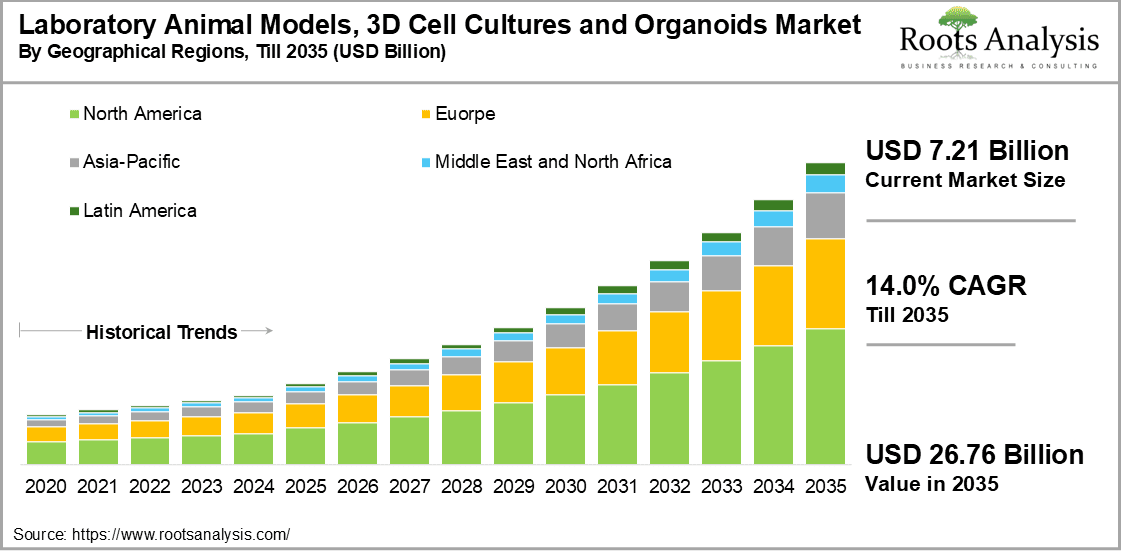
The global laboratory animal models, 3D cell cultures and organoids market, valued at USD 6.16 billion in 2024, is projected to reach USD 7.21 billion in 2025 and USD 26.76 billion by 2035, representing a CAGR of 14.0% during the forecast period.
 |
To learn more about this report, request a free sample copy
Given by the rising trend of personalized medicine to treat diseases, researchers are adopting a combination approach of laboratory animal models, 3D cell cultures and organoids for understanding diseases progression and drug development. Laboratory animal models such as mice, rats, guinea pigs and hamster has been traditionally used to study the effect of drug. These animal models genome profile resemble with humans, hence it is easier to understand the impact of drugs on human by using these models.
However, with rising ethical concerns and high chances of inaccurate results, pharmaceutical industries have shifted to implement a combined approach of laboratory animals, 3D cell cultures and organoids for understand the response of drugs on the humans. It is important to highlight here that with availability of advanced technologies such as 3D bioprinting technology, it is possible to develop the 3D model of the tissues and cells that can mimic the organs of humans, making them ideal solutions to understand drug toxicity and response on humans.
These 3D cell culture models and organoids are used for studying drug safety and efficacy. In addition to clinical studies, the growing focus on stem cell therapy and regenerative medicine has further bolstered the demand for advanced 3D cell cultures and organoids.
Considering the significances of advanced technology-based models, several industrial players are aiming to develop advanced organoid technologies and platforms for drug discovery and clinical studies. For instance, in July 2025, MD Anderson Cancer Center and TOPPAN Holdings announced strategic partnership to co-develop organoid technology for evaluating cancer treatment. Considering the ongoing adoption of advanced 3D cell cultures and organoids as an alternate of animal models, we believe that laboratory animal models, 3D cell cultures and organoids market is expected to grow at a steady rate during the forecast period.
The market report provides comprehensive information on the key players of the industry who are presently active across various segments as mentioned in the table below.
| Key Report Attributes | Details | |
| Historical Trend | Since 2018 | |
| Forecast Period | Till 2035 | |
| Market Size 2025 | USD 7.21 Billion | |
| Market Size 2035 | USD 26.76 Billion | |
| CAGR (Till 2035) | 14.0% | |
| Type of Animal Models |
|
|
| Type of 3D Cell Cultures |
|
|
| Type of Organoids |
|
|
| Type of Purpose |
|
|
| Type of Application |
|
|
| End User |
|
|
| Geographical Regions |
|
|
| Key Companies Profiled |
|
|
| PowerPoint Presentation (Complimentary) |
Available | |
| Customization Scope | 15% Free Customization | |
| Excel Data Packs (Complimentary) |
Available | |
One of the key objectives of the laboratory animal models, 3D cell cultures and organoids market report was to estimate the current market size, opportunity and the market growth potential, over the forecast period, till 2035. We have provided informed estimates on the likely evolution of the market for the forecast period.
Additionally, the market report features the likely distribution of the current and forecasted opportunity within the market distributed across various segments such as type of animal models (mice, rats, rabbits, hamsters, guinea pigs and other animal models), type of 3D cell culture (hydrogel / extracellular matrix (ECM), 3D bioreactor, 3D petri dish, hanging drop plate, microfluidic system, micropatterned surface, microcarrier, solid scaffold, and suspension system), type of organoid (liver, lung, brain, heart, intestine, kidney and other organoids), type of purpose (research use and therapeutic use), type of application (drug discovery / toxicity testing, cancer research, stem cell research, tissue engineering / regenerative medicine and other applications), end user (pharmaceutical and biotech companies, academic and research institutes and other end users), geographical region (North America, Europe, Asia-Pacific, Middle East and North Africa, and Latin America), and leading players.
To account for the uncertainties associated with the development of advanced laboratory animal models, 3D cell cultures and organoids solutions and to add robustness to our model, we have provided three market forecast scenarios, portraying the conservative, base and optimistic tracks of the market’s evolution.
All actual figures have been sourced and analyzed from publicly available information forums and primary research discussions. Financial figures mentioned in this market research report are in USD, unless otherwise specified.
Based on the type of animal model, the global animal models, 3D cell cultures and organoids market is segmented into mice, rats, rabbits, hamsters, guinea pigs and other animal models. According to our projection, mice and rats are dominating the industry. This can be attributed to the fact that mice and rats are inexpensive, have short life cycles and are easy to handle. Moreover, their genomes are similar to humans which further makes them ideal to conduct research and drug toxicity testing.
The global animal models, 3D cell cultures and organoids market is categorized across different types of products, such as hydrogel / extracellular matrix (ECM), 3D bioreactor, 3D petri dish, hanging drop plate, microfluidic system, micropatterned surface, microcarrier, solid scaffold, and suspension system. Among these, hydrogels / extracellular matrices account for the highest share of the market. This can be attributed to the fact that hydrogels and extracellular matrices provide a three-dimensional, hydrated scaffold for cells to grow.
This structure closely mimics the natural extracellular matrix that surrounds cells in living tissue. This allows for more realistic cell-to-cell and cell-to-matrix interactions, which are crucial for accurately studying cell behavior, proliferation, differentiation, and migration. Owing to the ability to mimic natural extracellular matrix, this segment will continue to grow at a higher CAGR in the future.
The global animal models, 3D cell cultures, and organoid market are distributed across different types of organoids, such as liver, lung, brain, heart, intestine, kidney and other organoids. According to our projection, presently liver organoid models account for the highest share of the market. This can be attributed to the increasing usage of liver-on-a-chip models for understanding drug toxicity.
However, in the long run, it is expected that lungs, brain, and heart-on-a-chip models are expected to hold a substantial share of the overall revenue market and are likely to grow at a higher CAGR during the forecast period. These models accurately replicate the internal structures of the organ, which enable study of drug effects on particular organ in real time. Owing to the growing awareness about potential role of these organoids in drug research and development, these segments will continue to gain traction in the upcoming years.
This segment highlights the distribution of global laboratory models, 3D cell cultures and organoids market into research and therapeutic purposes. According to our projection, presently research segment holds the largest share of the overall market for laboratory models, 3D cells culture and organoids market. However, it is important to highlight here that the trend of dominance is likely to change driven by the increasing usage of 3D cell culture and organoids across therapeutic applications.
Additionally, the heightened demand for target specific therapies to treat genetic disorders, cancer and neurological disorders has further bolstered the requirement of innovative solutions such as 3D cell culture and organoids to understand diseases and drug toxicity in real time. Given the ongoing demand, therapeutic purpose segment is expected to grow at a higher CAGR during the forecast period.
The global laboratory models, 3D cell cultures and organoids market is distributed across drug discovery / toxicity testing, cancer research, stem cell research, tissue engineering / regenerative medicine and other applications. According to our projection, presently, cancer research accounts for the highest share of the market. This can be attributed to the growing usage of 3D cell culture and organ-on-chip models for cancer research, early diagnosis and therapies development.
However, it is important to highlight here that stem cell research and tissue engineering / regenerative medicine segments are likely to grow at a substantial CAGR during the forecast period. Stem cell research and regenerative medicine are gaining attention of the pharmaceutical industries and healthcare experts for targeting diseases that specifically occurred due to tissue damage.
On the basis of end user type, the global laboratory models, 3D cell cultures and organoids market is segmented into pharmaceutical and biotech companies, academic and research institutes and other end users. Currently, pharmaceutical and biotech companies occupy the largest share of the market. This can be attributed to the increasing adoption of animal-free testing models for drug discovery, development and also for determining the toxicity of therapeutics.
Additionally, the increasing regulatory support to adopt tech-oriented models and rising ethical concerns has fueled the adoption of 3D cell culturing technology and organ-on-a-chip technology in pharmaceutical industry. However, academic and research institutes segment is expected to grow at a higher CAGR during the forecast period. This can be attributed to the rising demand for advanced technology-based animal-free models to understand drug toxicity and clinical studies.
Based on the type of geographical regions, the global laboratory models, 3D cell cultures and organoids market is distributed across different geographical regions, such as North America, Europe, Asia-Pacific, Middle East and North Africa, and Latin America. It is worth mentioning here that North America accounts for the highest share of the market. This is primarily due to the increasing adoption of 3D cell cultures and organ-on-a-chip models by industrial players for driving research and development of therapeutic drugs. Additionally, the government support and advanced healthcare infrastructure for leveraging advanced technologies for disease diagnosis and drug development has further contributed to the highest share of the market.
However, the market for laboratory models, 3D cell cultures and organoids in Europe is expected to register a higher CAGR during the forecast period. This can be attributed to the increasing research for the development of novel drugs and acceptance of 3D cell culture systems and organ-on-a-chip solutions despite of traditional animal models has further fueled the growth of this segment during the forecast period. It is worth highlighting here that European countries have banned animal-based models for product and drug trials in pharmaceutical and cosmetic industry, which is anticipated to be a key growth factor of the market in this region.
“Laboratory Animal Models, 3D Cell Cultures and Organoids Market Report, Till 2035,” research report features an extensive study of the focus on competitive landscape of strategic initiatives, emerging mega trends, big pharma initiatives, company profiles and key drivers and restraints. The market report highlights the efforts of several stakeholders engaged in this rapidly evolving segment of the laboratory animal models, 3D cell cultures and organoids industry. Key takeaways of the market report are briefly discussed below.
Currently, the global laboratory animal models, 3D cell cultures and organoids market is moderately competitive, witnessing the presence of well-established and new entrants. It is important to highlight here that several research organizations and industrial players are aiming to develop advanced 3D cell cultures and organoid models that aid in real-time analysis. Several industrial players are forging collaborations, partnerships and acquisitions to develop advanced 3D cell cultures and organoid technologies.
For instance, in June 2025, InSphero announced a strategic distribution agreement with Tessara Therapeutics to strengthen their product portfolio of 3D neuronal models. Driven by the ongoing penetration of the companies, we believe that the global laboratory animal models, 3D cell cultures and organoids market will remain competitive throughout the projected period.
Some of the potential drivers that are propelling the market growth include high demand for precision medicine and banned animal-based testing models due to ethical concerns and regulatory guidelines. It is important to highlight here that healthcare industry is continually shifting towards targeted therapies to meet individual patient specific requirements. This rising focus towards patient-centric therapeutic drug development has necessitated the demand for 3D organoid models that aid in predicting drug responses in real time. In addition, the increasing focus on stem cell-based therapies to target diseases has further driven the demand for 3D cell cultures and organoid demands.
Despite the growing adoption of organoids and 3D cell culture for drug research, there are some challenges that need to be addressed. Some of the notable challenges include high cost associated with installation and maintenance of organoids-based technologies. Furthermore, scaling up 3D cell cultures and organoids for high-throughput drug testing can be challenging for the industrial leaders. Moreover, the biological complexities associated with organ structures may create challenges in the development of organoids for drug testing. Additionally, the complex regulatory guidelines associated with the acceptance of 3D cell cultures and organoid models for clinical trials of drugs may hinder the adoption of these technologies on a large scale.
Some of the significant trends that are shaping industrial growth include integration of AI technology with 3D cell culture models and organoids to improve analysis of the data collected during drug discovery. Furthermore, the rising emphasis on miniaturized technologies such as microfluidic devices and organ-on-a-chip for high throughput screening of drug candidates has opened avenues for industrial players to drive innovations in this field. In addition, the rising collaborations and partnerships between industrial players to develop advanced organoid-based screening technologies and platforms for preclinical studies and widespread acceptance for drug development has further fueled the market during the projected period. Considering the widespread adoption and ongoing innovations, the laboratory animal models, 3D cell cultures and organoids market is expected to grow at a substantial pace during the forecast period.
The global market for laboratory animal models, 3D cell cultures and organoids is presently valued at USD 7.21 billion and is poised to reach USD 26.76 billion by 2035. This unprecedented growth can be attributed to the growing demand for advanced technologies for high throughput screening of drug candidates and predictive analytic tools for testing drug toxicity. It is important to highlight here that several industrial players and research organizations are aiming to explore more applications of 3D cell cultures and organoids in drug development, which is expected to be key driver of the market.
Recently, International Society for Stem Cell Research, QMUL Centre for Predictive in Vitro Models and University of Bern announced a new Organoid and Organ-on-a-Chip Training partnership for three of WORD+2025. Owing to the ongoing initiatives, we believe that this market will remain progressive throughout the projected period and is expected to grow at a CAGR of 14.0%.
The market report presents an in-depth analysis, highlighting the capabilities of various companies engaged in this domain across different segments. Amongst other elements, the market report includes:
Several recent developments have taken place in the laboratory animal models, 3D cell culture and organoids field. We have outlined some of these recent initiatives below.