


 Download Free Sample
 Buy Now
Market Outlook
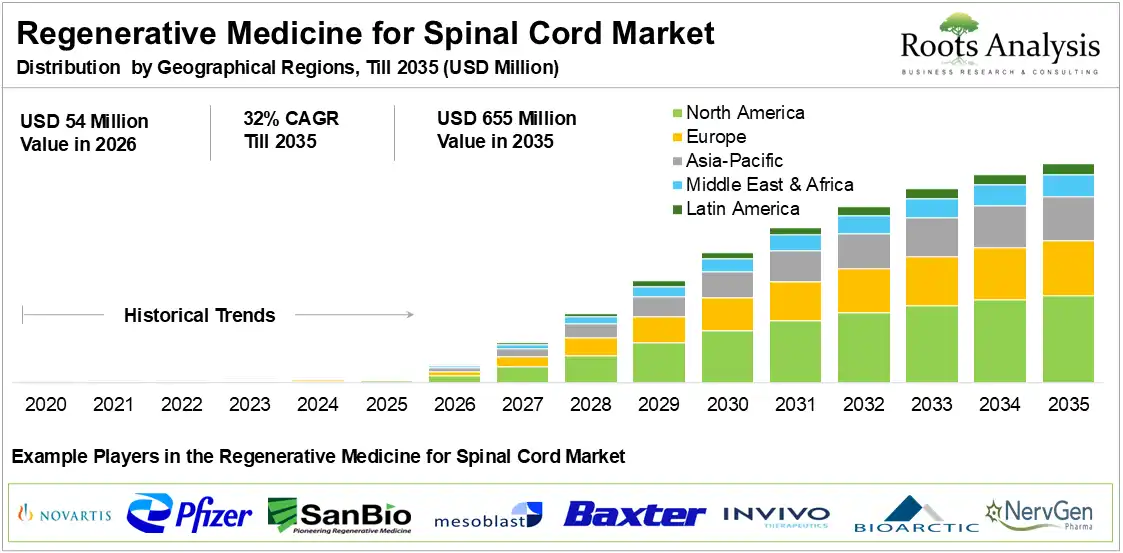
The global regenerative medicine for spinal cord market size, valued at USD 16 million in 2025, is projected to reach USD 54 million in 2026 and USD 655 million by 2035, representing a CAGR of 32% during the forecast period, 2026 to 2035. The growth in the market is driven by strong scientific progress, expanding clinical trial activity, and increasing investment in advanced therapies such as stem cells and gene-based approaches.
See What’s in the Full Report - Request Your Complimentary Insights!
Market Report: Summary
- The global market for regenerative medicine for spinal cord injuries is experiencing significant growth, driven by the unmet need for effective treatments beyond symptom management. The market is projected to reach USD 655 million by 2035, indicating a substantial expansion.
- Stem cell therapies currently hold the largest market share due to their versatility and neuroprotective properties. However, gene therapies are expected to see the highest CAGR in the future as they offer a more fundamental approach by delivering corrected genes to repair the spinal cord from within.
- The intrathecal administration route dominates the market, accounting for the highest share. This method is preferred because it allows for direct delivery of therapies to the spinal cord, thereby bypassing the blood-brain barrier and reducing the systemic side effects.
- North America is currently the dominant market leader due to its high rate of technological innovation and robust research initiatives.
- A few indications being explored by the drug developers include spinal muscular atrophy, spinal cord injury and more. In May 2025, the first allogenic, stem cell therapy for reversal of paralysis caused by spinal cord injury, entered phase I clinical trials.
Market Overview
Regenerative medicine refers to the cell-based therapies that are used to replace the damaged tissues, potentially nerve tissues, to restore function. Generally, stem cells are injected into the spinal cord under the guidance of X-ray and ultrasound, to release bioactive protein that initiate healing of spinal injury. Notably, regenerative medicine has recently caught attention for the treatment of spinal injuries, driven by the rising focus of pharmaceutical companies on neuro-regeneration.
It is worth mentioning that spinal cord injury can cause permanent motor, and autonomic dysfunction. The conventionally available treatment only helps to stabilize the patient condition to prevent further complications rather than restoring neural function. These limitations have necessitated the demand for advanced regenerative medicine solutions to move beyond symptom management. The primary objective of using regenerative medicine is to promote tissue repair, and restore lost neurological function and enhance axonal growth.
Several market players, such as Novartis (Switzerland), Pfizer (US), and Baxter (US) are presently focusing on cell therapies, gene therapies and biomaterials to promote spinal healing. For instance, in July 2025, Dancing molecules, developed at Northwestern University by Samuel I. Stupp received orphan drug designation from the USFDA. This therapy helps to repair tissues and reverse paralysis after traumatic spinal cord injuries.
As more regenerative drugs evolve and receive approval from the USFDA, it is expected that treatment of spinal cord injuries will hold a promising future, offering a new vision to treat patients.
Get an Instant Quote in 10 Minutes. Lowest Price Guaranteed
Market Segmentation Insights
Market Share by Type of Injury: Complete Spinal Injury is Likely to Drive the Demand
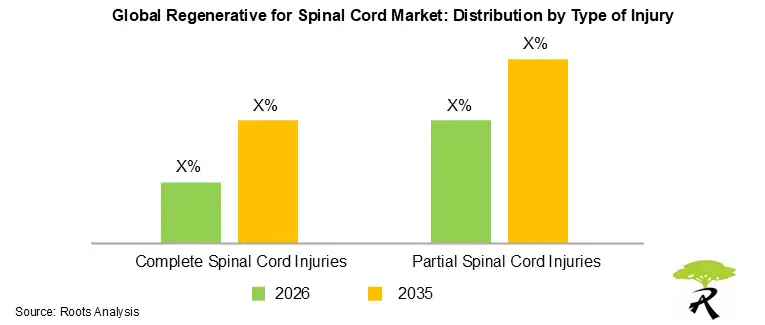
- This segment highlights two main types of injuries, including complete spinal cord injuries and partial spinal cord injuries. According to the regenerative medicine spinal cord injuries market report, the complete spinal cord injuries segment is dominating the market by occupying 60% of the overall revenue share. The rising need to restore loss function has boosted research on regenerative medicine for complete spinal injury treatment.
- It is important to highlight here that complete spinal injury segment will remain dominant in the future and is likely to register higher CAGR. This stems from the growing need to find a tissue engineering spinal cord regeneration solution for providing quality life to patients.
Market Share by Type of Product: How Large is the Stem Cell Therapy Segment?
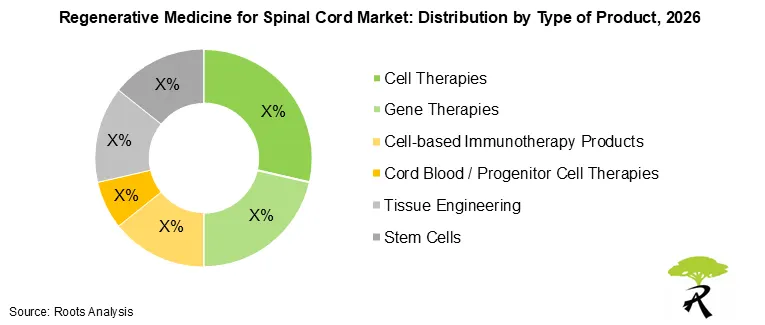
- Global market players are finding opportunities across different type of product, such as cell therapies, gene therapies, cell-based immunotherapy products, cord blood / progenitor cell therapies, tissue engineering and stem cells. According to the regenerative medicine spinal cord injuries market forecast, the stem cells segment accounts for the largest share and is unlikely to change in the future. This stems from the expanding research on stem cell therapies due to their versatility in restoring motor function and neuroprotective properties.
- In the future, gene therapies segment is likely to grow at a higher CAGR during the forecast period.
Which Regions are Leading Adoption of Regenerative Therapies for Spinal Cord Injuries?
North America: Remains the Center for Technological Innovations
Currently, North America dominates the market and is likely to remain same in the future. As per National Spinal Cord Injury Association, US alone has 450,000 people living with a SCI, with ~17,000 new cases reported in the country annually. This growth in incidence of spinal cord injuries is supported by technological innovations and expanding research on regenerative medicine.
EMA has given Orphan Medical Product Designation to ExoPTEN: A Promising Solution Ahead
Several industrial players are encouraging research on advanced cell-based therapies for spinal cord trauma, to treat patients with spinal cord injuries. In late 2024, NurExone Biologic's ExoPTEN received orphan medicinal product designation from European Medicines Agency, making a crucial step towards treatment for acute spinal cord injury. This designation will support the future innovation and development of ExoPTEN for faster entry into the European market, where the demand is high for spinal cord injury therapies.
Asia-Pacific: Emerging as a Hotspot for Regenerative Medicine
According to the spinal cord injury regenerative medicine industry analysis, the Asia-Pacific region is likely to show robust growth in the future.
- China: Presently, China emerged as the leading research-oriented country in stem cell therapy industry, conducting a significant trial and undertaking strategic initiatives for advancing stem cell research.
- Japan: Japan is also known for the first-in human clinical trials of iPSC-derived neural precursor cell transplants in patients to regain lost function and improve quality of life. As more innovations continue to reflect in this domain, it is expected that the market will continue to grow in this country.
Want Information on Specific Region / Segment?
Recent Industry Developments
- In May 2025, XellSmart Biopharmaceutical (China) announced that its off-the-shelf allogenic iPSC-derived subtype-specific neural regenerative cell therapy has received the USFDA and China's NMPA approval for Phase I clinical trial to treat spinal cord injury.
- In May 2025, Lineage Cell Therapeutics initiated DOSED clinical study to evaluate safety and utility of the manual inject parenchymal spinal delivery system to deliver OPC1 directly to area of spinal cord injury.
Clinical Outlook in the Market
Recent Clinical Activity
NervGen Pharma: A New Ray of Hope by Evaluating its NVG-291 in a Phase Ib / IIa Trial
In June 2025, NervGen Pharma shared an update on NVG-291. It is being evaluated to identify its efficacy for treating cervical spinal cord injury: chronic (1-10 years post-injury), and subacute spinal cord injury (20-90 days post-injury). The topline results have shown promising changes in "GRASSP" score (designed to assess hand function of an individual with cervical CSI).
How are Clinical Trial Successes Affecting Market Valuations for Regenerative SCI Companies?
Several market players are accelerating their research resulting in maturing clinical evidence for the approval. For instance, Phase II / III outcomes of KP-100IT (hepatocyte growth factor), Neuro-Cells® and NVG-291 under clinical trials are showing promising therapeutic outcomes. This robust pipeline depicts strong potential of the neural regeneration spinal cord injuries market.
Commercial Outlook and Future Opportunities
What's The Investment Outlook for Gene Therapy and Tissue Engineering in SCI Treatment?
| Research Project | Research Organization | Funding Amount / Period | Research Fund Provider |
| Peripheral Nerve Graft Therapy | Karolinska Institute (Sweden) | USD 284,274 / January 2025 to January 2027 | Swedish Research Council (Sweden) |
| Biomimetic Peptoid Hydrogels | University of Maine (US) | USD 235,977 / February 2025 to January 2027 | Office of the Director (US) |
Personalized Medicine: Emerging Biomarkers Predicting Treatment Response
Notably, the field is likely to shift towards more personalized approach to meet unmet requirement of patients. Under this approach, researchers are using emerging biomarkers to identify the heterogenous nature of spinal cord injury and leverage genetic profiling to develop personalized cell therapies for functional recovery. Advanced technologies like single-cell omics and CRISPR-mediated hypoimmunogenic engineering are enabling precision-driven SCI repair, allowing for more targeted interventions that account for patient-specific variability.
Pay Only for What You Need – The Best Way to Optimize
Combination Therapies: What Makes Combination Therapies More Effective than Single Interventions in SCI Regeneration?
The future approach also involves the development of combination therapies. This combinational approach includes integration of advanced gene therapy with cell therapies and biomaterials. For instance, tissue neuro-engineering will combine hydrogels with neural stem / progenitor cells to support the endogenous regeneration and mechanical reconstruction. It is worth mentioning that researchers are also focusing on the development of minimally invasive delivery methods for targeted delivery.
Regenerative Medicine for Spinal Cord Market: Scope of the Report
| Key Report Attribute | Details | |
| Historical Trend | Since 2020 | |
| Forecast Period | Till 2035 | |
| Market Size 2026 | USD 54 Million | |
| Market Size 2035 | USD 655 Million | |
| CAGR (Till 2035) | 32% | |
| Segments Covered |
|
|
| Key Players Profiled |
(A complete list of companies captured is available in the report) |
|
| PowerPoint Presentation (Complimentary) | Available | |
| Customization Scope | 15% Free Customization | |
| Excel Data Packs (Complimentary) | Available | |


