
Oncology Molecular Diagnostics Market: Solutions Driving Early Cancer Detection
Globally, cancer is one of the leading causes of death, however advancements in molecular diagnostics have enabled early detection and improved outcomes. Early detection of cancer is crucial as it improves the treatment process and increases the chances of survival. This article explores the role of molecular diagnostics in early cancer detection, highlighting the benefits and future prospects in the oncology molecular diagnostics market. Before we dive into the article, let us first understand what molecular diagnostics solutions are.
Roots Analysis has conducted an exhaustive study on Molecular Diagnostics Market featuring the current market landscape and future opportunity for the companies working across multiple therapeutics areas, over a span of 11 years. A growing sub-segment of the overall market is oncology molecular diagnostics market, which is helping fill the unmet need for early diagnosis.
Understanding Molecular Diagnostic Solutions
Molecular diagnostic solutions are advanced techniques and tools used to analyze biological markers in the genome and proteome. These diagnostic solutions are essential for detecting and monitoring diseases, identifying genetic predispositions, and guiding personalized treatment plans. The core technologies include polymerase chain reaction, next generation sequencing and microarrays. Molecular diagnostic solutions are pivotal across various medical fields, including oncological disorders, infectious diseases, genetic testing, and personalized medicine. These solutions enhance the accuracy of diagnoses, enable and support tailored treatment strategies aiming to ultimately improve diagnostic outcomes and advancing public health.
How Oncology Molecular Diagnostics Solutions Aid in Early Cancer Detection?
Traditionally, there have been several diagnostics methods available in the cancer diagnostics market, such as imaging and histopathology. While these techniques are useful, they often detect cancer at later stages. Usually, by that time, the symptoms had already appeared, and the disease had progressed to a significant degree. On the other hand, solutions available in the oncology molecular diagnostics market can identify cancer at a much earlier stage, in some cases, even before symptoms develop. It is worth mentioning that early detection of cancer means that the disease is detected at an earlier and treatable stage of the disease progression. This leads to better prognosis and a higher chance of survival.
Technologies Driving Early Cancer Detection in the Oncology Molecular Diagnostics Market?
Oncology molecular diagnostics market offers solutions that employ a variety of advanced diagnostic techniques, such as:
- Polymerase Chain Reaction (PCR): This technology amplifies the DNA sequences to detectable levels. Some of the key examples include qPCR, RT-PCR and loop-mediated isothermal amplification. PCR is a widely used technique in molecular diagnostics that amplifies small amounts of DNA or RNA to detectable levels. In cancer diagnostics, PCR can identify specific genetic mutations or chromosomal rearrangements associated with different types of cancer.
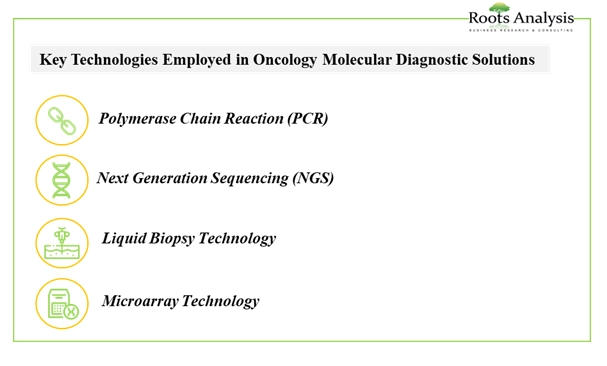
- Next Generation Sequencing (NGS): DNA sequencing provides comprehensive genomic insights identifying mutations and variations in the sequence. NGS has revolutionized cancer diagnostics by enabling comprehensive analysis of the entire genome or specific genomic regions. This technology can identify a wide range of genetic alterations, including point mutations, insertions, deletions, and copy number variations. This technique finds applications in the diagnosis of breast and ovarian cancer.
- Liquid Biopsy: Liquid Biopsy is one of the most popular non-invasive methods available in the oncology molecular diagnostics market for tumor detection, more specifically, the circulating tumor DNA (ctDNA). This technique is gaining popularity owing to its ability to provide real-time and precise insights about the molecular basis of tumors without the need for invasive tissue biopsies
- Microarrays: Microarray technology is particularly useful for simultaneous detection of over thousands of genes. This technique helps in detect expression patterns, gene signatures which in turn help to predict cancer prognosis and the response of such cells to a particular therapy. For instance, microarray technology can help determine the chances of resurgence of breast cancer recurrence and help make treatment decisions.
Benefits of Oncology Molecular Diagnostic Solutions
- High Accuracy: Oncology molecular diagnostic solutions offer an enhanced level of accuracy in comparison to their traditional diagnostic alternatives. These solutions aim to target specific biomarkers, which reduces the possibility of false diagnosis and provide precise diagnosis for oncological disorders.
- Personalized Treatment: The ability of such solutions to offer diagnosis of a patient at the genetic level enables healthcare providers to tailor specific treatments for patients based on their unique genetic make-up. By understanding these genetic complexities, oncologists can offer tailored therapies to drive patient’s cancer care treatment.
- Minimally Invasive: Unlike the traditional technologies intended for cancer diagnosis, such as tissue biopsies and histology; the oncology molecular diagnostics market offers a variety of non-invasive / minimally invasive diagnostic solutions that reduce discomfort and risk for patients.
The oncology molecular diagnostics market is growing at a significant rate owing to the advancements in the overall diagnostics market and increasing awareness for early cancer detection. However, it also faces several challenges and restraints in its growth as listed below.
What are the Key Restraints Hindering the Growth of Oncology Molecular Diagnostics Market?
- Regulatory Compliances: The oncology molecular diagnostic solutions need to be compliant with stringent regulatory frameworks, such as FDA and CE marking. These frameworks impose strict requirements on the development, validation, and commercialization which requires significant time, resources, and expertise in the oncology molecular diagnostics market.
- Capital Extensive: Advanced oncological diagnostic tests tend to be very expensive in nature. These solutions often come with high price tags which limit their accessibility for patients and healthcare setups, specifically in the lower-income regions.
- Data Interpretation and Security: Vast genetic data requires the use of advanced bioinformatic tools and expertise for accurate analysis, the lack of which may give false positive or negative diagnoses. In addition, such solutions require robust encryption and strict cybersecurity measures in order to protect sensitive genetic information from unauthorized access and data breaches.
Despite the challenges, several growth factors continue to drive the oncology molecular diagnostics market forward. Strategic collaborations and partnerships between such players, diagnostic centers, and research institutions are expected to foster innovation and accelerate the development and adoption of new diagnostic technologies. Further, the integration of artificial intelligence and machine learning are transforming the oncology molecular diagnostics market by providing powerful tools for data analysis and interpretation. These technologies hold the ability to process vast number of datasets, identify genetic patterns and correlations. Recent studies suggest that AI algorithms can analyze genomic data to predict cancer risk, identify potential biomarkers, and may help suggest optimal treatment strategies.
Author Bio:
Gaurav Raj Bangarh
Gaurav Raj Bangarh is a business research analyst and competitive intelligence professional. He is highly skilled at generating useful insights from unstructured / structured datasets. As a senior analyst at Roots Analysis, Gaurav has assisted several clients across multiple industry verticals within the healthcare domain. These verticals include, medical devices / technologies, digital healthcare services and various drugs / disease indications.
Gaurav holds a B. Tech degree in Biotechnology from Lovely Professional University. In addition to working on market research and pharmaceutical business analysis, he has hands-on laboratory experience and has worked at esteemed research institutes of India, such as CSIR-CFTRI, Mysore. To date, he has contributed to over eight full length market research projects and consulting projects.
Email: gaurav.raj@rootsanalysis.org

Fibrotic Disease Diagnosis: A Step Towards Painless Detection of Fibrosis
Companion Diagnostics Services: Future of Outsourcing
Cancer Biomarkers and Rise of TMB
About Author
