
Sustainable Pharmaceutical Packaging Market: The Need, Advantages and Drivers
Packaging is the process of enclosing a product in a container in order to protect and store it. In the pharmaceutical industry, packaging plays a crucial role in ensuring the strength and integrity of a product. Further, the type of raw material utilized for packaging highly depends on the type of product / drug to be enclosed. Glass, plastic, metals, cardboard and wood are some of the most commonly used raw materials for pharmaceutical packaging. However, a huge amount of waste is generated due to these conventional raw materials primarily due to their inability to decompose naturally. It is worth highlighting that over 500 million tonnes of waste is generated through pharmaceutical packaging globally. Further, the global demand for pharmaceutical products is continuously increasing, hence imposing a burden on the environment. As a result, there is an increase in share of sustainable pharmaceutical packaging market.
Types Of Pharmaceutical Packaging
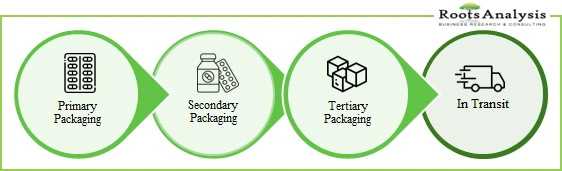
There are three types of packaging, namely primary packaging, secondary packaging and tertiary packaging.
- Primary packaging: It refers to the packaging which is in direct contact with the drug product and therefore has a major impact on its shelf life. Majority of the oral solid dosage forms are primarily being packaged in blister packs, sachets and plastic bottles. Further, pharmaceutical vials, ampoules and bottles made of plastic or glass are used for primary packaging of liquids (injectables / orals). Apart from the aforementioned types of primary packaging, foil packaging (made of metals like aluminum and stainless steel) is also widely used by medical companies and laboratories for the safe transport of medical devices and samples.
- Secondary packaging: Once the drug is packed in a primary package, another packaging layer is required for its safety, termed as secondary packaging. It consists of printed material (label) containing all information about the active and inactive ingredients used in the preparation. Along with this it also presents the information regarding dosage form, dosing schedule, manufacturer’s name and address, marketing details of the company, and warning (if any). While providing additional protection to the drug product, pharmaceutical secondary packaging is also used to ameliorate the attractiveness and brand image of the manufacturer. The most commonly used materials for secondary packing include paper, cardboard and plastic.
- Tertiary packaging: For bulk handling and shipping of pharmaceuticals from one place to another, an additional layer of protection is required, known as tertiary packaging. Materials for the preparation of tertiary packaging include cardboard, pasteboard and wood.
The following figure presents the various types of pharmaceutical packaging.
Need For Sustainable Pharmaceutical Packaging
Conventional packaging raw materials have several drawbacks when compared to sustainable packaging including its dependency on fossil fuels, single-use nature, inability to biodegrade, chemical leaching and negative public perception. Further, globally, only 2% of plastic packaging materials are recycled, while others are either incinerated or dumped into landfills and water bodies. It is important to mention that 30% of the plastic packaging materials are either too complex or too small to recycle; examples include sachets and wrappers. This has resulted in causing a negative impact on the environment. These packaging materials are a major concern to the environment, hence stirring an alarming need for research in this domain.
The use of recycled paper, plastic and cardboard has emerged as a promising alternative to conventional pharmaceutical packaging raw materials. These materials help in optimizing both cost and sustainability of the process. They have also been formulated to decompose naturally and leave no harmful residues in the environment. This has helped in substantially lowering the environmental impact, when compared to other traditional petroleum plastics. Further, they are manufactured under strict regulatory guidelines which ensures the safety and integrity of the packaging product. Owing to these advantages, green packaging materials have garnered considerable attention from the players involved in the healthcare industry.
Additionally, given the increased consumer awareness about the negative impacts on environment in terms of increase in greenhouse gas emissions and growing accumulation of waste in landfills due to conventional packaging materials, paradigm shift in consumer preference has been observed towards the use eco-friendly packaging materials. In this regard, many companies in the sustainable pharmaceutical packaging market have started the development of novel green packaging solutions made up of raw materials such as corn starch, sugarcane, cotton wool and cassava.
Advantages Associated with Sustainable Packaging
Sustainable packaging materials have a wide array of advantages primarily due to their ability to decompose naturally in the environment and reduce the consumption of resources.
The following figure presents the significant advantages associated with sustainable packaging.
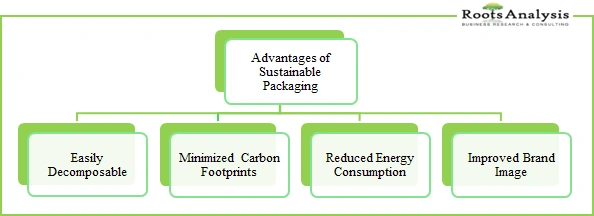
- Easily Decomposable: Microorganisms easily decompose sustainable packaging materials, thereby resulting in reduction of raw materials getting dumped in the landfills. Further, these raw materials being easily biodegradable do not release harmful toxins, once decomposed. This reduces the harmful impact on the environment.
- Minimized Carbon Footprint: Sustainable packaging materials help in minimization of carbon footprints by reducing greenhouse gas emission.
- Reduced Energy Consumption: Recycling packaging materials helps in reduction of energy consumption while manufacturing new packaging systems.
- Improved Brand Image: Use of eco-friendly packaging materials facilitates an improved brand image of companies engaged in sustainable pharmaceutical packaging market by demonstrating an increased effort to save the environment.
Key Drivers of Sustainable Pharmaceutical Packaging Market
The adoption of sustainable packaging in the healthcare industry is increasing due to several driving factors, resulting in the increasing potential of sustainable pharmaceutical packaging market over the coming years.
The following figure presents the key drivers of sustainable pharmaceutical packaging market.
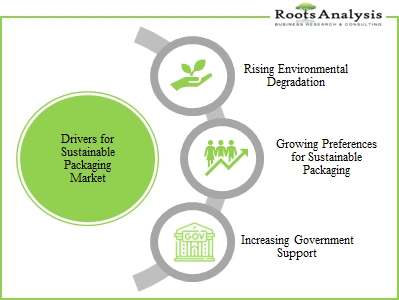
- Rising Environmental Degradation: The environmental degradation attributed to plastic and other conventional packaging materials, is a key driving factor for sustainable pharmaceutical packaging market. To surmount this challenge, there is a dire need to adopt eco-friendly and sustainable packaging materials in order to prevent the ongoing environmental deterioration.
- Growing Preference for Sustainable Packaging: Owing to the increased awareness amongst individuals to protect the environment from the undesirable consequences posed by the conventional packaging materials, there has been a shift in consumer preferences towards eco-friendly, recyclable and biodegradable packaging materials.
- Increasing Government Support: Recently, governments in many countries are offering subsidies and incentives to various companies in the sustainable pharmaceutical packaging market, with an intent to support the research and development of eco-friendly raw materials for packaging. Interestingly, UK government has invested GBP 60 million to support 70 projects aiming to develop smart sustainable plastic packaging. This acts as a lucrative opportunity for the growth of the sustainable pharmaceutical packaging market. It also provides opportunities for new companies working to provide an online marketplace / platform to connect pharmaceutical manufacturers to pharmaceutical packaging suppliers.
Future Perspectives
In recent years, the sustainable pharmaceutical packaging market has witnessed significant developments related to biodegradable / recyclable materials (potential alternatives to plastics); some of these are being widely used for packaging purposes. One such material is plastic made from sugarcane, which is biodegradable in nature. This product has shown promising results, in terms of strength and majority of its properties, such as non-reactivity and robustness, as compared to traditional petroleum plastic. Further, other plastic alternatives, such as polylactic acid (PLA) obtained from corn starch, sugarcane and cassava, can serve as excellent materials for sustainable packaging. US based Innovative Bottles, Inc. is making prescription vials from PLA supplied by TotalEnergies Corbion.
These novel and sustainable packaging raw materials hold a promise to eliminate the unprecedented issue of environmental degradation in the pharmaceutical industry. This will eventually lead to a sustainable future not only in the pharmaceutical domain but in many other industries. Further, we believe that with increasing awareness, the sustainable pharmaceutical packaging market space is likely to witness increased adoption in the coming years.
To know more about sustainable pharmaceutical packaging market, please visit
https://www.rootsanalysis.com/reports/sustainable-biodegradable-and-eco-friendly-packaging-market.html

Cell Therapy Packaging Market – Importance and Future Potential

Pharmaceutical Packaging: The Rising Demand and Opportunities

Pharmaceutical Glass Vials: Current Scenario and Future Trends
About Author
